
Indoor Air Quality After Mold: Spores, Mycotoxins, Air Purifiers, and Whole-Home Cleanup
You’ve had the mold removed. The damaged drywall is gone. The affected area has been cleaned.
So why are you still thinking about the air?
For a lot of homeowners we speak to, that question doesn’t go away the moment visible mold disappears. Maybe the house still smells musty. Maybe you’re worried about what’s moving through the HVAC system. Or maybe you’ve already been dealing with mold-related health concerns and simply don’t feel comfortable assuming that removing what you could see fixed everything you couldn’t.
Those are reasonable questions, because mold remediation and indoor air quality are closely connected.
According to the U.S. Environmental Protection Agency, people spend around 90% of their time indoors. That makes the condition of the environment inside your home worth taking seriously – not just the surfaces you can see, but also the air you breathe.
Source: U.S. EPA — What Is Indoor Air Quality?
At Spotless, Lead Inspector Caleb Jones sees proper mold remediation as having two sides. First, you need to control what happens to mold spores and other particles while contaminated materials are being disturbed and removed. Then you need to think about what the wider indoor environment may need afterward.
That second part is what homeowners often don’t hear much about from remediators.
“We’ve gotten a little bit more active in actually addressing air quality after the fact of mold remediation.”
Caleb Jones
Improving indoor air quality after mold remediation isn’t about buying one magic machine or spraying something into the air. It’s about understanding how contamination moves, controlling it during remediation, cleaning what needs cleaning, dealing with the HVAC system where appropriate and – most importantly – fixing the moisture conditions that allowed mold to grow in the first place.
Watch the full interview here!
Here’s what that process can actually look like.
- Why Removing Visible Mold Doesn’t Automatically Fix Indoor Air Quality
- Clean Air Starts During Remediation, Not After It
- Spores, Dust and Mycotoxin Concerns: Why Whole-Home Cleanup May Matter
- Don’t Forget the HVAC System: Air Moves Beyond the Moldy Room
- Air Purifiers, Air Scrubbers and Fogging: Useful Tools, Not Silver Bullets
- How Do You Know Whether the Air Is Better After Remediation?
- Keeping Indoor Air Healthy After the Remediation Crew Leaves
- Mold Remediation Should Leave You With a Plan for the Whole Home
Why Removing Visible Mold Doesn’t Automatically Fix Indoor Air Quality
When people picture mold, they usually picture the colony.
It’s the patch on the bedroom wall. The discoloration in the crawl space. The growth around a vent cover. The mold behind a cabinet after a slow plumbing leak.
That’s the part you can point to.
But a visible colony isn’t the only thing a remediation plan has to consider. Mold reproduces by releasing microscopic spores, and those particles can become airborne and move beyond the immediate area where growth is visible.
That’s why Caleb often has to help homeowners stop thinking about mold as purely a surface problem.
“Mold creates an air quality problem that you can’t see.”
Caleb Jones
His explanation to clients is deliberately simple: if you’ve got mold on one bedroom wall, you’re not generally interacting with it by physically touching the wall all day. That means the mold is spreading some other way, and air is one of the pathways that matters.
The problem is air doesn’t stay put.
It moves between rooms. It’s pulled through returns and pushed through supply vents. Dust gets disturbed. Doors open and close. People and pets move through the house.
That doesn’t mean finding a small area of mold automatically means your entire home is severely contaminated. Every property is different, and the extent of the response should match the actual conditions.
But it does mean that simply wiping off the visible patch doesn’t tell you anything about why it grew, whether mold exists elsewhere, or what happened to particles released before and during cleanup.
For homeowners already wondering whether there’s a wider problem, this is also where a good inspection becomes important. A musty odor, historic water damage or mold that keeps returning can justify looking beyond the obvious surface. Our guide to hidden mold in your home and what to do next goes deeper into those warning signs.
It’s also important to keep the health side of this responsible. Spotless addresses mold, moisture and the home environment. We don’t diagnose medical conditions or promise that remediation will resolve a particular symptom. If you’re experiencing health problems, speak with a qualified healthcare professional as well as investigating environmental concerns in the home.
But from a building standpoint, the principle is straightforward: indoor air quality after mold remediation deserves attention because the visible mold was only one part of the environment in which the problem existed.
If the mold is gone but the house still smells musty – or you simply aren’t confident the wider problem was addressed – Spotless can help you work out whether there’s more to investigate rather than asking you to guess.
Clean Air Starts During Remediation, Not After It
One of the biggest misconceptions about post-remediation air quality is that you deal with the air once the mold-removal work is finished.
In reality, some of the most important air-quality decisions happen before anyone starts cutting drywall, removing insulation or cleaning affected framing.
Why? Because disturbing mold-containing materials can release particles.
“You do not want to release more particles or contained mold or anything like that into the air whenever you’re doing your job.”
Caleb Jones
That’s where controlled remediation comes in.
Containment keeps the work area controlled
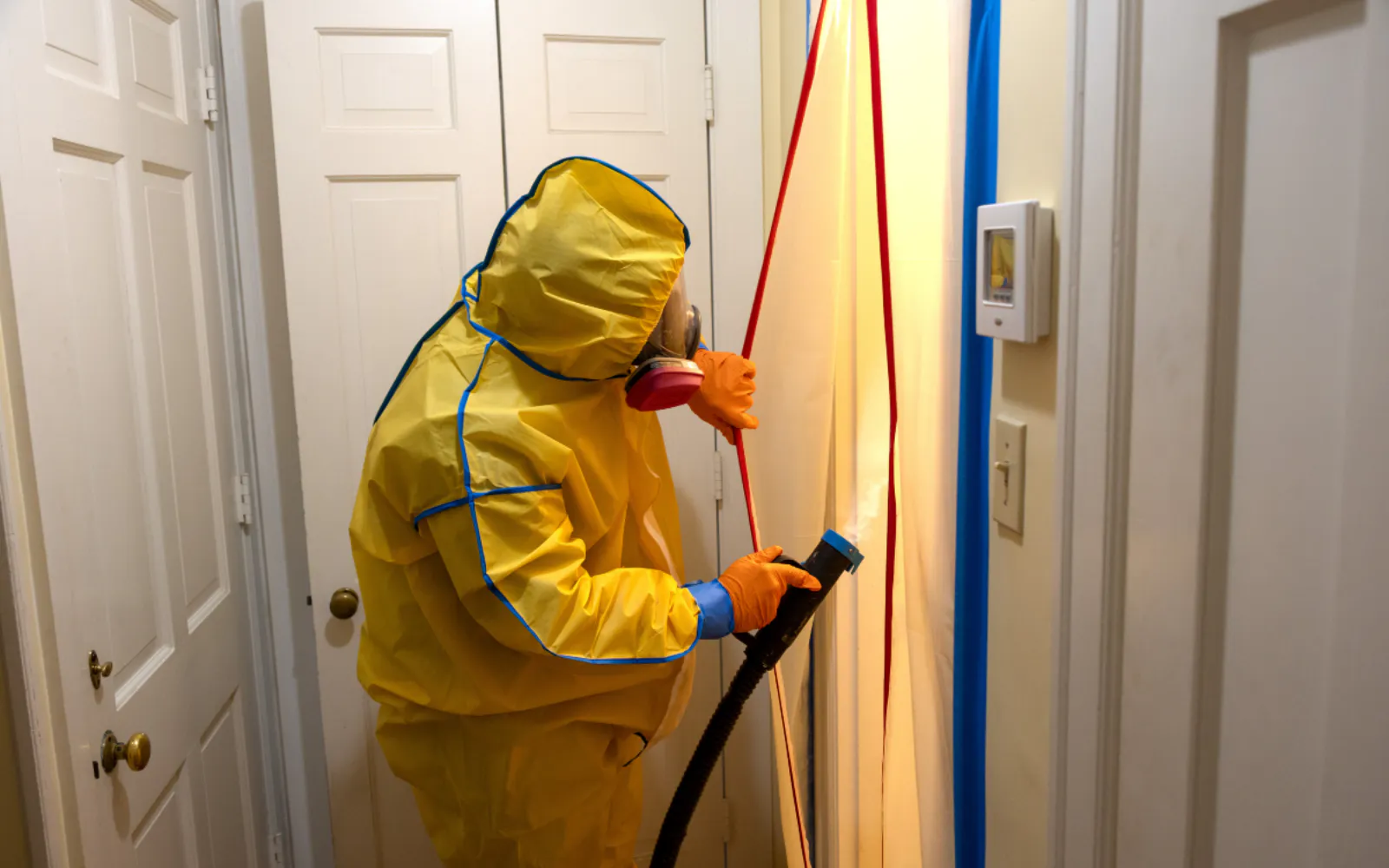
On appropriate remediation projects, containment creates a physical separation between the affected work area and cleaner parts of the home.
Caleb describes Spotless using plastic containment around rooms or individual removal areas so the work doesn’t simply take place open to the rest of the property.
Think of it less like putting up a dust sheet and more like creating a controlled workspace.
If moldy drywall is being removed in a bedroom, you don’t want everything disturbed during demolition freely moving through the hallway, into the living room and around the rest of the home.
Containment gives technicians a defined area in which to work.
Negative pressure helps control airflow
Containment becomes much more useful when you also control the direction air is moving.
Negative air pressure is designed so air is drawn toward the contained work area and, where appropriate, exhausted away rather than pushed from the contaminated area into adjoining spaces.
That matters because cross-contamination prevention is part of remediation – not an optional cleanup step afterward.
It’s one reason Spotless’ approach to professional mold remediation in Lexington places so much emphasis on containment and air control during removal.
HEPA filtration captures airborne particles
Inside the work area, HEPA filtration becomes another piece of the process.
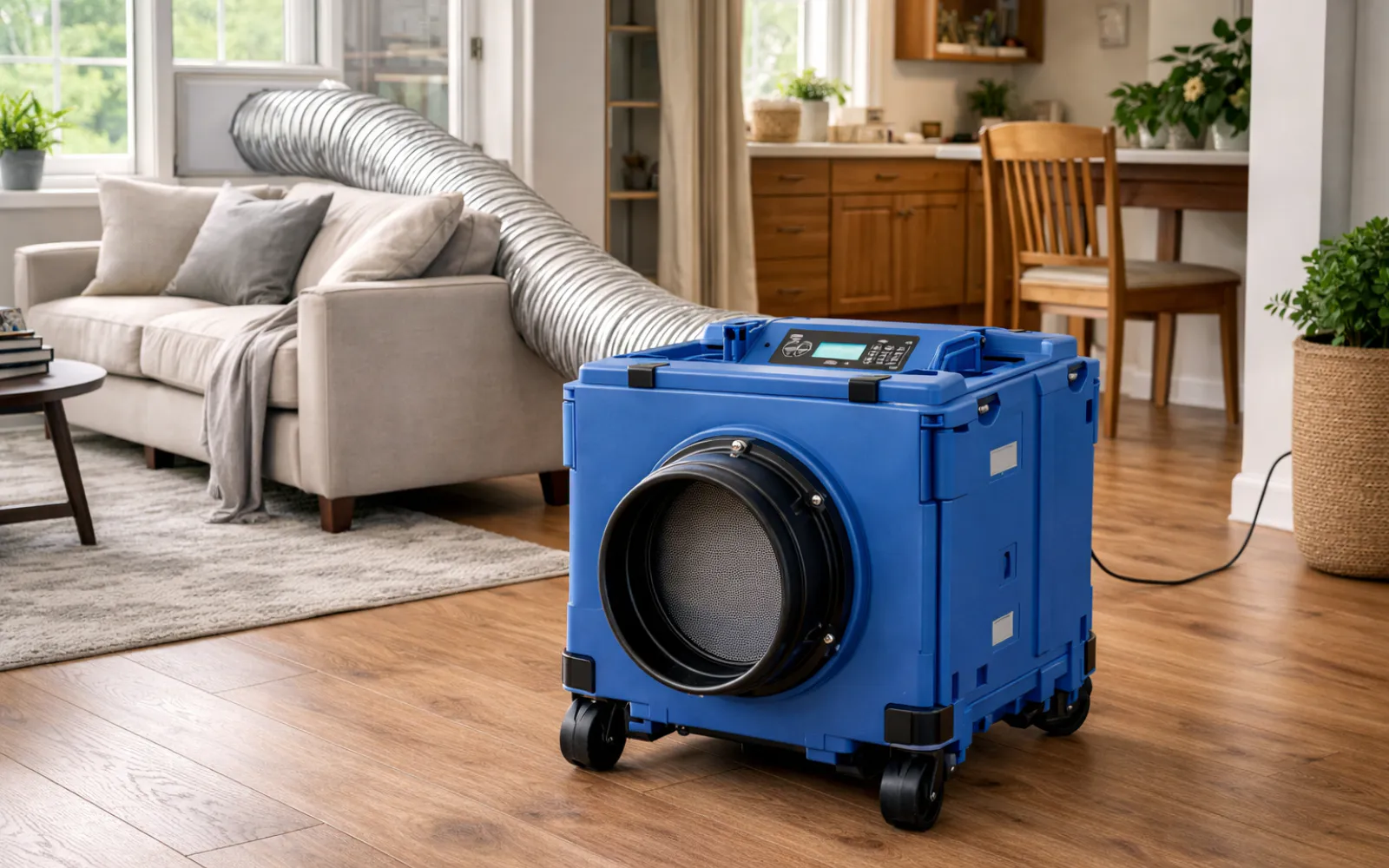
Caleb describes HEPA-filtered vacuums being used during surface cleaning and air scrubbers continuously cycling air through filters within containment.
“You’re pulling spores in, capturing them on the HEPA filter in the vacuum.”
Caleb Jones
A true HEPA filter can theoretically capture at least 99.97% of airborne particles measuring 0.3 microns, according to the EPA. The agency notes that this includes dust, pollen, mold, bacteria and other airborne particles.
Source: U.S. EPA — What Is a HEPA Filter?
That number needs context, though.
It does not mean putting a HEPA machine into a moldy house makes the home “99.97% mold free.” It describes the performance of the filter at a specified particle size. Successful remediation still depends on identifying and correcting the source, removing contaminated materials correctly, preventing further spread and cleaning the environment appropriately.
Caleb says professional air scrubbers may run continuously for several days in some environments, repeatedly cycling air through HEPA filtration.
That’s why good indoor air quality after mold remediation begins with something surprisingly simple:
Don’t unnecessarily contaminate the air during remediation in the first place.
If a mold-remediation estimate only talks about demolition and never mentions containment, negative pressure or HEPA filtration, ask what’s being done to control the particles disturbed during the work. Spotless can walk you through exactly how those safeguards fit into your property’s remediation plan.
Spores, Dust and Mycotoxin Concerns: Why Whole-Home Cleanup May Matter
There’s a point in Caleb’s interview that gets to the heart of why Spotless approaches some mold jobs differently from a basic tear-out company:
“We have to treat the entire house as an envelope and the HVAC system has to be treated as part of that envelope.”
Caleb Jones
That doesn’t mean every mold problem requires every room in a house to be stripped, sanitized or treated.
It means the property needs to be looked at as a connected environment.
If you’ve had a small, contained area of growth caught early, the scope may be relatively limited. If you’ve had a long-standing problem, contaminated dust, HVAC involvement or wider concerns about mycotoxins, the appropriate cleanup may look very different.
After the source remediation is complete, things that may need consideration include:
- airborne particles that were disturbed before or during remediation;
- dust and debris in or near affected areas;
- contents or surfaces exposed to contamination;
- HVAC components or ductwork where there’s evidence of involvement;
- and moisture conditions that could allow new mold growth.
For mycotoxin-focused projects in particular, Caleb talks about small-particle cleaning as part of Spotless’ more thorough approach. It’s kinda like a detox for your home.
“A small particle cleaning afterwards… is getting as much dust and debris and stuff out of the property as possible.”
Caleb Jones
The goal isn’t to make a medical “detox” claim about the homeowner though. Spotless works on the building environment. When we talk about whole-home mold cleanup or environmental detoxification, we’re talking about addressing contamination, dust, debris and conditions within the property – not detoxifying someone’s body.
And there’s another reason small particle cleaning matters: treatments that rely on contact have limits if contamination is buried under layers of ordinary household debris.
Cleaning and source removal do jobs an air purifier or fogging treatment can’t do by themselves.
For someone who has spent months feeling like every answer leads to another unanswered question, a clear scope from your remediation can also remove some of that uncertainty. That way you know what was removed, what was cleaned, what was treated and what still needs monitoring.
That’s a much stronger place to be than simply hearing, “We got the mold off the wall.”
If your remediation involved widespread contamination or you’re especially concerned about mycotoxins and settled debris, ask whether the scope addresses the surrounding environment as well as the original mold source.
Don’t Forget the HVAC System: Air Moves Beyond the Moldy Room
Picture this fairly common situation.
There’s mold in one bedroom.
The affected material is removed and the room is cleaned.
Meanwhile, your heating and cooling system continues pulling air through returns and distributing conditioned air throughout the property. Then, after the remediation, the mold shows up again in your bathroom.
That’s why the HVAC system deserves attention when there’s reason to think it has been affected.
“Mold has a really bad habit of contaminating HVAC systems naturally over time.”
Caleb Jones
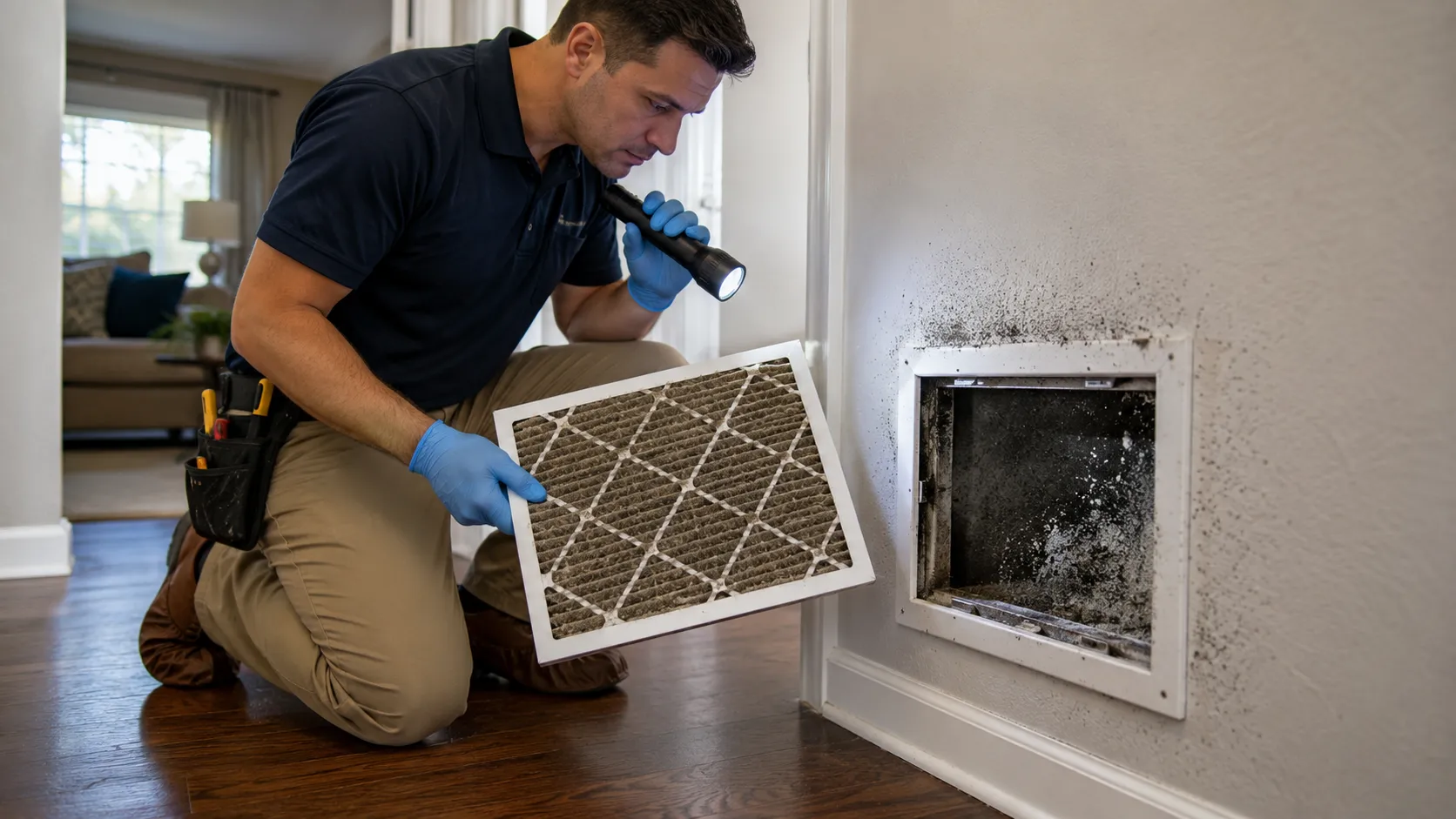
Caleb spends a lot of time looking at the places through which household air actually moves. Depending on the property and what he finds, that can include accessible parts of the HVAC system, filters, vent covers and surrounding areas.
It doesn’t mean every mold remediation job automatically requires professional duct cleaning. There should be a reason for doing it.
But when the system itself is implicated, ignoring it because the original mold colony was in another room doesn’t make much sense either.
Spotless works with qualified HVAC and duct-cleaning contractors when specialized work is needed. Caleb describes HVAC professionals cleaning appropriate internal components while ductwork can be placed under negative pressure and physically cleaned to remove accumulated dust, debris, pet hair and other material.
That cleaning has another purpose when additional treatment is planned.
If mold particles or contamination are buried underneath a heavy layer of dust in ductwork, a contact-based treatment may not reach what’s underneath effectively.
So the sequence matters:
inspect → clean → treat where appropriate.
Not the other way around.
Caleb also sees vent covers as useful places for homeowners to keep an eye on. In his recent work around Kentucky, he’s encountered homes where growth around vents pointed toward humidity or HVAC-related problems requiring investigation.
When you’re trying to protect indoor air quality after mold remediation, the HVAC system shouldn’t automatically be treated as though it has nothing to do with the rest of the home.
It’s moving air through that home all day.
The question is whether the evidence suggests it needs professional attention.
If musty odors seem stronger when your HVAC starts running, you’re seeing suspicious growth around vent covers, or mold was discovered close to the system, get it evaluated instead of assuming a room air purifier will take care of it.
Air Purifiers, Air Scrubbers and Fogging: Useful Tools, Not Silver Bullets
Homeowners understandably want to know whether there’s something they can put in the house that will simply clean the air.
Sometimes an air purifier can help.
But there’s a big difference between helping filter airborne particles and solving an active mold problem.
Myth: An air purifier gets rid of mold
A HEPA air purifier can capture certain airborne particles as they pass through the unit.
What it can’t do is crawl behind your drywall and fix a pipe leak.
It can’t remove rotting, mold-contaminated building material.
It can’t dry a wet crawl space.
And it can’t correct condensation around an HVAC system.
So yes, filtration can be useful – but filtration and remediation aren’t interchangeable.
Reality: Professional air scrubbers support controlled remediation
During a professional mold project, air scrubbers can continuously cycle air through HEPA filtration within the controlled environment.
Caleb calls this more of a passive air-quality treatment: rather than putting an agent into the environment, you’re repeatedly drawing air through filtration and capturing particles.
That’s very different from believing one purifier in the hallway somehow replaces source removal.
Fogging can have a role – but it has limits
Fogging is another tool that tends to get misunderstood.
Spotless uses mold fogging as part of a wider remediation plan on appropriate projects. The goal is to supplement the physical remediation and cleaning process, not replace it.
Caleb is particularly clear about that:
“The fog material has limitations. It’s not a silver bullet, it’s not a perfect cure all.”
Caleb Jones
That line is worth remembering whenever anyone promises that one spray, mist, fog or purifier will solve a mold problem.
If there’s mold growing behind a wall because a pipe is still leaking, fogging hasn’t repaired the pipe.
If contaminated material needs to be removed, an air cleaner hasn’t removed it.
If ductwork is loaded with dust and debris, contact treatment may not adequately reach whatever is sitting underneath that debris.
The tools work best when each one is used for the job it’s actually good at.
That’s the difference between a product and a remediation strategy.

A product might capture particles, but a strategy asks where those particles came from, whether the source still exists, how they’ve moved through the building and what needs to happen so you’re not dealing with the same issue again.
Before spending heavily on purifiers, foggers or other equipment, find out whether you’re filtering the aftermath of a resolved problem – or trying to use air treatment to compensate for an active mold or moisture source that’s still there.
How Do You Know Whether the Air Is Better After Remediation?
This is usually the point where homeowners ask:
Can’t I just test the air afterward and know for sure?
Sometimes testing is useful.
But it isn’t as simple as a universal pass/fail test.
Caleb uses air sampling in certain situations, but he also explains one of its limitations:
“The air quality testing, I still use it in some use cases, but you are a little bit taking a gamble if the mold spores go through that filter capture at the right time.”
Caleb Jones
The EPA makes a similar point in its mold-remediation guidance. It says air sampling is usually not necessary on its own to determine whether remediation has been effective, and describes air sampling as a snapshot of what was in the air at the moment the sample was collected.
Source: U.S. EPA — Evaluating Mold Remediation
In other words, one sample should never replace professional judgment, visual inspection and moisture investigation.
Caleb sometimes prefers surface/swab information from accessible parts of an HVAC system because he knows household air is repeatedly moving through those areas. That gives him a different type of evidence to work with.
Depending on the job, post-remediation evaluation may consider several things together:
- Has the original moisture source actually been fixed?
- Has visible mold and mold-damaged material been removed?
- Is there still a moldy or musty odor?
- Are previously wet materials now dry?
- Does visual inspection support the conclusion that remediation is complete?
- Is targeted air or surface testing useful for this particular job?
- Would independent post-remediation verification provide useful reassurance?
There’s an important trust point here too.
Spotless can perform mold sampling and testing before remediation, but there’s an ethical problem with clearing our own remediation work. Where independent clearance testing is appropriate, bringing in a qualified third party means the company doing the work isn’t also marking its own homework.
If you’re specifically trying to understand the condition of the air in your Lexington home, Spotless also offers professional indoor air quality testing using inspection, sampling and other tools where appropriate.
If objective post-remediation reassurance is important to you, discuss verification before the work begins. That way you’ll know what success is supposed to look like rather than trying to invent a test plan after everything has already been cleaned up.
Keeping Indoor Air Healthy After the Remediation Crew Leaves
A thorough remediation company can remove contamination, clean affected areas, help address air quality and point you toward the moisture conditions that caused the problem.
What it can’t do is make your home permanently immune to water.
Caleb puts that transition to homeowners well:
“It is more of a passing of a baton than it is a running across the finish line.”
Caleb Jones
That isn’t Spotless shifting responsibility. It’s acknowledging how houses actually work.
Pipes leak. Roofs age. HVAC equipment produces condensation. Crawl spaces get humid. Gutters overflow. Appliances fail. Filters get dirty.
And mold spores exist naturally in the environment. You’re not going to create a permanently sterile house.
The better goal is to stop providing mold with the moisture conditions it needs to colonize indoors.
The EPA recommends keeping indoor relative humidity below 60%, and ideally between 30% and 50%, where possible.
Source: U.S. EPA — A Brief Guide to Mold, Moisture and Your Home
In Kentucky, humidity deserves particular attention.
Caleb says dehumidification can be extremely valuable in the right environment – especially in crawl spaces – but he doesn’t believe every piece of equipment is automatically right for every home.
We don’t want you buying a whole-home dehumidifier just because you read that dehumidifiers help with mold. We want you understanding why your home has a moisture problem and what solution fits it.
After remediation, some of the most useful habits are pretty ordinary:
Keep an eye on leaks.
Check under sinks. Pay attention to staining around ceilings and plumbing. Don’t ignore recurring drips because they’re “small.”
Know where your HVAC equipment is.
Caleb regularly meets homeowners who aren’t sure where parts of their system are located. If the unit is in an attic or crawl space, make sure someone checks it periodically for condensation, standing water or drainage problems.
Maintain your filters.
Follow the filter and HVAC manufacturer’s recommendations, and make filter checks part of routine home maintenance rather than something you remember once every year or two.
Control humidity.
A dehumidifier may make sense in a crawl space, basement or whole home depending on the conditions. The right answer depends on the building.
Keep dust and debris under control.
Especially after more extensive or mycotoxin-focused remediation, Caleb emphasizes ordinary ongoing cleaning once the deeper remediation and small-particle cleanup are complete.
Deal with water quickly.
Leak-detection technology can help, but so can something much less sophisticated: regularly paying attention to the parts of your home where water and condensation are most likely to appear.
Caleb uses an automatic leak-detection and shutoff system in his own home. When it detected an unusual pressure condition, it shut the water off before a potential hidden leak could turn into something much bigger.
You don’t need to become a mold inspector.
You just need to know your home well enough to notice when something changes.
Protecting indoor air quality after mold remediation ultimately comes back to this: don’t recreate the conditions that allowed the original mold problem to develop.
If you’re in Lexington or Central Kentucky and you’re not sure whether humidity, HVAC condensation, crawl-space moisture or a hidden leak could put your home at risk again, Spotless can help you identify the weak point before you’re facing another major remediation project.
Mold Remediation Should Leave You With a Plan for the Whole Home
Removing visible mold matters.
But thorough mold remediation shouldn’t end with someone taking down the containment and driving away without explaining what comes next.
For many homes, protecting the indoor environment means thinking through the entire chain:
Find the source. Control the work area. Remove the contamination. Filter the air. Clean what needs cleaning. Evaluate the HVAC system where appropriate. Correct moisture. Verify the result when needed. Maintain the home afterward.
That’s the difference between treating mold as a stain on a wall and treating it as a building problem.
At Spotless, that fuller approach is especially important because many of the people who call us aren’t simply annoyed by something ugly growing in a bathroom. They may have spent months trying to work out why their home smells wrong, why mold keeps returning or whether their indoor environment could be contributing to health concerns.
We get why “the mold is gone” isn’t always enough reassurance.
That’s why we focus so heavily on controlled remediation, cross-contamination prevention, indoor air quality and moisture control – not just tear-out.
Spotless is an IICRC-certified firm with more than 30 years of restoration experience, serving Lexington and communities throughout Central Kentucky. Our goal is to help you understand what’s actually happening in your home, what needs to be fixed and what doesn’t.
No scare tactics. No pretending one purifier fixes everything. And no shortcut that ignores the reason the mold grew in the first place.
If you’ve already had mold removed but still have concerns about the air in your home – or you’re preparing for remediation and want the indoor environment considered from the beginning – get your home’s indoor air quality properly evaluated by Spotless.
A mold problem shouldn’t leave you guessing about the home you’re going back to.
Spotless is the most trusted name in restoration in central Kentucky including Lexington, Nicholasville and surrounding communities.
Specializing in health-focused mold remediation and water damage restoration, we leave mold-affected clients with a healthier home.
Call 859-459-0424 and speak to a technician today!