
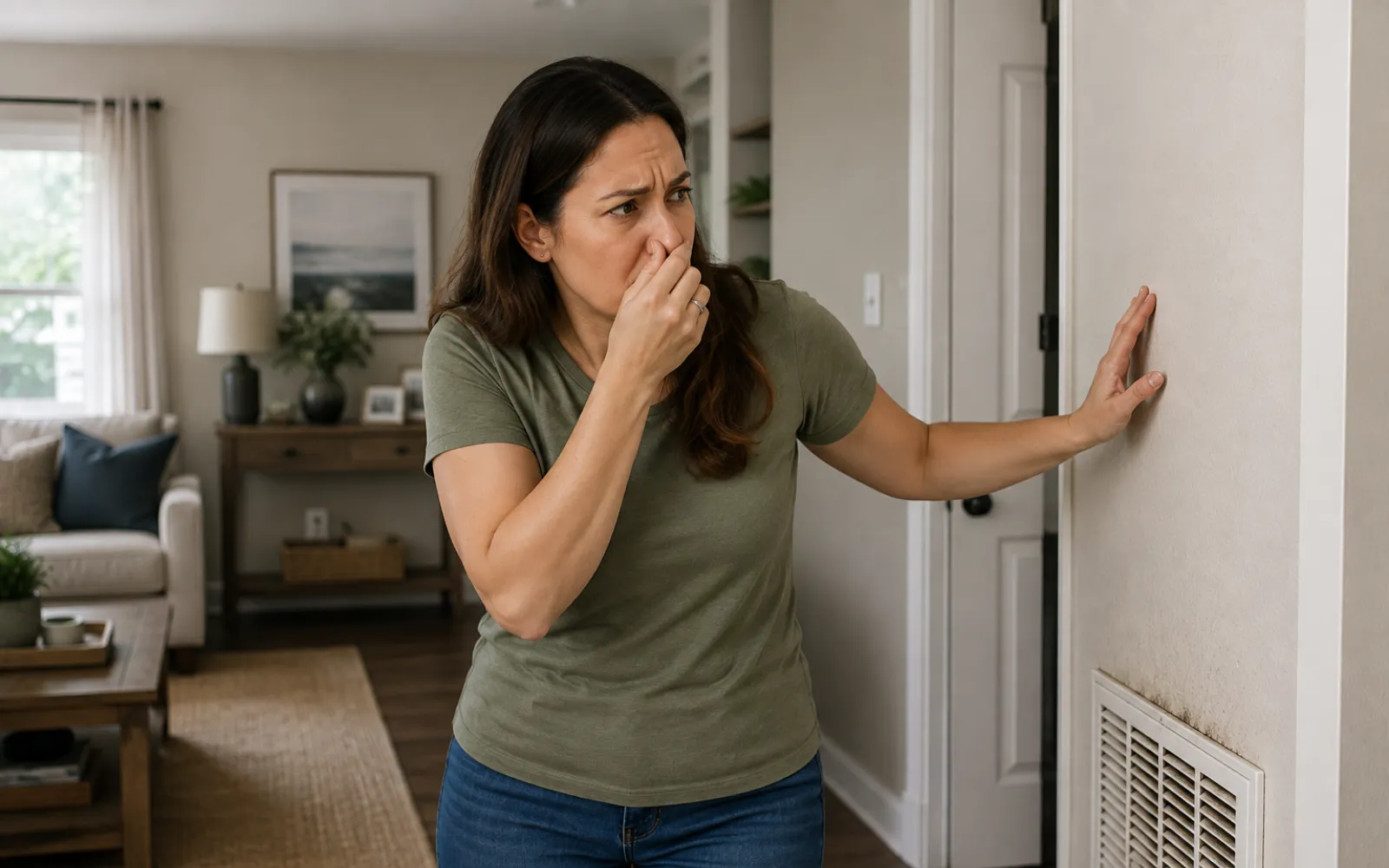
What Does Toxic Black Mold Smell Like?
There’s a smell in the basement you can’t quite get rid of.
Maybe it’s damp and earthy. Maybe it reminds you of an old cellar, wet cardboard or a room that’s been closed up too long. You clean, open the windows and run a dehumidifier, but a few days later it’s back.
Could that be toxic black mold you’re smelling?
Possibly, but there’s an important distinction.
Toxic black mold doesn’t have a unique smell that lets you identify it by odor alone. Mold growth is commonly associated with a musty or moldy smell, but your nose can’t tell you whether the mold is Stachybotrys chartarum, another species, or how significant the underlying problem is.
The EPA explains that molds can produce microbial volatile organic compounds, or mVOCs. Some of these compounds have strong odors and contribute to the familiar musty smell people associate with mold. A moldy odor is therefore a reason to investigate, not a species-identification test. (Source: EPA)
That’s very close to how Caleb Jones, Lead Inspector at Spotless, approaches the problem in real homes.
The smell matters.
But what it leads you to matters more.
What Does Toxic Black Mold Smell Like?
If you’re wondering what toxic black mold smells like, people commonly describe mold odors as:
- musty
- earthy
- damp
- stale
- similar to a wet basement
- like old, damp building materials
But none of those descriptions belongs exclusively to “toxic black mold.”
Caleb regularly inspects homes where an odor is part of the clue. In some basements, he says the mold problem can be significant enough that you notice it in the air before the full extent of the growth is obvious.
“If you go into a basement that has a pretty significant mold problem and you can smell it in the air…”
Caleb Jones
That’s useful information, but it doesn’t mean a particularly strong smell equals a particularly toxic species.
Different molds can produce odors, and the way a room smells can also be affected by moisture, ventilation, building materials and other conditions.
So if somebody tells you they can walk into a house, take one sniff and announce, “That’s definitely toxic black mold,” be cautious.
A more useful conclusion is:
There’s a persistent moldy or musty odor here. We need to understand where it’s coming from.
NIOSH goes a step further in its building-assessment guidance, noting that thorough visual inspections and detecting problems through musty odors can be more useful than routine air sampling when investigating dampness and mold. (Source: NIOSH)
If a musty smell keeps returning, don’t wait for a wall to turn black before taking it seriously. Treat the odor as a clue and start looking for the conditions behind it.
You Can’t Identify Toxic Black Mold by Smell
One of the biggest misunderstandings around black mold is the idea that there’ll be something unmistakable about it.
A certain color.
A certain smell.
A certain reaction the moment you walk into the room.
In reality, identifying mold is rarely that simple.
Caleb deals with this misconception constantly because people use “black mold” as though it’s the name of one organism. Usually, what they’re worried about is Stachybotrys chartarum.
But lots of mold can look dark.
“There’s a lot of molds that are black in color. You don’t know unless you do laboratory testing.”
Caleb Jones
The same principle applies to smell.
A moldy smell is evidence. It isn’t identification.
If something smells musty, that’s worth investigating.
If something looks black, that’s worth investigating.
But neither tells you on its own:
- which species is present
- whether Stachybotrys is present
- how extensive the contamination is
- whether growth continues inside a wall or cavity
- what’s causing the underlying moisture problem
And from a homeowner’s point of view, that’s actually quite freeing.
You don’t have to stand in the basement wondering whether the smell is the right kind of smell to justify doing something.
If there’s mold growth or persistent evidence of dampness, the practical issue is already in front of you.
The CDC advises that when you see or smell mold, you should deal with the mold and correct the moisture problem; you don’t need to know the mold type before taking action. (Source: CDC)
If you’re also seeing discoloration or physical changes around the room, our guide to the first signs of black mold explains what else to look for.
Don’t let the word “toxic” keep you stuck trying to identify mold with your nose. If the house smells persistently moldy, investigate why.
Why a Musty Mold Smell Usually Leads Back to Moisture
The smell might be what gets your attention, but during an inspection Caleb quickly starts looking for water.
That’s particularly important when a homeowner is concerned about Stachybotrys. In his experience, that concern often goes hand-in-hand with a history of water intrusion, flooding or building materials that have remained wet.
“It’s a lot more emphasis on finding the source of what is causing that water damage.”
Caleb Jones
That’s the real detective work.
Does the smell get stronger after heavy rain?
Is it worst beside a window that’s leaked before?
Does one section of the basement smell noticeably different?
Is there plumbing on the other side of the wall?
Has flooring been wet?
Was drywall soaked during an old leak and never opened or inspected?
A musty smell can be frustrating because you know something isn’t right, but you can’t necessarily point to it. Sprays and air fresheners might cover the odor temporarily, but they can’t answer any of those questions.
And dampness in homes isn’t unusual.
Lawrence Berkeley National Laboratory reviewed several U.S. housing studies and found a population-weighted average prevalence of dampness or mold of 47%. That doesn’t mean 47% of homes contain toxic black mold. It shows how common the broader moisture and mold conditions are in U.S. housing. (Source: Lawrence Berkeley National Laboratory)
EPA guidance sums up the basic principle neatly: the key to mold control is moisture control. If mold is present, the mold needs addressing and the source of moisture needs eliminating. (Source: EPA)
So if you want to know what’s behind a toxic black mold smell, start following the water rather than chasing the odor.
If that musty smell gets stronger after rain, plumbing trouble or periods of damp weather, don’t simply deodorize the room. Find out where the moisture is coming from.
What If You Can Smell Mold but Can’t See It?
This is where homeowners can become really frustrated.
You’ve checked the walls. You’ve looked behind the furniture. Nothing looks obviously moldy. So why does the room still smell like that?
Mold problems aren’t always sitting conveniently in the middle of a painted wall.
Caleb tells homeowners to look at the places they normally don’t pay any attention to.
“Look at the closet ceiling that you haven’t looked at in six months. Look around your HVAC system, check your water heater.”
Caleb Jones
During an inspection, some of the areas he’s routinely interested in include:
- water sources
- previous leak areas
- closet ceilings
- accessible parts of the HVAC system
- water heaters
- basement framing
- areas exposed to excess humidity
- surfaces that have warped or changed shape
He’s also looking for building clues. A baseboard pulling away. A ceiling starting to buckle. Flooring changing shape. Evidence that water has traveled down a wall.
And where a space isn’t readily visible, Caleb may use photographs or a borescope to get a better look without immediately tearing the structure apart.
Sometimes changing the angle reveals more
Caleb also has a simple technique he uses on certain wood surfaces.
Instead of pointing a powerful flashlight directly at the surface, he’ll angle the beam across it. In some situations, surface changes that weren’t obvious head-on become much easier to notice under side-lighting.
That’s not a test for toxic black mold. A flashlight can’t identify Stachybotrys.
It’s simply an example of why “I don’t see anything” and “there’s nothing there” aren’t always the same thing.
The EPA advises investigators to pay attention to damp or musty odors because they can suggest current or previous water intrusion and likely mold growth. (Source: EPA)
Our broader guide to black mold risks, warning signs and safe removal explains what to consider if the clues start adding up.
If you can smell mold but can’t see it, don’t start randomly cutting holes in walls. Follow the moisture history, odor and physical clues first so you’re investigating the house rather than guessing.
When Is a Mold Smell a Reason to Get Professional Help?
Not every odd smell means you need a remediation crew at your door.
But there are situations where the evidence starts stacking up.
Pay more attention when a persistent mold smell appears alongside:
Recurring water damage
A window leaks every time there’s driving rain. A plumbing repair has already failed once. The basement has taken on water before.
The repeated moisture gives mold the conditions it needs to keep becoming a problem.
Visible dark growth
Remember: black color doesn’t prove Stachybotrys.
But visible growth plus a persistent musty odor is more information than either clue on its own.
Warped building materials
Buckled flooring, distorted drywall, sagging ceilings and baseboards separating from walls can indicate moisture has affected the material.
HVAC concerns
Caleb specifically checks accessible parts of HVAC systems during residential inspections.
“I’ll check all of the water sources whenever I go into a home. I’ll check the interior of the HVAC system whenever I go into a home.”
Caleb Jones
If the odor appears particularly noticeable when the HVAC runs or seems concentrated around equipment or vents, that’s useful information to give your inspector.
The smell returns after cleaning
This one’s important.
If you keep cleaning the same room and the smell keeps coming back, ask whether you’re cleaning the source or simply the surfaces you can reach.
EPA remediation guidance says that once a cleanup has been successfully completed, visible mold and moldy odors shouldn’t remain. (Source: EPA)
If the smell is in a bedroom or another space you spend hours in every day, you may also want to read about whether it’s safe to stay in a house with black mold.
And if you can’t confidently locate the source, a mold inspection in Lexington KY can help you move from “Something smells wrong” to an actual understanding of what’s happening in the building.
A persistent mold smell doesn’t automatically mean you have a major remediation project ahead of you. But if you can’t find the source, professional investigation is far more useful than another can of air freshener.
Your Nose Can Find the Clue But It Can’t Identify the Mold
So, what does toxic black mold smell like?
It can be associated with the same sort of musty, earthy, damp or stale odor people commonly associate with other indoor mold growth.
What it doesn’t have is a unique smell that lets you say, “That’s definitely toxic black mold.”
Your nose can tell you there’s something worth investigating.
It can’t tell you the species.
And that’s why the better question isn’t:
How do I make this smell disappear?
It’s:
Where is this smell coming from, and why is there enough moisture here for mold to grow?
For homeowners in Lexington and Central Kentucky, Spotless takes that source-first approach seriously. Mold inspection isn’t just about finding a suspicious patch. It’s about looking at water sources, building conditions, HVAC areas and the clues that may explain why the problem developed in the first place.
If there’s a musty smell in your home that won’t go away, schedule a mold inspection in Lexington KY and get clearer answers about what you’re actually dealing with.
Spotless is the most trusted name in restoration in central Kentucky including Lexington, Nicholasville and surrounding communities.
Specializing in health-focused mold remediation and water damage restoration, we leave mold-affected clients with a healthier home.
Call 859-459-0424 and speak to a technician today!