
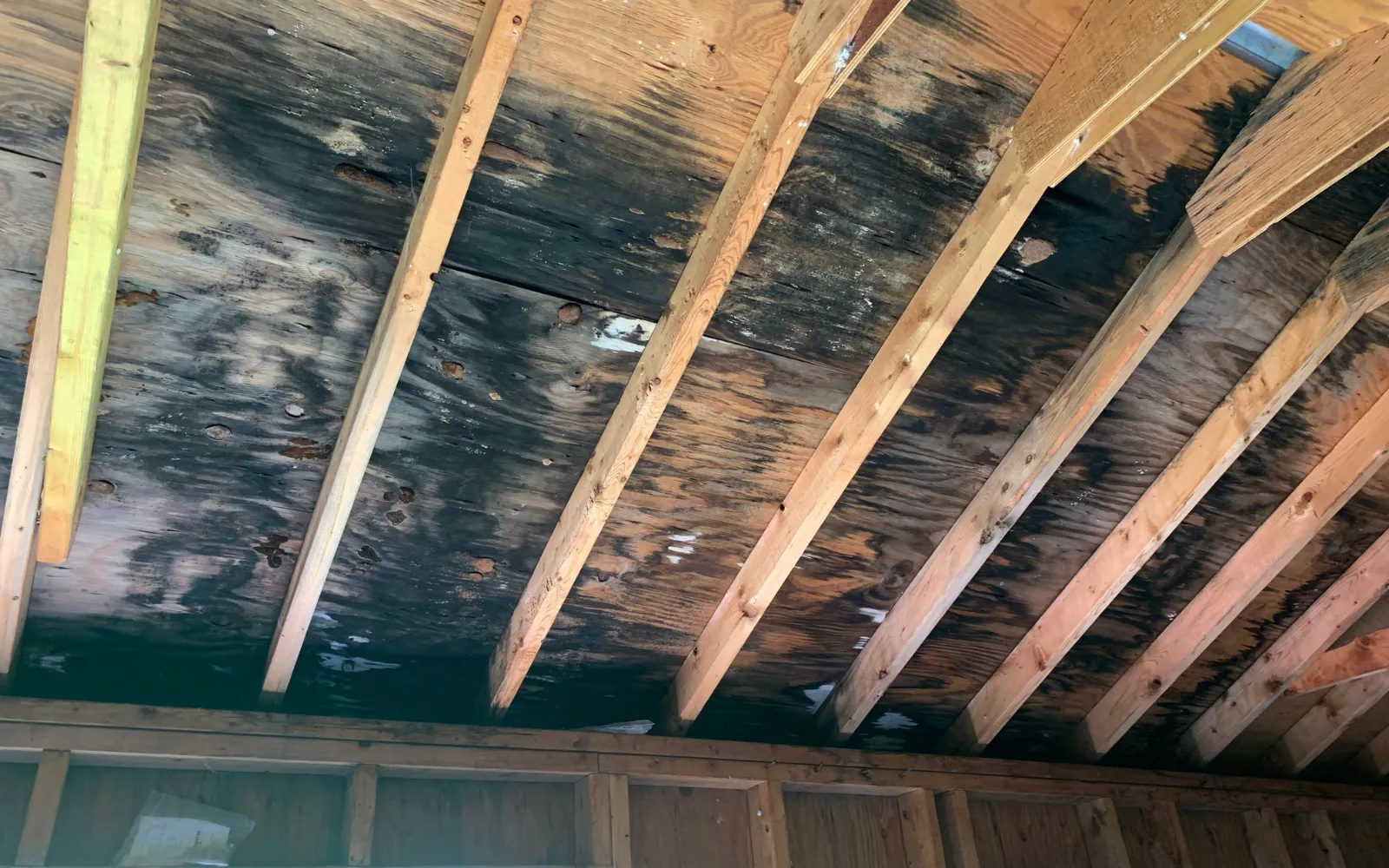
Can You Safely Live in a House with Black Mold?
You’ve found dark mold in a bedroom, around a leaking window or somewhere in the basement.
Maybe an inspection is scheduled for tomorrow. Maybe you’ve only just discovered it.
Either way, there’s one question that suddenly feels much more urgent than everything else:
Can we safely stay here tonight?
There isn’t a universal yes-or-no answer to whether you can safely live in a house with black mold.
The location and extent of the problem matter. So does whether the mold appears contained to one area or may have spread farther, whether remediation work is underway, and whether anyone living in the home has a medical condition that could make mold exposure more concerning.
Even the phrase “black mold” needs some perspective. Stachybotrys chartarum is a greenish-black mold associated with persistently wet building materials, but CDC guidance says molds capable of producing mycotoxins should be considered alongside other indoor molds: mold growing in a building indicates a water or moisture problem that needs to be addressed.
For Caleb Jones, Lead Inspector at Spotless, the goal isn’t to scare a family out of its home.
It’s to give them enough information to make a sensible decision.
Spotless evaluates mold conditions in buildings and performs remediation. We don’t diagnose health conditions or determine whether an individual is medically safe to remain in a property. If you’re concerned about your personal health or that of a family member, speak with a qualified healthcare professional.
- There’s No Single Rule for Whether You Should Stay or Leave
- Five Things to Consider Before Deciding Whether to Stay
- When Temporarily Staying Somewhere Else May Make Sense
- What Changes Once Mold Remediation Starts?
- Don’t Let Fear or Embarrassment Make the Decision for You
- Make the Decision From Facts, Not the Color of the Mold
There’s No Single Rule for Whether You Should Stay or Leave
Caleb gets asked some version of this question regularly.
Would you stay here?
Should I take the kids somewhere else?
Is this house safe?
He deliberately avoids giving every homeowner the same answer.
“I don’t want to be the fear monger that’s gonna come in and tell them that their house is not safe to live in.”
Caleb Jones
Instead, Caleb explains what he can establish about the building: where the known mold is, what areas appear to be affected, whether there’s reason to investigate other parts of the property or the HVAC system, what remediation will involve and how quickly the work can realistically happen.
That distinction is important.
A mold inspector can tell you about the condition of the house. They can’t look at a wall and tell you exactly how that environment will affect a particular person.
People don’t all respond to mold exposure in the same way. The CDC says exposure can cause stuffy nose, sore throat, coughing or wheezing, burning eyes and skin rash in some people. People with asthma or mold allergies may have more severe reactions, while people with weakened immune systems or chronic lung disease can be at risk of fungal lung infections.
So when you’re asking whether you can safely live in a house with black mold, the useful question isn’t simply “Is black mold dangerous?”
It’s:
What do we know about this particular house, this particular mold problem and the people living here?
If you don’t yet know how far the problem extends, start there. A mold inspection in Lexington KY can give you far more useful information than trying to make an occupancy decision from the color of one patch.
If you’re deciding whether to stay or leave, first find out what’s actually affected. Knowing whether you’re dealing with one localized area or a wider moisture and mold problem puts that decision on much firmer ground.
Five Things to Consider Before Deciding Whether to Stay
There’s no single checklist that can declare a home safe or unsafe, but there are several factors that can change the picture considerably.
1. Where is the mold?
Location matters.
A small affected area in an isolated section of a basement creates a different practical question from visible mold in the bedroom where somebody spends eight hours every night.
If mold is in a room you can avoid until it’s evaluated, your options may be different from a situation where the affected space is central to everyday life.
2. How extensive is the problem?
Don’t judge the entire situation by the square inches you can see.
Has there been repeated water damage?
Is the drywall warped?
Are baseboards pulling away?
Does the room smell musty?
Could contaminated material be hidden inside a cavity?
Those clues may suggest there’s more to investigate before deciding that the visible patch represents the whole problem.
3. Could the HVAC system or other areas be involved?
Caleb specifically considers whether contamination may have moved beyond the immediately visible area.
He routinely checks water sources and accessible portions of HVAC equipment during residential inspections. And when talking to homeowners about occupancy, he explains when there’s a possibility that mold or contamination could also be present elsewhere in the house or HVAC system.
That doesn’t mean finding mold beside a window automatically means your entire HVAC system is contaminated.
It means extent matters more than assumptions.
4. Who lives in the home?
Existing medical conditions deserve additional consideration.
CDC guidance says people with asthma or mold allergies can experience stronger reactions to mold. People with weakened immune systems and chronic lung disease may be more susceptible to fungal lung infections.
In specific post-flood mold-cleanup guidance, the CDC goes further, advising people with asthma, COPD or compromised immune systems not to stay in a moldy home or be present while mold cleanup is taking place. That guidance is written for flood and disaster cleanup situations, but it highlights why personal medical vulnerability shouldn’t be treated casually.
If that describes someone in your household, speak with their healthcare professional about personal exposure decisions.
5. Does anything change when you’re away?
This is one of the questions Caleb often asks when a client is concerned about both their house and how they feel.
“Do you feel better when you go to work and you feel worse whenever you come home?”
Caleb Jones
He doesn’t use the answer as a diagnosis.
In fact, Caleb says he actively tries to avoid leading people into attributing every symptom they experience to mold. He looks for patterns and gives the homeowner information about the property.
Feeling different away from your house doesn’t prove that mold caused your symptoms. But if you consistently notice a pattern, it’s reasonable information to share both with your inspector and your healthcare provider.
If several factors are stacking up – mold in an occupied bedroom, recurring water damage, possible wider contamination and a medically vulnerable family member – get professional guidance rather than relying on a generic answer from the internet.
When Temporarily Staying Somewhere Else May Make Sense
Sometimes a homeowner already knows what makes them most comfortable.
They leave the house for a weekend and feel reluctant to return. Or they’re already dealing with health concerns and don’t want another uncertainty hanging over them while an inspection or remediation is underway.
Caleb’s response isn’t to order them out of the house.
It’s to give them room to make that decision.
“If you feel more comfortable and you feel better outside of this house, then by all means you can go and find somewhere to stay.”
Caleb Jones
He then works with the client to explain what remediation involves and get the problem addressed.
Temporarily staying elsewhere may deserve particular consideration when:
- the mold is in a bedroom or another heavily occupied room
- a substantial area of normal living space is affected
- remediation will make rooms impractical to use
- the affected area can’t easily be isolated
- a healthcare professional has advised someone to limit exposure
- someone in the household has a condition that puts them in a higher-risk group
- remaining in the property is creating significant stress and uncertainty
Spotless’ own service information reflects that case-by-case approach. The company notes that clients are sometimes asked to vacate while work is underway depending on factors such as the client’s circumstances and the extent and location of the mold.
And this isn’t about declaring the entire property ruined.
It may simply mean spending a few nights somewhere else while the affected area is investigated or treated.
If staying elsewhere temporarily would give your family peace of mind while a significant problem is being evaluated, that can be a perfectly reasonable choice. Make it from good information, not because someone has frightened you into believing every dark patch makes a house uninhabitable.
What Changes Once Mold Remediation Starts?
There’s another distinction homeowners don’t always consider.
Living with an undisturbed mold problem isn’t quite the same situation as being beside an active mold-remediation work zone where contaminated building materials are being opened and removed.
That’s why containment matters so much.
Caleb describes a typical example involving mold around a leaking window. Before his team starts removing drywall, they establish plastic containment around the affected area or isolate the room.
They then use negative air pressure, HEPA vacuuming and controlled removal techniques. Contaminated drywall is bagged inside the containment rather than being carried uncovered through the rest of the house.
“A lot of what goes into what we do is not causing an issue elsewhere in the house.”
Caleb Jones
EPA guidance supports the same fundamental principle: containment is intended to stop mold spores moving from contaminated areas into unaffected parts of a building, and negative pressure can help prevent contaminated air flowing into adjoining spaces.
That means you may be able to remain in one part of a property while another area is professionally contained, but whether that’s practical depends on the scope of the individual job.
You should know before work starts:
- which rooms will be inaccessible
- where containment will be installed
- how workers will enter and leave the area
- how contaminated materials will be removed
- whether HVAC operation needs to change
- how long the affected space is expected to remain out of use
And if active water damage caused the problem, speed matters.
The EPA says that when wet or damp materials are dried within 24–48 hours after a leak or spill, mold will not grow in most cases.
That’s why you don’t want the question “Should we stay here?” to distract from an active leak that still needs to be stopped and dried.
Before remediation begins, ask exactly how the work area will be contained and which parts of your home will remain usable. A good remediation plan should address cross-contamination, not simply tell you that someone’s going to tear out the moldy drywall.
Don’t Let Fear or Embarrassment Make the Decision for You
There’s another side of these conversations Caleb sees all the time.
People are embarrassed.
They assume mold means their home is dirty or that they somehow failed to look after it properly.
That can make homeowners reluctant to ask family members for somewhere to stay or even reluctant to talk about what’s going on.
Caleb wants people to get rid of that idea.
“Mold can happen in any house, any format, any age of home.”
Caleb Jones
He’s inspected mold problems in new construction as well as much older homes.
Mold needs the right environmental conditions. A leaking window, failed pipe, roof problem or other moisture source doesn’t care how tidy your kitchen is.
The same applies to the decision about staying in the property.
There’s no prize for remaining in a mold-affected room because you think leaving means you’re overreacting. Equally, there’s no reason to assume you need to abandon an entire house because you’ve discovered a localized patch of dark growth.
Caleb describes it in much more personal terms: it’s the client’s health, their body and their family. His role is to explain what’s happening in the building so they can decide what makes sense for them.
You don’t have to prove your house is “dangerous” before you ask for help. If you’ve found mold and don’t know what it means for the rooms your family uses every day, an inspection can replace a lot of that uncertainty with facts.
Make the Decision From Facts, Not the Color of the Mold
So, can you safely live in a house with black mold?
For some homeowners, remaining in unaffected parts of the property while a localized issue is evaluated may be practical. For others, particularly where occupied rooms are affected, remediation is extensive or health vulnerabilities are involved, temporarily staying elsewhere may be the more appropriate choice.
There isn’t one answer for every house or every family.
What matters is understanding:
- where the mold is
- how extensive the problem may be
- whether other areas or HVAC could be involved
- who is living in the property
- whether remediation is actively taking place
- what your inspector and healthcare provider can each tell you
Caleb’s approach is deliberately straightforward: give homeowners the facts about the environment without using fear to make the decision for them.
If you’re in Lexington or Central Kentucky and you’re trying to work out what mold in your home actually means, schedule a mold inspection in Lexington KY with Spotless. We can investigate the building, explain what appears to be affected and help you understand what remediation would involve so you can make your next decision with better information.
Spotless is the most trusted name in restoration in central Kentucky including Lexington, Nicholasville and surrounding communities.
Specializing in health-focused mold remediation and water damage restoration, we leave mold-affected clients with a healthier home.
Call 859-459-0424 and speak to a technician today!