
Does Bleach Kill Mold or Make the Problem Worse?
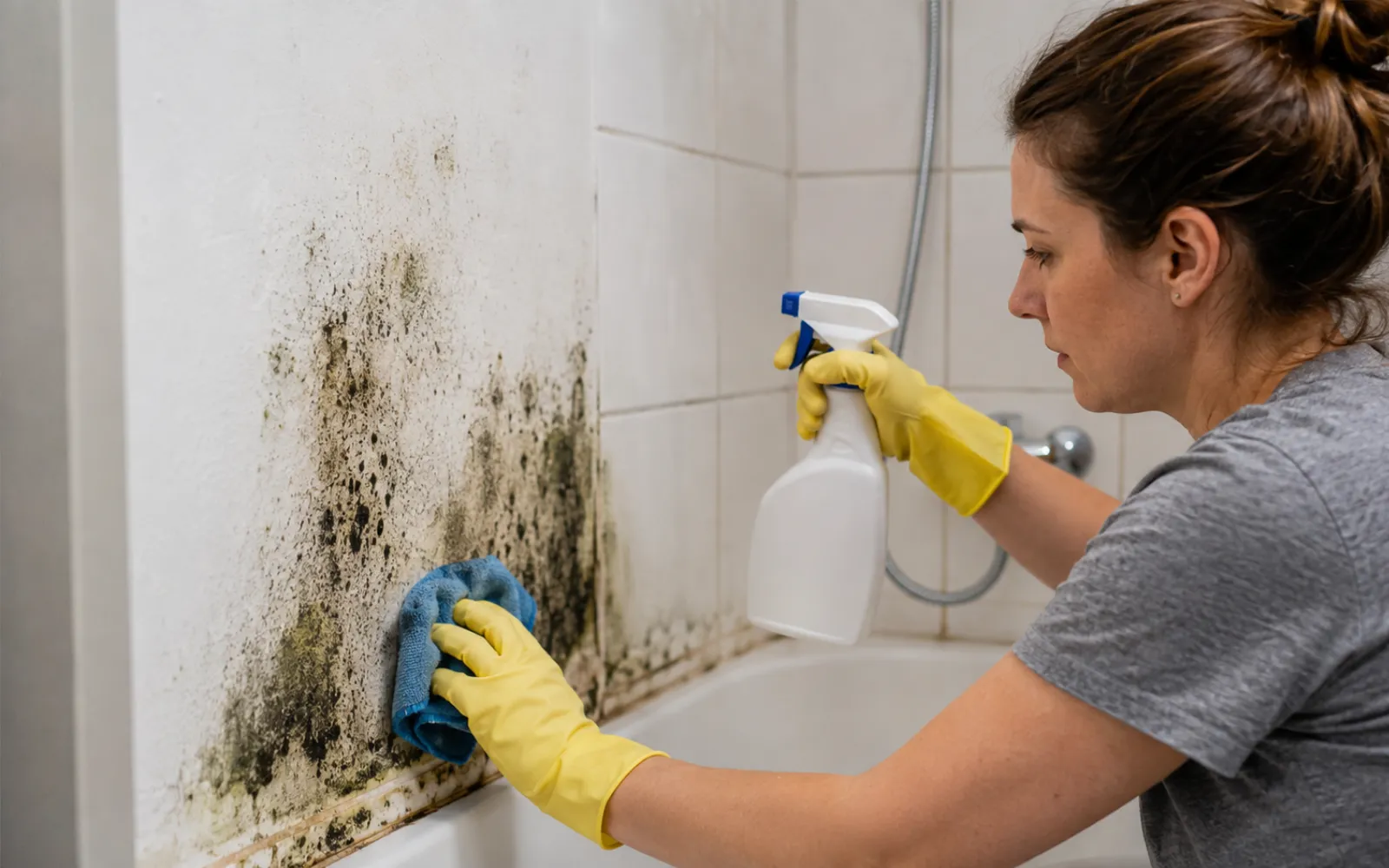
You spray bleach onto a dark patch of mold.
Within minutes, it starts fading. The wall looks cleaner. The stain may almost disappear.
Problem solved, right?
Then a few weeks or months later, the dark marks start showing again.
That experience is one reason homeowners end up searching “does bleach feed mold?” or wondering whether bleach somehow made the problem worse.
The reality needs a little more nuance.
Bleach can be used to kill or clean mold on some suitable hard surfaces. But bleach isn’t a complete mold-remediation method, and there isn’t good evidence for the blanket claim that bleach literally “feeds” mold and makes it grow stronger.
What often goes wrong is simpler: the surface changes, but the leak, damp material or hidden contamination that allowed the mold to grow is still there.
Caleb Jones, Lead Inspector at Spotless, has a memorable way of describing what that can look like in the field:
“We call it like giving mold a haircut.”
Caleb Jones
Here’s what he means, and where the science and official guidance fit in.
- Does Bleach Actually Kill Mold?
- Does Bleach Feed Mold?
- Why Bleach Can Look Like It Worked When It Didn’t Solve the Problem
- Bleach on Tile Isn’t the Same as Bleach on Drywall
- Don’t Turn a Mold Problem Into a Chemical-Safety Problem
- What Should You Do Instead of Bleaching the Same Mold Again?
- Bleach Isn’t the Villain, or the Whole Solution
Does Bleach Actually Kill Mold?
Yes, bleach can kill mold under some conditions.
CDC guidance allows household bleach as one option when cleaning mold and says to use no more than 1 cup of household laundry bleach per 1 gallon of water. CDC also stresses that bleach should never be mixed with ammonia or other cleaners.
That’s an important distinction because you’ll sometimes see the opposite claim online: bleach doesn’t kill mold at all.
That’s too broad as well.
Caleb describes seeing a very obvious visual effect when bleach is applied:
“Sodium hypochlorite, which is a component in bleach, will have a visual effect on mold.”
Caleb Jones
So why doesn’t Spotless simply recommend bleaching every moldy surface?
Because killing mold organisms and properly remediating a mold problem aren’t necessarily the same thing.
EPA says chemicals or biocides such as chlorine bleach aren’t recommended as a routine mold-cleanup practice, although there are circumstances where professional judgment may support their use. EPA’s homeowner guidance instead emphasizes physically cleaning mold from suitable hard surfaces, drying them completely, and correcting moisture problems.
That’s not really a contradiction with CDC.
CDC is explaining how bleach can be used when cleaning appropriate surfaces. EPA is warning against assuming that killing mold with a chemical means the remediation problem has been solved.
If bleach makes a black patch disappear, don’t judge success by the color of the wall. Ask why mold was able to grow there and whether the affected material is actually clean and dry.
Does Bleach Feed Mold?
This is where Caleb’s interview and the broader evidence need to be separated carefully.
Caleb has seen a familiar pattern in Lexington-area homes:
“A lot of clients will spray bleach on it. It’ll look great for a couple of months and then the mold will come back.”
Caleb Jones
In the interview, Caleb explains that recurrence by saying bleach breaks down into water and can then “feed” the mold.
We wouldn’t present “bleach feeds mold” as an established scientific fact, though.
There’s a much simpler explanation for why homeowners frequently see mold return.
The moisture is still there
EPA calls moisture control the key to mold control. If a plumbing leak, window leak, condensation problem or another source of moisture continues, the basic conditions mold needs to grow haven’t changed.
The contaminated material is still there
Porous materials are a different challenge from tile or another hard surface. EPA notes that mold can penetrate porous substances and fill spaces or crevices, making complete cleaning difficult or sometimes impossible. Wet, moldy porous materials may need to be discarded.
So bleach doesn’t have to feed mold for this cycle to happen:
spray → stain fades → wall still gets wet → contaminated material remains → visible growth returns.
That’s often what homeowners are really describing when they say bleach “made the mold worse.”
If mold returned after you bleached it, don’t automatically reach for a stronger bleach solution. Treat the recurrence as evidence that something about the moisture, material or extent of contamination still needs to be investigated.
Why Bleach Can Look Like It Worked When It Didn’t Solve the Problem
This is where Caleb’s “haircut” analogy becomes useful.
Imagine mold is growing on drywall beneath a window that has leaked repeatedly.
You spray the visible marks.
They fade.
That feels like success.
But the appearance of the painted surface tells you very little about:
- whether the window is still leaking
- whether the drywall stayed wet
- whether mold is present on the back of the drywall
- whether insulation inside the cavity is affected
- whether adjacent framing needs cleaning
- how far the moisture traveled
Caleb’s concern isn’t simply that somebody used bleach. It’s that a strong visual improvement can convince a homeowner to stop investigating.
“It’ll look like it will get rid of the mold…”
Caleb Jones
The EPA’s guidance is particularly relevant here. Mold can generally be cleaned from nonporous hard surfaces, but wet porous materials may have to be removed because mold can grow inside them rather than only sitting on top.
So Caleb’s “haircut” line is best understood as an inspector’s analogy, not a chemistry rule.
The visible part changes. The underlying building problem may not.
A lighter-looking wall isn’t enough. Successful cleanup means dealing appropriately with the affected material and correcting the conditions that allowed mold to grow there.
Bleach on Tile Isn’t the Same as Bleach on Drywall
One of the biggest problems with generic mold advice is that it treats every surface as though it’s interchangeable.
It isn’t.
Hard surfaces
CDC specifically provides bleach-cleaning instructions for mold growth on hard surfaces such as certain floors, sinks, countertops and tools.
EPA also says mold can generally be removed from hard surfaces by scrubbing with water and detergent, followed by thorough drying.
Porous materials
Drywall, insulation, carpet and ceiling tile behave differently.
EPA warns that mold can infiltrate porous materials, which can make complete removal difficult or impossible. Depending on the material and extent of contamination, disposal may be necessary.
Caleb’s leaking-window example shows what that difference looks like in actual remediation.
Rather than spraying moldy drywall through the finished surface, Spotless may establish containment, open the cavity, remove affected drywall and insulation, HEPA vacuum exposed materials, treat appropriate remaining surfaces and document the water source. Contaminated drywall is bagged within containment so it isn’t carried exposed through cleaner areas of the home.
“Once you open that surface, you need to bag the drywall within the containment so that way when you take it out of the containment, you’re not cross-contaminating.”
Caleb Jones
That’s a very different job from wiping mold from a hard bathroom surface.
Before putting bleach on moldy drywall, wood or insulation, work out whether that material can actually be cleaned. Sometimes the right solution isn’t a different cleaner, it’s controlled removal.
Don’t Turn a Mold Problem Into a Chemical-Safety Problem
Bleach also deserves respect as a chemical.
CDC warns homeowners never to mix bleach with ammonia or any other cleanser because dangerous vapors can be produced. It also recommends fresh-air ventilation when using cleaning products.
That’s especially important if you’ve already tried another mold product.
Don’t assume it’s safe to follow:
vinegar → bleach
store-bought mold spray → bleach
another household cleaner → bleach
without knowing what’s in those products.
Caleb’s own line in the sand is partly about this complexity:
“When it gets to the point of doing the science and the actual chemical usage and different things like that to deal with the mold, that’s where I draw the line in the sand.”
Caleb Jones
There’s nothing wrong with being a capable homeowner.
But more chemical isn’t automatically more remediation.
Never mix cleaners in an attempt to make a mold treatment stronger. If you don’t know what has already been applied to a surface, stop before adding another product.
What Should You Do Instead of Bleaching the Same Mold Again?
If you’re on your third round of spraying the same patch, change the question.
Instead of:
What else can I put on this?
work through the problem in this order.
1. Find the moisture
Look for the leak, condensation, plumbing problem, water intrusion or damp condition supporting the growth.
EPA is unequivocal that moisture control is fundamental to mold control.
2. Identify the affected material
A hard, cleanable surface calls for a different response from wet drywall, insulation or carpet.
3. Work out how far the problem extends
The visible black patch may not show you what’s behind the wall.
Recurring discoloration, warping, leaks and musty odors all deserve more attention. Our guide to the first signs of black mold explains what Caleb looks for during an inspection.
4. Remove what can’t be properly cleaned
Repeatedly treating a badly contaminated porous material because replacement is inconvenient doesn’t make the material easier to remediate.
5. Control contamination if materials need to come out
This is where professional mold remediation becomes very different from wiping or spraying.
Caleb describes Spotless using containment, negative air pressure, HEPA vacuuming and controlled removal to help keep contamination from spreading outside the work area.
“A lot of what goes into what we do is not causing an issue elsewhere in the house.”
Caleb Jones
That approach also matches Spotless’ documented focus on air quality and preventing cross-contamination rather than simply tearing moldy material out of a property.
If you’re repeatedly bleaching the same mold and it keeps returning, stop treating the visible symptom. Professional mold remediation in Lexington KY can help determine what’s wet, what needs to come out and how to address it without spreading the problem.
Bleach Isn’t the Villain, or the Whole Solution
So, does bleach kill mold?
It can be used against mold on some suitable hard surfaces, and CDC provides specific instructions for diluted household bleach when it’s used for mold cleanup.
Does bleach feed mold?
We wouldn’t present that as established fact.
What we can say is that bleach doesn’t repair a leaking window. It doesn’t dry wet insulation. It doesn’t automatically remove mold from the interior of porous material. And it doesn’t replace containment when contaminated drywall has to come out. EPA’s current guidance consistently puts moisture correction and appropriate physical cleaning or material removal at the center of mold control.
Caleb’s “giving mold a haircut” analogy works because it describes the trap homeowners can fall into: the surface looks better, so everyone assumes the building is better.
Sometimes it is.
Sometimes the real problem is still behind the paint.
If mold keeps returning in your Lexington or Central Kentucky home, contact Spotless for professional mold remediation. We’ll help you look beyond the stain and work out why the mold has somewhere to keep growing.
Spotless is the most trusted name in restoration in central Kentucky including Lexington, Nicholasville and surrounding communities.
Specializing in health-focused mold remediation and water damage restoration, we leave mold-affected clients with a healthier home.
Call 859-459-0424 and speak to a technician today!