
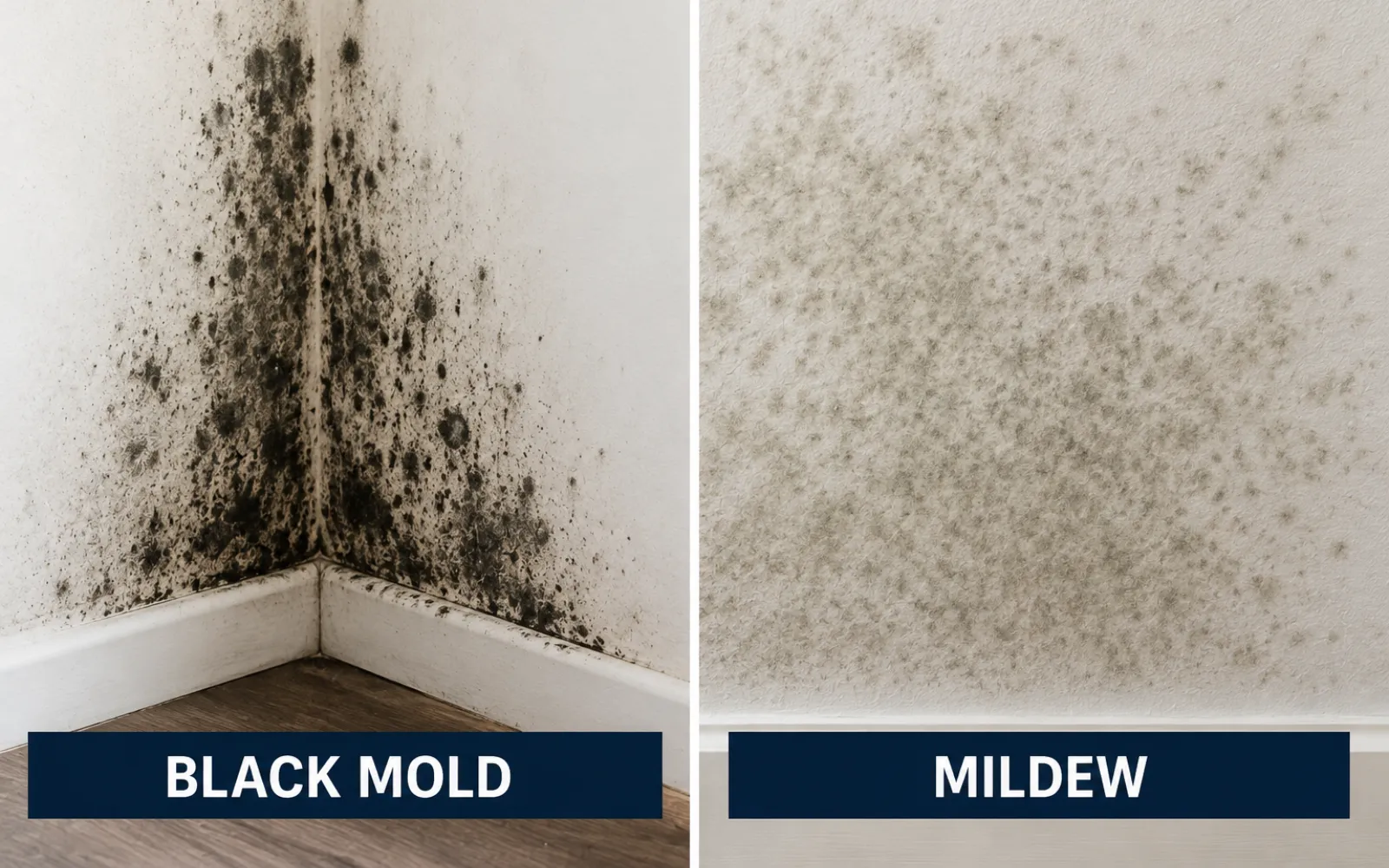
Black Mold vs Mildew: How to Tell the Difference
There’s a dark patch around the bathroom window. Or maybe you’ve noticed something spreading across a basement wall.
Is it mildew you can wipe away, or black mold that means you’ve got a much bigger problem?
It’s a reasonable question, but black mold vs mildew isn’t quite as simple as many comparison guides make it sound.
For one thing, mildew isn’t a completely separate category from mold. The EPA describes mildew as a term for certain kinds of mold or fungus and says it’s often used generically for mold with a flatter growth habit.
And something looking black doesn’t automatically make it the mold people commonly mean when they talk about “toxic black mold.”
Caleb Jones, Lead Inspector at Spotless, has to explain that distinction to homeowners regularly.
“There’s a lot of molds that are black in color. You don’t know unless you do laboratory testing.”
Caleb Jones
So appearance can give you clues. It just can’t give you the whole answer.
- Is Mildew Actually Different From Mold?
- What Does Mildew Look Like Compared With Black Mold?
- The Moisture Source Matters More Than Whether You Call It Mold or Mildew
- Can You Tell Black Mold From Mildew by Color Alone?
- Does Mildew Need Less Attention Than Black Mold?
- When to Stop Comparing Mold Photos and Get the Area Inspected
- Don’t Let the Label Distract You From the Moisture
Is Mildew Actually Different From Mold?
The words mold and mildew are often presented as opposites.
You’ll see comparisons suggesting mildew is one organism and mold is another entirely.
That’s misleading.
According to the EPA, mildew refers to certain kinds of mold or fungus, and people commonly use the term for fungal growth with a flatter appearance. The EPA’s mold training materials also note that molds may be referred to as fungi or mildew.
So when you’re comparing black mold vs mildew, it’s more useful to think of mold as the broader category and mildew as a term often used for particular types or appearances of fungal growth.
Why does that matter?
Because homeowners can hear the word mildew and assume:
Oh, that’s the harmless one.
But the label doesn’t tell you why it’s growing.
If you have recurring fungal growth around a window, bathroom wall or basement surface, you still have a moisture question to answer.
Don’t make the cleanup decision based on whether you feel more comfortable calling something mildew. If fungal growth keeps returning indoors, find out what’s keeping the area damp.
What Does Mildew Look Like Compared With Black Mold?
There are visual clues that can help you describe what you’re seeing.
Growth people commonly call mildew may appear relatively flat or superficial across a surface. That flatter growth habit is one of the few distinctions specifically supported in EPA’s explanation of the term.
Dark mold growth, meanwhile, might look:
- black
- greenish-black
- dark brown
- spotted
- irregular
- patchy across a damp building material
But here’s where visual identification starts breaking down.
There are many mold species, and molds can appear in many different colors. NIOSH specifically warns that the color of mold doesn’t indicate whether it’s more or less dangerous.
“There’s a lot of molds that are black in color.”
Caleb Jones
Even Stachybotrys chartarum (the species homeowners often mean by “black mold”) is described by CDC as greenish-black rather than simply jet black. It grows particularly well on high-cellulose materials such as gypsum board, fiberboard and paper where there’s sufficient moisture.
So a visual comparison might help you notice:
That looks like fungal growth.
It can’t reliably tell you:
That’s definitely Stachybotrys.
And the opposite is true too. Something flatter or lighter in color shouldn’t automatically be dismissed as harmless mildew.
Use appearance to recognize that something has changed. Don’t use it to diagnose the species or decide whether a recurring moisture problem is worth addressing.
The Moisture Source Matters More Than Whether You Call It Mold or Mildew
There’s one thing both sides of the black mold vs mildew comparison have in common:
They need the right environmental conditions to grow.
The EPA explains that mold can grow when moisture and oxygen are present, and its guidance repeatedly puts moisture control at the center of preventing indoor mold growth.
That’s exactly where Caleb’s attention tends to go during an inspection.
If the growth follows a plumbing leak, flooding or repeatedly wet building material, he wants to know why the water got there and whether it’s still happening.
“It’s a lot more emphasis on finding the source of what is causing that water damage.”
Caleb Jones
Take a bathroom as an example.
If a small amount of flat fungal growth appears because the room stays humid after every shower, you may be dealing with a ventilation and humidity problem.
If dark growth appears on drywall beneath a plumbing leak, you’ve got a different moisture source and potentially a different material problem.
In a basement, the question might be groundwater, condensation, humidity or a previous water intrusion.
The EPA currently recommends keeping indoor relative humidity below 60%, ideally between 30% and 50% where possible, to help reduce conditions favorable to mold growth.
That’s much more actionable than staring at a photo online trying to decide whether a patch looks more like mildew or black mold.
If the same “mildew” keeps coming back, stop debating the label for a moment. Recurring growth is telling you that the conditions supporting it haven’t been fully corrected.
Can You Tell Black Mold From Mildew by Color Alone?
No.
Color can be part of your description, but it isn’t a reliable species test.
NIOSH says mold comes in many colors and specifically cautions that color doesn’t tell you whether one mold is more or less dangerous than another.
Caleb’s advice from the field is equally straightforward:
“You don’t know unless you do laboratory testing.”
Caleb Jones
That doesn’t mean every mold problem needs laboratory testing before you do anything.
CDC guidance says that when mold is growing indoors, the practical priority is to remove the mold and correct the moisture problem rather than first determining precisely which mold species is present.
Testing makes sense when the result will answer a useful question.
It shouldn’t become an excuse to leave obvious indoor mold and water damage untouched while you wait to learn its Latin name.
If the only reason you believe you have “toxic black mold” is that the patch looks black, don’t panic. But don’t ignore the moisture and growth while trying to identify it from color alone.
Does Mildew Need Less Attention Than Black Mold?
This is another place where the internet often creates an overly tidy rule:
Mildew = minor. Black mold = serious.
Real homes aren’t that predictable.
CDC advises dealing with indoor mold when you see or smell it and correcting the moisture problem that allowed it to grow.
The practical response depends on things such as:
- how large the affected area is
- what material the growth is on
- whether it appears superficial
- whether water damage is continuing
- whether porous materials are affected
- whether growth may extend into hidden areas
- whether HVAC or several rooms may be involved
Caleb explains that the type of mold can change where he looks during an inspection, but it doesn’t fundamentally change the end goal.
“Different types of molds can change the inspection style, but the result is the same at the end as far as the remediation goes.”
Caleb Jones
That’s a useful way to think about mildew too.
A little superficial growth on an appropriate cleanable surface isn’t the same job as mold throughout wet drywall or insulation.
But you shouldn’t assume something needs no attention simply because it looks more like mildew.
Let the material, moisture and extent of the problem determine your response, not whether one photo online labels the growth “mildew.”
When to Stop Comparing Mold Photos and Get the Area Inspected
At some point, comparing pictures stops giving you useful information.
It’s worth getting the area investigated when:
The growth keeps returning
You clean it, it disappears, and then it comes back.
That suggests the underlying conditions haven’t changed.
There’s a musty smell but no obvious source
CDC notes that mold can smell musty, and persistent odor can be a useful clue even when visible growth isn’t obvious.
Building materials are changing
Caleb tells homeowners to pay attention to things such as separating baseboards, buckled flooring and ceilings that have changed shape.
Those signs don’t prove mold is present. They can, however, suggest moisture has affected the material.
The problem followed a leak or flood
Water history matters.
If drywall, insulation or flooring stayed wet, the visible surface may not show the whole problem.
You suspect HVAC or hidden mold
Caleb routinely checks water sources and accessible parts of HVAC equipment during residential inspections.
“I’ll check all of the water sources whenever I go into a home. I’ll check the interior of the HVAC system whenever I go into a home.”
Caleb Jones
If finding out what’s happening means opening walls, investigating hidden cavities or determining whether contamination has extended beyond an obvious patch, a mold inspection in Lexington KY can give you much more useful information than another image search.
If you’ve reached the point where you’re comparing ten photos and still can’t tell whether you’re looking at mildew or black mold, change the question. Find out where the moisture is coming from, what material is affected and how far the problem extends.
Don’t Let the Label Distract You From the Moisture
So, what’s the difference between black mold and mildew?
Mildew is a term used for certain types or appearances of fungal growth, often with a relatively flat growth habit. Black mold is a broad homeowner term frequently used for dark-colored mold and, more specifically, for Stachybotrys chartarum.
But black mold vs mildew isn’t a reliable shorthand for dangerous versus harmless.
Something being black doesn’t identify its species.
Something being flat or lighter-colored doesn’t mean you can ignore it.
What matters more is what’s happening in the building:
Why is the area wet? Is the moisture still active? What material is affected? How extensive is the growth? Can it actually be cleaned?
If you’re in Lexington or Central Kentucky and you’re struggling to tell what you’re looking at, schedule a mold inspection in Lexington KY with Spotless.
You don’t need to diagnose mold from a photo before asking for help. The more useful job is finding out why it’s there and what needs to happen next.
Spotless is the most trusted name in restoration in central Kentucky including Lexington, Nicholasville and surrounding communities.
Specializing in health-focused mold remediation and water damage restoration, we leave mold-affected clients with a healthier home.
Call 859-459-0424 and speak to a technician today!