
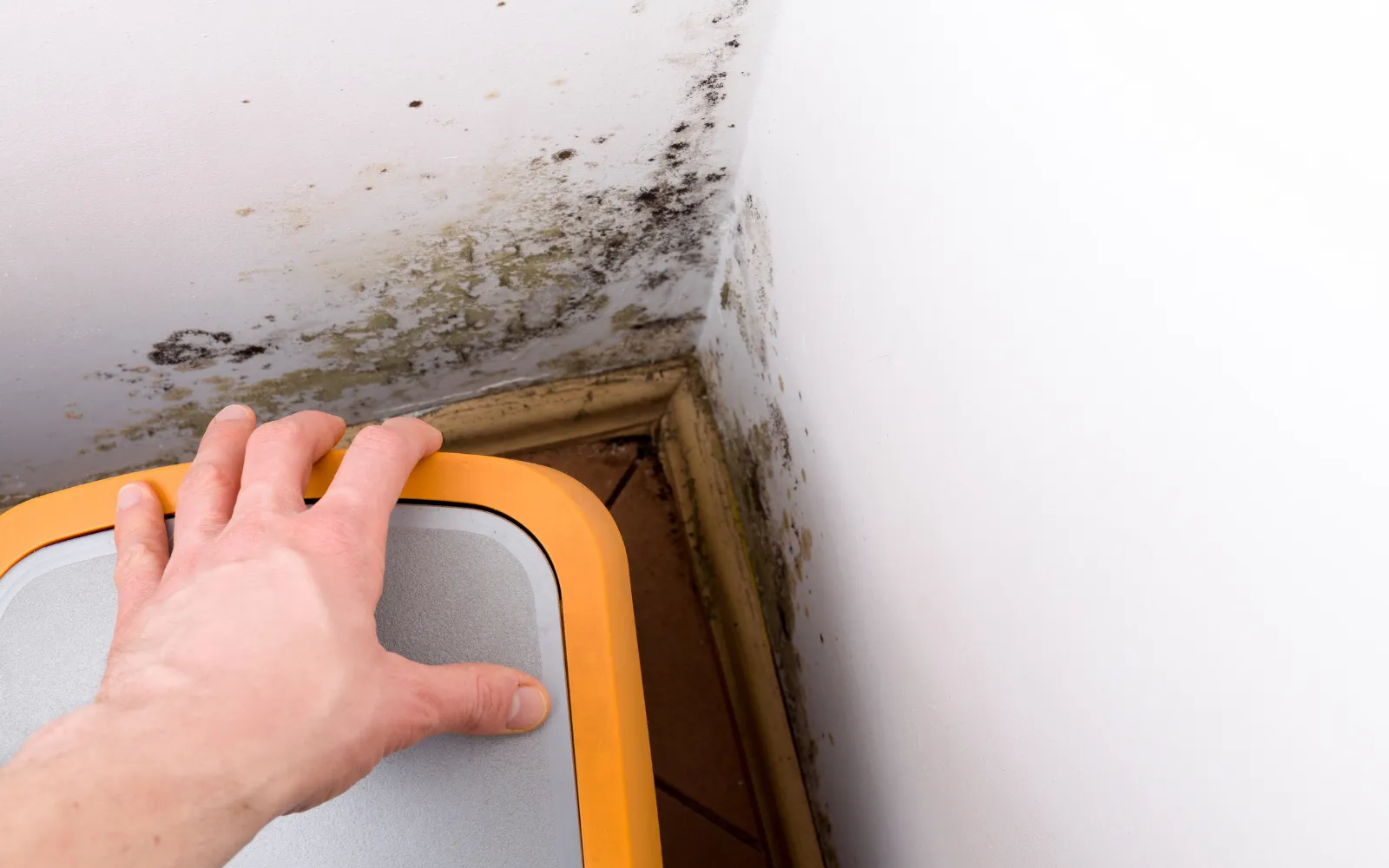
What Kills Black Mold Naturally? What Works and What Doesn’t
You’ve found mold and would rather not reach straight for harsh chemicals.
So you start searching.
Vinegar. Baking soda. Hydrogen peroxide. Essential oils. Homemade sprays.
Within a few minutes, you’ll find plenty of confident claims that one household ingredient or another will “kill black mold naturally.”
The reality is less tidy.
There isn’t one natural household remedy that can be relied on to solve every black mold problem. Some substances do have antifungal properties, but showing that something can inhibit mold under particular conditions isn’t the same thing as successfully remediating mold growing inside drywall, insulation, wood or a hidden wall cavity.
Caleb Jones, Lead Inspector at Spotless, has seen plenty of homeowners try household products before calling in professional help.
“We’ve done a lot of internal testing on some publicly available products and remedies and have not gotten the best results.”
Caleb Jones
That’s Spotless’ own field experience rather than published scientific research. But it points to the bigger issue with the question what kills black mold naturally?
Killing mold isn’t necessarily the same thing as removing a mold problem from your home.
- What Actually Kills Black Mold Naturally?
- Does Vinegar Kill Black Mold?
- What About Baking Soda, Hydrogen Peroxide and Other Natural Remedies?
- The Most Important Mold-Control Strategy Isn't in a Spray Bottle
- Is Bleach Better Than Natural Mold Remedies?
- When a Natural DIY Approach Has Reached Its Limit
- The Best Remedy Depends on What the Mold Is Growing On
What Actually Kills Black Mold Naturally?
The word kills can send homeowners down the wrong path from the beginning.
It makes mold remediation sound like a chemistry problem:
Find something strong enough to kill the organism, spray it on, job done.
But proper mold cleanup is usually more about removal, moisture control and the material the mold is growing on.
EPA guidance tells homeowners to scrub mold from suitable hard surfaces with detergent and water, then dry those surfaces completely. It also warns that absorbent or porous materials may sometimes need to be discarded because mold can grow in spaces that are difficult or impossible to clean fully. (Source: EPA)
So there are really three different questions:
- Can a substance inhibit or kill mold?
- Can the mold contamination actually be removed from the material?
- Has the moisture problem that caused the growth been corrected?
Those aren’t interchangeable.
A product might alter the mold you can see while leaving wet drywall, contaminated insulation or an active leak untouched.
Caleb sees the end result of that fairly often.
“I’ve had countless clients attempt home remedies and call us back whenever the issue gets worse.”
Caleb Jones
That doesn’t mean every small DIY cleanup fails. Spotless naturally sees the homeowners whose problems turned out to be more complicated.
But it does highlight why finding the strongest natural mold killer shouldn’t be your first priority.
If you’re wondering what kills black mold naturally, a better question is:
What will remove the contamination and stop the conditions that allowed it to grow in the first place?
Before you choose a natural cleaner, identify what the mold is growing on and why that area is wet. A product that works on an accessible hard surface may be completely unsuitable for mold inside drywall or insulation.
Does Vinegar Kill Black Mold?
Vinegar is probably the most common natural mold remedy recommended online.
And there’s some evidence behind the idea that acetic acid can inhibit certain fungi.
But the claim “vinegar kills black mold” is much broader than the evidence supports.
A peer-reviewed study published in 2015 tested household vinegar containing approximately 4.0–4.2% acetic acid against two common indoor fungi. Under the study conditions, vinegar inhibited Penicillium chrysogenum but didn’t inhibit Aspergillus fumigatus. (Source: published study via PMC)
That result is useful because it shows two things at once:
Vinegar isn’t necessarily useless. But it isn’t universally effective against every mold either.
And that’s before we even get into the difference between laboratory testing and a mold problem inside a house.
A study can tell us whether a substance inhibits a particular organism under controlled conditions.
It doesn’t automatically tell us that pouring or spraying that substance onto moldy drywall will:
- penetrate every affected area
- remove contamination from the material
- correct hidden water damage
- prevent particles from spreading
- stop regrowth
- make the building material suitable to keep
The interview doesn’t include Caleb giving a specific verdict on vinegar, so we wouldn’t put one in his mouth.
His broader point is about the limitations of home remedies as a category:
“Home remedies and stuff – I’ve had countless clients attempt home remedies…”
Caleb Jones
If you have a genuinely small problem on an appropriate surface, vinegar may be one of the products you consider.
If you’re dealing with swollen drywall, wet insulation, recurring growth or mold inside a cavity, you’ve moved beyond the question of which household liquid works best.
Vinegar may have a place in cleaning certain small surface problems. It shouldn’t be treated as proof that mold inside a porous building material has been properly remediated.
What About Baking Soda, Hydrogen Peroxide and Other Natural Remedies?
This is where online mold advice becomes particularly confusing.
You’ll find recommendations for:
- baking soda
- hydrogen peroxide
- tea tree oil
- citrus oils
- essential-oil blends
- various homemade combinations
Some household substances do demonstrate antifungal activity under particular laboratory conditions.
For example, published research has shown antifungal activity from sodium bicarbonate against certain fungi. But that research wasn’t designed to establish baking soda as a complete remediation method for mold-contaminated building materials. (Source: PubMed)
That distinction matters.
Antifungal activity isn’t the same thing as successful building remediation.
There’s also not enough information in Caleb’s interview to rank vinegar against baking soda, hydrogen peroxide or essential oils. He says Spotless has tested some publicly available remedies and hasn’t liked every result, but he doesn’t provide a product-by-product comparison.
So we won’t invent one.
Instead, ask what the product is actually being asked to do.
If you’re cleaning a tiny amount of superficial growth from an appropriate hard surface, the conversation is one thing.
If you’re hoping baking soda will somehow remediate mold embedded in wet drywall, that’s another.
Natural black mold remedies make more sense when they’re treated as cleaning tools for appropriate surfaces, not replacements for understanding how far the mold extends.
Be skeptical of anyone promising that one pantry ingredient works on every mold and every material. Tile, framing, drywall and insulation don’t behave the same way when they’re contaminated.
The Most Important Mold-Control Strategy Isn’t in a Spray Bottle
Imagine you found the perfect product.
It removed every visible mark from the wall.
The wall looked completely clean.
But the pipe behind it was still leaking.
What happens next?
That’s the piece homeowners can miss when they focus too heavily on what kills black mold naturally.
Mold needs moisture. If the moisture remains, the underlying conditions haven’t been solved. The mold will just grow back.
EPA guidance puts this very simply: the key to mold control is moisture control. Water problems need to be fixed promptly, mold needs to be cleaned from appropriate surfaces, and affected areas need to be dried completely. (Source: EPA)
Caleb takes the same source-first approach during inspections.
When he’s dealing with mold associated with repeated water intrusion, he doesn’t just look at the growth. He places more emphasis on working out how that water got there.
“It’s a lot more emphasis on finding the source of what is causing that water damage.”
Caleb Jones
A sensible mold response therefore looks more like this:
- Stop the moisture source. Repair the leak, plumbing issue or water intrusion.
- Determine what got wet. The visible surface may not be the only affected material.
- Work out what can actually be cleaned.
- Remove materials that can’t be adequately cleaned or saved.
- Clean and dry what remains.
- Control contamination if materials need to be disturbed or removed.
That’s very different from spraying something until the black marks fade.
And this source-first approach is central to how Spotless handles professional mold remediation in Lexington KY: not simply treating the visible mold, but looking at moisture, affected materials and cross-contamination as part of the same problem.
Want mold to stay gone? Put more effort into finding out why the material is wet than finding the strongest “natural” thing to spray onto it.
Is Bleach Better Than Natural Mold Remedies?
Bleach deserves its own discussion because it’s usually the other side of this debate.
Homeowners often compare vinegar and bleach as though the question is simply:
Natural or chemical – which one kills mold better?
Caleb talks about bleach more specifically than any of the natural remedies.
He has a memorable way of describing what he sometimes sees when people repeatedly treat mold on porous building materials without addressing the larger problem:
“We call it like giving mold a haircut.”
Caleb Jones
His point isn’t simply that the bleach exists.
It’s that making the visible surface look better doesn’t necessarily mean the contamination and moisture problem have been resolved.
The more important principle for now is that the word natural doesn’t automatically make one method safe or effective, and the word chemical doesn’t automatically make another one appropriate.
The material, moisture and scope of contamination still matter.
Don’t judge a mold-removal method by whether it’s natural or chemical. Judge it by whether the contamination is removed, the rest of the home is protected and the moisture source is corrected.
When a Natural DIY Approach Has Reached Its Limit
There are small mold problems homeowners can reasonably tackle themselves.
EPA guidance says that when mold covers less than about 10 square feet, homeowners can handle cleanup themselves in many cases. There are exceptions, including significant water damage and possible HVAC contamination. (Source: EPA)
That means a DIY approach may make sense when:
- the affected area is genuinely small
- the surface is accessible and cleanable
- you know what caused the moisture
- the moisture source has been fixed
- the material can be dried fully
- there’s no evidence of hidden contamination
But the situation changes when:
- mold repeatedly returns after cleaning
- drywall or insulation is affected
- water has entered a wall or floor cavity
- you suspect mold near or inside HVAC components
- the affected area is extensive
- contaminated materials need to be cut out
- you don’t know where the water is coming from
- removal could spread debris through occupied areas
That’s where Caleb draws his own line between homeowner maintenance and remediation work.
“When it gets to the point of doing the science and the actual chemical usage and different things like that to deal with the mold, that’s where I draw the line in the sand.”
Caleb Jones
The problem hasn’t become “professional” because somebody wants to sell you something.
It’s become professional because the work now involves understanding the building, controlling contamination and deciding which materials can actually remain.
If solving your mold problem requires opening walls, removing porous materials, controlling contaminated debris or tracking down hidden water damage, stop looking for a stronger DIY recipe. You’re dealing with a remediation problem, not a cleaning-product problem.
The Best Remedy Depends on What the Mold Is Growing On
So, what kills black mold naturally?
Vinegar has shown antifungal activity against some molds in laboratory research. Other common household substances may have antifungal properties too.
But there isn’t one natural remedy you can rely on for every mold, every surface and every building condition.
A small amount of mold on a suitable hard surface may be something you can clean yourself.
Mold inside wet drywall, insulation or a concealed cavity is a different problem entirely.
The most important questions aren’t:
Is vinegar stronger than baking soda?
Should I use something natural instead of bleach?
They’re:
Why is this material wet? How far does the contamination go? And can the affected material genuinely be cleaned?
If you’re in Lexington or Central Kentucky and home remedies haven’t solved the problem, or you’re not sure whether the material can safely stay, contact Spotless for professional mold remediation in Lexington KY.
We’ll help you understand the source, the affected materials and what actually needs to happen next.
Spotless is the most trusted name in restoration in central Kentucky including Lexington, Nicholasville and surrounding communities.
Specializing in health-focused mold remediation and water damage restoration, we leave mold-affected clients with a healthier home.
Call 859-459-0424 and speak to a technician today!