
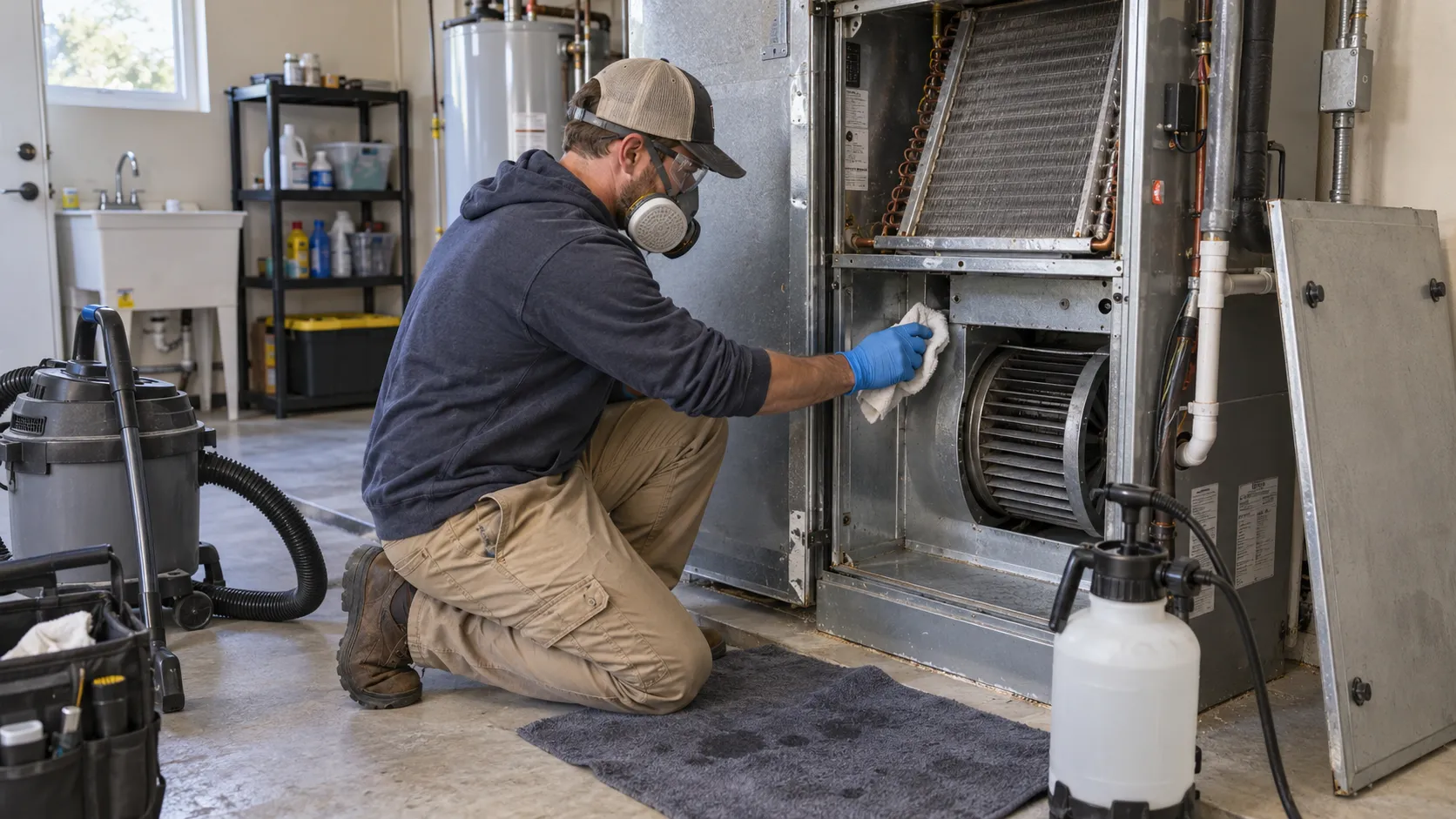
Should You Clean Your HVAC System After Mold Remediation?
You’ve remediated mold in one room of your home.
The affected materials have been removed, the area has been cleaned and the obvious source has been dealt with.
But your HVAC system has been moving air through the house the entire time.
So, should you clean your HVAC system after mold remediation too?
Sometimes, yes.
But HVAC or duct cleaning shouldn’t be an automatic add-on to every mold job. It makes the most sense when inspection, testing or the circumstances of the original problem suggest that the heating and cooling system was actually involved.
Spotless Lead Inspector Caleb Jones pays close attention to HVAC systems because of the way they connect different parts of a home through airflow.
“Mold has a really bad habit of contaminating HVAC systems naturally over time.” – Caleb Jones
That’s Caleb’s experience from inspecting mold-affected properties. It doesn’t mean every home with mold automatically has contaminated ductwork.
The question is whether your system gives you a reason to look closer.
Should You Clean Your HVAC System After Mold Remediation?
You should consider HVAC or duct cleaning after mold remediation when there’s evidence that mold or excess moisture affected the system itself.
That might include mold on appropriate HVAC components, contamination close to an air intake, moisture problems involving the air handler or coils, or other signs discovered during inspection.
What you shouldn’t do is assume:
There was mold in the bedroom, therefore every duct in the house needs cleaning.
The U.S. Environmental Protection Agency doesn’t recommend routine duct cleaning simply because ducts exist or because a home has normal household dust. It says homeowners should consider duct cleaning when there is substantial visible mold growth inside hard-surface ducts or on other heating and cooling components, among other specific circumstances.
There’s another distinction worth making:
Your HVAC system is more than your ducts.
Depending on the system, it can include:
- the air handler;
- blower components;
- cooling coils;
- drain pans and condensate systems;
- filters;
- supply and return ductwork;
- registers and grilles.
Different parts may require different professionals.
So, should you clean your HVAC system after mold remediation?
Only when the evidence suggests it was involved.
That’s a much better standard than automatically adding duct cleaning to every remediation invoice.
If someone recommends HVAC cleaning after mold remediation, ask what they actually found. A good scope should be based on evidence, not assumption.
What Signs Suggest Your HVAC System Needs a Closer Look?
When Caleb is investigating a home where the indoor environment still raises concerns, he follows the places where air moves.
“I need to look in places that the air is flowing, I need to look inside the HVAC system.” – Caleb Jones
That may be especially important if you notice:
- suspected mold on accessible HVAC components;
- mold close to a return or intake;
- ongoing condensation around the system;
- standing water around an air handler or drain pan;
- suspicious recurring growth around vents;
- musty odors that become more noticeable when the system runs;
- or testing that suggests contamination in an accessible HVAC area.
The EPA advises homeowners to investigate a system that is known or suspected to be contaminated with mold, because running a contaminated HVAC system may spread mold through the building.
But be careful not to mistake ordinary dust for evidence of a major mold problem.
Return grilles often collect dust simply because air is continually being pulled through them. EPA guidance specifically notes that normal dust around return registers doesn’t, by itself, mean the duct system needs cleaning.
That’s why inspection matters.
You want to know whether you’re looking at:
normal dust, actual mold growth, moisture damage, or something that only looks like mold.
Where there’s uncertainty, appropriate laboratory sampling may sometimes help. Caleb also sometimes uses accessible HVAC surfaces as targeted sampling locations because household air repeatedly passes through them.
We cover that distinction in more detail in indoor air quality testing after mold remediation.
If you’re seeing suspicious growth or dealing with an HVAC-related moisture issue, investigate before deciding what needs cleaning. Evidence should drive the scope.
What Does HVAC Cleaning After Mold Remediation Actually Involve?
One of the most useful things Caleb explains in the interview is that HVAC-related mold cleanup can require more than one trade.
It isn’t simply a matter of sticking a vacuum hose into the nearest vent.
1. Start with the HVAC equipment
“It begins with the HVAC system itself.” – Caleb Jones
Internal HVAC components can collect dust, condensation and debris.
Caleb works with qualified HVAC contractors when parts such as coils, blower assemblies and internal equipment need to be opened or professionally cleaned.
That matters because some HVAC work requires specialized training or licensing, and a mold-remediation technician shouldn’t pretend to be every trade at once.
2. Clean the ductwork when the evidence supports it
When duct cleaning is warranted, Caleb describes working with a contractor who places the ductwork under negative pressure and physically removes accumulated debris.
That can include ordinary household material such as:
- dust;
- pet hair;
- debris;
- and particles that may be holding contamination.
EPA guidance describes a similar basic process: professional duct cleaning typically involves specialized tools that dislodge dirt and other material before a high-powered vacuum removes it.
The negative-pressure part is important because the goal isn’t to knock debris loose and let it blow into the house.
The material needs to be controlled as it’s removed.
3. Additional treatment may follow where appropriate
Caleb also discusses coordinated sanitizing or supplemental treatment on selected projects.
But this part shouldn’t be oversold.
The EPA says homeowners should understand the benefits and limitations of chemical biocides or other treatments used inside ductwork rather than assuming they’re automatically necessary or effective in every situation. It also advises that such treatments, if used, should follow proper removal of visible dust and debris.
So the order matters:
Inspect. Physically clean. Then consider supplemental treatment where there’s a reason for it.
That process fits into the full indoor air quality process after mold remediation.
If HVAC cleaning is warranted, ask what the contractor is actually proposing to clean – the equipment, the ductwork, or both – and who is qualified to handle each part.
Why Cleaning the Ducts Alone May Not Solve the Problem
“Get the ducts cleaned” sounds reassuringly simple.
But there are several ways that approach can miss the bigger issue.
Cleaning the ducts but ignoring the HVAC equipment
If contamination is present elsewhere in the system, cleaning only one section may not be enough.
EPA guidance warns that failure to clean a contaminated system comprehensively can allow an uncleaned component to re-contaminate the rest of the system.
Treating dirty ductwork before physically cleaning it
Caleb makes this point particularly clearly:
“If you have a high layer of dust and debris and there are mold spores trapped underneath that dust and debris, then the fog material has limitations.” – Caleb Jones
A treatment that works on contact can’t reliably act on contamination buried beneath layers of dust.
That’s why physical cleaning comes first.
It’s the same principle behind the wider whole-home mold treatment process.
Cleaning everything without fixing the water
This may be the most expensive mistake.
If mold developed because a cooling coil, clogged condensate drain, humid attic or another moisture source remained wet, cleaning the system without fixing that condition simply resets the clock.
The EPA is explicit that if the conditions allowing mold growth aren’t corrected, the mold is likely to return.
Don’t pay for duct cleaning as an isolated add-on if nobody has explained why mold was there or checked the rest of the HVAC system.
Moisture Control Matters More Than Repeated HVAC Cleaning
When Caleb sees mold around vents or HVAC equipment, one of his first questions is why moisture is present there.
That can lead well beyond the duct itself.
He’s encountered Kentucky homes where mold or moisture around HVAC areas was connected with broader condensation, insulation or ventilation conditions.
That matters because mold around a vent doesn’t automatically mean:
Every duct in the home is full of mold.
But it does mean the moisture deserves an explanation.
HVAC systems naturally involve temperature differences.
Warm, humid air meeting a colder surface can create condensation. Drain pans and condensate lines need to move water away properly. Insulation around ducts and equipment needs to be in suitable condition.
EPA guidance identifies moisture control as the key to preventing biological growth within HVAC systems and recommends paying attention to coils, drain pans, insulation, leaks and condensation.
Caleb also discusses HVAC care as part of longer-term maintenance:
“Maintaining HVAC systems with cleanings and duct cleanings and different things like that and including that in their maintenance plan over the several years.” – Caleb Jones
That doesn’t mean every homeowner should schedule duct cleaning at a fixed interval.
The EPA doesn’t recommend routine duct cleaning on a predetermined timetable. Instead, the decision should depend on the condition of the system.
A better approach is:
Inspect → maintain → correct moisture → clean when evidence says cleaning is needed.
And after a mold project, HVAC cleaning is only one part of the bigger picture. Detailed post-remediation cleaning may also matter depending on the extent of contamination.
If mold keeps appearing around vents after cleaning, don’t automatically schedule another duct cleaning. Check condensation, drainage, insulation, humidity and the HVAC equipment itself.
When HVAC or Duct Cleaning Probably Isn’t Necessary
A thorough mold company should also be comfortable telling you when not to buy something.
There are plenty of mold projects where HVAC cleaning may not be necessary.
For example:
- the mold was small and tightly localized;
- appropriate containment kept the work controlled;
- there’s no evidence the HVAC system was involved;
- the moisture problem had nothing to do with the system;
- and inspection finds no suspicious contamination within accessible HVAC components.
EPA guidance says routine duct cleaning is probably unnecessary when there’s no evidence of significant dust or mold contamination. It also points out that a light amount of ordinary dust inside ducts hasn’t been shown to create a health problem by itself.
There’s also a special case worth knowing about.
If insulated duct material itself becomes wet and moldy, EPA says that insulation cannot be effectively cleaned and should be removed and replaced rather than simply vacuumed and treated.
Again, the right answer depends on what is actually there.
Caleb says something similar when talking more broadly about indoor-air-quality equipment:
“I wish I could be just a perfect cure-all for everyone.” – Caleb Jones
There isn’t one remediation add-on that every home needs.
If your project calls for professional mold remediation in Lexington, Spotless’ goal is to investigate the pathways that were genuinely involved and build the scope around the house in front of us.
Thorough remediation doesn’t mean making every job bigger. It means dealing properly with the parts of the property that actually need attention.
Clean the HVAC System When the Evidence Says It Needs Cleaning
So, should you clean your HVAC system after mold remediation?
Sometimes.
If mold or moisture affected the air handler, coils, ductwork or other HVAC components, cleaning those parts may be an important part of restoring the indoor environment.
But routine duct cleaning after every mold job isn’t necessary.
The better sequence is:
Inspect the system.
Confirm whether contamination is present.
Clean the components that actually need cleaning.
Correct the moisture problem.
Then maintain the system going forward.
And if the HVAC system is known or strongly suspected to contain mold, don’t simply keep running it and hope the filter takes care of everything. EPA guidance warns that operating a contaminated system may spread mold through the building.
For homeowners in Lexington and Central Kentucky, Spotless can assess how your HVAC system fits into the wider mold problem and coordinate qualified HVAC or duct-cleaning professionals where the evidence shows they’re needed.
Clean what’s contaminated. Fix what made it wet. Don’t pay to clean what didn’t need cleaning in the first place.
Spotless is the most trusted name in restoration in central Kentucky including Lexington, Nicholasville and surrounding communities.
Specializing in health-focused mold remediation and water damage restoration, we leave mold-affected clients with a healthier home.
Call 859-459-0424 and speak to a technician today!