
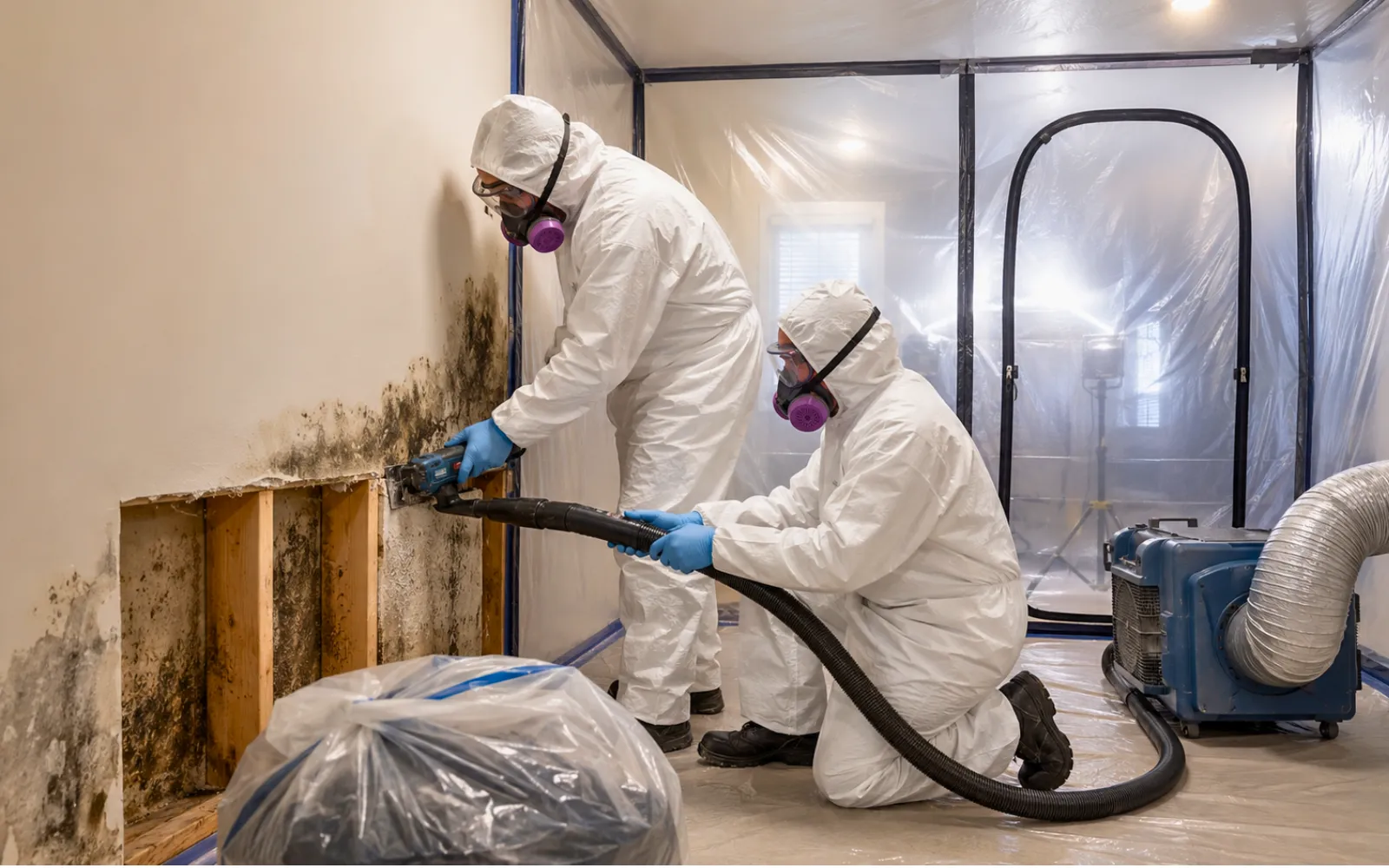
Whole-Home Mold Detox: What Professional Air and Surface Treatment Can Do
If you’ve been researching mold exposure, mycotoxins or more thorough remediation methods, you may have come across the term “whole-home mold detox.”
It can sound a little vague.
What exactly are you detoxing?
At Spotless, we use the term to describe environmental cleanup of the home. We’re not talking about detoxifying someone’s body, diagnosing mold illness or promising a particular health outcome.
Those are medical questions for an appropriately qualified healthcare professional.
What we are talking about is taking a broader look at the environment after mold contamination: the source itself, the air, settled dust and debris, surfaces, and – in the right circumstances – the HVAC system.
Spotless Lead Inspector Caleb Jones describes the logic this way:
“We have to treat the entire house as an envelope and the HVAC system has to be treated as an envelope.” – Caleb Jones
That doesn’t mean every patch of mold requires every possible treatment.
But when contamination is more extensive, a whole-home mold detox may involve much more than cutting out the visible mold and calling the job finished.
Whole-Home Treatment Starts With Removing the Mold Source
Let’s start with what whole-home mold treatment isn’t.
It isn’t fogging over active mold and hoping it disappears.
It isn’t running an air purifier while a pipe continues leaking behind the wall.
And it isn’t spraying something over mold-contaminated materials that really need to be removed.
A thorough process starts with the actual mold and the moisture that allowed it to grow.
The U.S. Environmental Protection Agency puts this very simply: if mold is present, you need to clean up the mold and fix the water problem. The EPA also points out that simply killing mold isn’t enough, because dead mold still needs to be removed.
That principle matters because some treatments sound much easier than remediation.
A fogging treatment can be quick.
An air purifier is easy to plug in.
But neither one can replace removing contaminated material when removal is necessary.
Caleb is very clear about that when he talks about the treatment products Spotless uses:
“The fog material has limitations. It’s not a silver bullet, it’s not a perfect cure all.” – Caleb Jones
That’s the difference between a product and a remediation plan.
A product has one job.
A remediation plan asks what caused the problem, what needs removing, where contamination may have traveled and what needs to happen afterward.
Proper whole-home mold detox work therefore begins with remediation of the source before attention shifts to the surrounding air and surfaces.
You can see how that fits into the full process for improving indoor air quality after mold remediation.
For active mold problems, Spotless also provides professional mold remediation in Lexington.
If someone is offering to “detox” your house without first asking where the mold is or why it grew, they’re starting at the wrong end of the problem.
Air Treatment and Surface Cleaning Do Different Jobs
One of the easiest mistakes to make is thinking that treating the air automatically takes care of the rest of the house.
It doesn’t.
Airborne particles and settled particles require different approaches.
Air treatment deals with what’s moving
During mold remediation, Spotless may use professional HEPA air scrubbers to repeatedly cycle air through filtration.
The goal is to capture airborne particles that reach the filter rather than allowing them to continue circulating through the controlled environment.
This is especially important while mold-contaminated materials are being disturbed.
Air movement is also controlled through containment and, on appropriate jobs, negative pressure.
But once particles settle onto a surface, they’re no longer simply an air-filtration problem.
Surface cleaning deals with what has landed
Dust, debris and mold particles can settle onto flooring, furniture and other surfaces.
That’s where HEPA vacuuming and detailed physical cleaning come in.
In more extensive or mycotoxin-focused projects, Caleb may also recommend what Spotless refers to as small-particle cleaning.
“A small particle cleaning afterwards… is getting as much dust and debris and stuff out of the property as possible.” – Caleb Jones
That explanation is important because it strips away some of the mystery around “detox.”
A lot of the process comes down to being extremely thorough about removing contamination and debris from the indoor environment.
The EPA says more than 200 mycotoxins produced by common molds have been identified, while also warning that you can’t determine whether a particular mold is producing mycotoxins simply by looking at it.
So we don’t make assumptions based on color alone, and we don’t claim that every mold problem is automatically a mycotoxin problem.
What we can do is approach the building carefully when a homeowner has legitimate concerns about environmental contamination.
If you want to understand the air-filtration side in more detail, read what pulls mold spores out of the air.
For more extensive contamination, ask whether the remediation plan addresses both what’s moving through the air and what has already settled onto surfaces. One doesn’t automatically solve the other.
Where Fogging Fits Into a Whole-Home Mold Treatment
Fogging is probably one of the most misunderstood parts of mold remediation.
Some companies present it as if fogging alone can solve an entire mold problem.
That isn’t how Spotless approaches it.
Caleb describes fogging as one part of a larger treatment process, and Spotless has developed a two-stage approach on appropriate projects.
After the controlled remediation and cleaning work, technicians can move through the home using a handheld fogging system that gives them control over where the treatment is applied.
Spotless may then set up additional equipment that continues treatment overnight before being collected the following day.
The key phrase there is after the remediation and cleaning work.
Fogging can supplement a thorough mold project.
It can’t replace source removal.
It can’t repair a plumbing leak.
It can’t remove mold-covered drywall.
And it can’t guarantee a permanently sterile house.
Caleb’s own wording is the best way to keep expectations realistic:
“It’s not a silver bullet, it’s not a perfect cure all.” – Caleb Jones
That honesty matters.
Even contact-based treatments have limitations. Caleb points out that if a surface or duct contains a significant amount of dust and debris, contamination may be sitting underneath that material.
A fogging product can only act on what it actually reaches.
That’s another reason physical cleaning has to come first.
The EPA also says routine use of biocides isn’t generally necessary during mold remediation and notes that sterilizing an indoor environment isn’t the objective.
Normal indoor environments will always contain some mold spores.
If you want to learn more about how Spotless uses this type of treatment responsibly, see our mold fogging in Lexington service.
Fogging can be a useful supporting tool when it has a specific job inside a broader remediation plan. Be wary of anyone selling it as the entire solution to active mold growth.
Why the HVAC System Can Become Part of Whole-Home Cleanup
A house doesn’t consist of completely isolated rooms.
Air moves.
Your heating and cooling system pulls air from parts of the home, moves it through the system and redistributes it elsewhere.
That’s why Caleb pays particular attention to HVAC systems when the evidence suggests they may be involved.
“Mold has a really bad habit of contaminating HVAC systems naturally over time.” – Caleb Jones
Spotless doesn’t automatically tell every homeowner that their entire duct system needs cleaning.
There should be a reason.
But if mold is found near the HVAC system, inspection identifies contamination, or musty odors appear when the system operates, ignoring that pathway may leave part of the problem untouched.
On jobs where HVAC cleaning is appropriate, Caleb coordinates with qualified contractors.
Internal components that require licensed HVAC work can be handled by an HVAC professional.
Duct-cleaning contractors may then place ductwork under negative pressure and physically remove accumulated dust, debris, pet hair and other material.
That cleaning can be especially important before additional treatment.
As Caleb explains, contact-based treatments have limitations if the contamination you’re trying to reach is buried underneath dirt and debris.
So again, the order matters.
Clean first. Treat second.
The EPA similarly advises homeowners to investigate HVAC systems known or suspected to contain mold because running a contaminated system can potentially distribute contamination through the building.
We’ll cover this in more detail in whether your HVAC should be cleaned after mold remediation.
If mold was discovered close to your HVAC system, musty odors appear when it starts running, or inspection suggests contamination inside it, include the HVAC pathway in the cleanup conversation rather than treating each room as an isolated box.
What Changes When Mycotoxins Are a Particular Concern?
Some people who contact Spotless aren’t simply trying to deal with a visible patch of mold.
They may already have spent months researching mold exposure, working with healthcare professionals or trying to understand whether the indoor environment needs more thorough cleaning.
We get why those clients want detail.
But we also need to be precise about what remediation can and can’t claim.
Some molds can produce mycotoxins under certain environmental conditions. Not all molds do, and you can’t determine whether a colony is producing mycotoxins simply because it’s dark or because someone calls it “toxic mold.”
Spotless’ responsibility is the building environment.
We can inspect for mold, remediate contamination, address air quality, clean surfaces and help homeowners control the conditions that allow mold to grow.
We don’t diagnose mycotoxin illness or promise that remediation will cure a health condition.
When mycotoxins are a particular environmental concern, though, Caleb says Spotless may use a more detailed process.
“Especially in the mycotoxin situation… our full mold treatment, the air quality treatments that we apply, and then a small particle cleaning afterwards.” – Caleb Jones
That can mean:
- remediating the actual mold source;
- controlling airborne contamination;
- applying appropriate air-quality treatments;
- cleaning settled particles and debris;
- and leaving the homeowner with a plan for ongoing cleaning and moisture control.
That’s the sense in which whole-home mold detox makes sense as a term.
We’re trying to reduce and remove environmental contamination as thoroughly as reasonably possible.
We’re not claiming to medically detox a person.
For more on the physical cleanup after removal, see what post-remediation cleaning should include.
If mycotoxins are part of your concern, tell the remediation company before the scope is written. A health-focused project may require a more detailed environmental-cleaning plan than a straightforward localized mold removal.
Whole-Home Cleanup Still Ends With Moisture Control
There’s a point at which the remediation company has done its part and the homeowner takes over again.
The mold source has been addressed.
Air and surfaces have been treated and cleaned as required.
The HVAC system has been evaluated where appropriate.
Then the job becomes maintenance.
Caleb puts the goal very simply:
“You’re not gonna prevent mold spores from coming in, but you can prevent mold from colonizing.” – Caleb Jones
That distinction should take a lot of pressure off homeowners.
You don’t need to create a permanently sterile house.
You couldn’t even if you tried.
Mold spores naturally exist outdoors and enter homes through doors, windows, clothing, pets and ordinary airflow.
The goal is to stop those spores from finding the conditions they need to establish significant indoor growth.
That means:
- controlling humidity;
- responding quickly to leaks;
- keeping HVAC equipment maintained;
- periodically checking attics, crawl spaces and basements;
- keeping dust under control;
- and fixing water intrusion instead of repeatedly cleaning the mold it causes.
The EPA makes the same point: mold spores can’t be completely eliminated from indoor environments, but they generally won’t grow without sufficient moisture.
So a responsible whole-home cleanup shouldn’t promise that you’ll never encounter another mold spore.
It should reduce abnormal contamination and help you stop creating the conditions that allow mold to colonize again.
A thorough cleanup should leave you with more than a clean house for one day. Spotless can help you understand what humidity, water and maintenance issues need attention so you’re less likely to repeat the same problem.
Whole-Home Mold Detox Is a Process, Not a Product
So what does whole-home mold detox actually mean?
It isn’t one fogging treatment.
It isn’t one air purifier.
And it definitely isn’t a medical claim about detoxifying your body.
Done responsibly, it’s a broader environmental-cleanup process that may involve:
source remediation → HEPA air filtration → detailed surface cleaning → HVAC assessment where needed → supplemental treatment → moisture control
The exact combination depends on the house.
A small, localized mold problem doesn’t need to be turned into a whole-home project just for the sake of selling more work.
But when contamination is more extensive – particularly when a homeowner is concerned about spores, settled debris, HVAC involvement or mycotoxins – the wider environment deserves attention.
That’s where Spotless’ health-focused approach is different.
The goal isn’t to promise you a sterile home. It’s to deal thoroughly with the mold problem you actually have and leave you with a cleaner environment and a practical plan for keeping it that way.
Spotless is the most trusted name in restoration in central Kentucky including Lexington, Nicholasville and surrounding communities.
Specializing in health-focused mold remediation and water damage restoration, we leave mold-affected clients with a healthier home.
Call 859-459-0424 and speak to a technician today!