
Indoor Air Quality Testing After Mold Remediation: Is It Worth It?
The containment is down. The damaged materials are gone. The remediation crew has finished cleaning.
Now comes the question that can be harder to answer:
How do I know it actually worked?
Indoor air quality testing after mold remediation can be useful, particularly when there’s a specific reason for testing or you want independent verification of a larger project. But one air sample shouldn’t be treated as a universal pass/fail test for your entire home.
A good post-remediation assessment looks at the building first.
Was the moisture source corrected? Is the remediated area visibly clean? Are materials dry? Is there still a musty odor? Does targeted sampling add useful information?
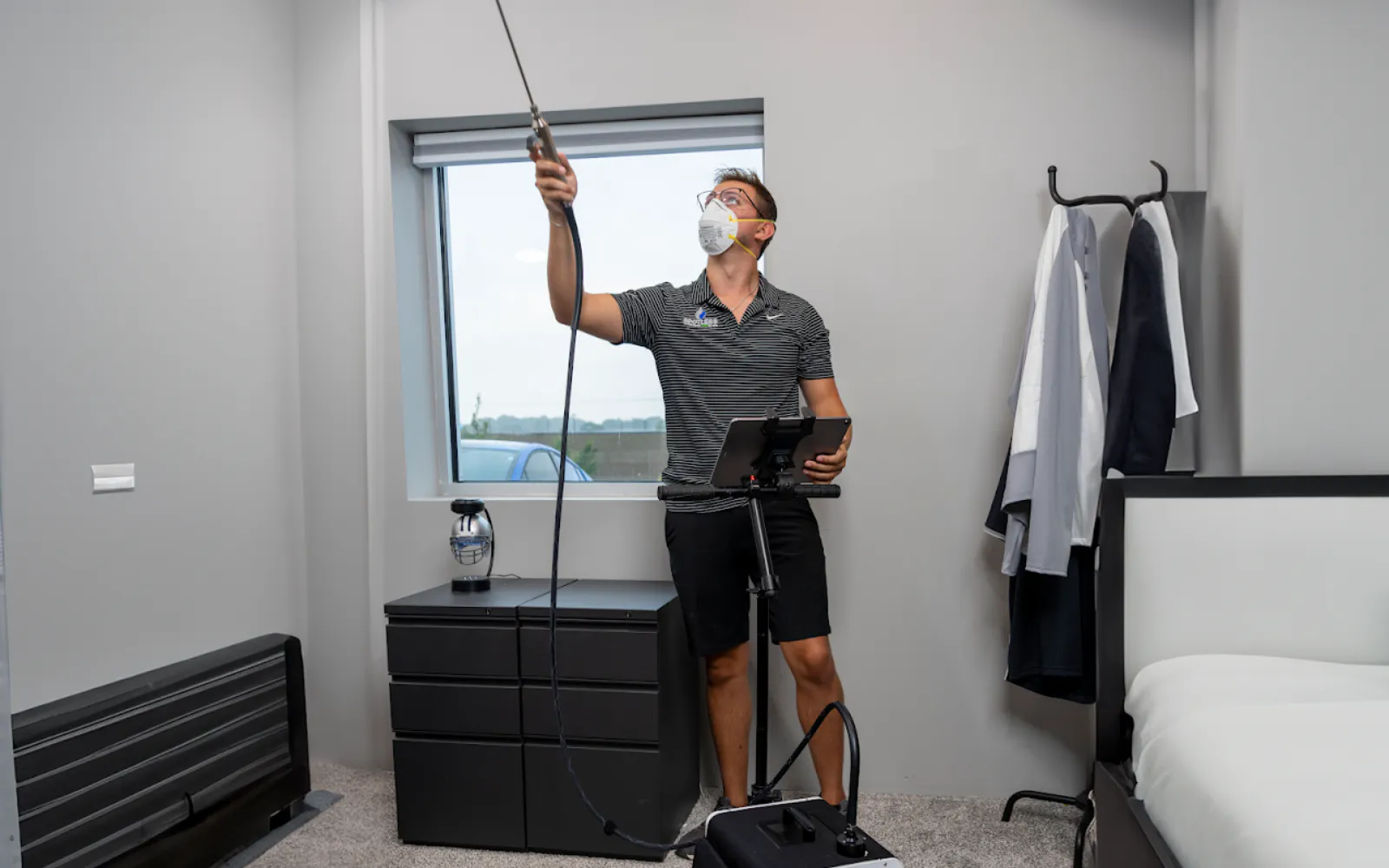
Spotless Lead Inspector Caleb Jones regularly combines what he can observe in the building with laboratory evidence where it makes sense.
“I prefer to approach it logically and either logic my way through it or use laboratory testing to kind of show them evidence.” – Caleb Jones
That’s the right way to think about post-remediation testing.
The test should answer a question. It shouldn’t replace the investigation.
Is Indoor Air Quality Testing After Mold Remediation Worth It?
Sometimes, absolutely.
Testing may be particularly worthwhile after a more extensive remediation project, where there was HVAC involvement, where an independent remediation protocol calls for clearance, or when a homeowner wants another layer of objective information before moving forward.
But there’s an important distinction between useful verification and trying to prove that a building is completely “mold-free.”
The U.S. Environmental Protection Agency says there are no federal threshold limits for airborne concentrations of mold or mold spores. That means there isn’t one EPA number that every home must fall below in order to officially “pass.”
Where post-remediation air sampling is used, EPA guidance says the types and concentrations of mold found indoors should generally be similar to those found in the local outdoor air after cleanup is complete.
That’s useful context – but it still needs professional interpretation.
Why does this matter so much to homeowners? The EPA reports that people spend around 90% of their time indoors on average.
If you’ve just invested in remediation, it makes sense to want confidence in the environment you’re returning to.
Caleb understands why the invisible part can be unsettling:
“The air quality… it’s typically an invisible problem.” – Caleb Jones
The value of indoor air quality testing after mold remediation therefore depends on whether the sampling is answering a useful question – and whether those results are being interpreted alongside what actually happened in the building.
If post-remediation testing is important to you, bring it up before remediation starts. That way everyone knows what will be inspected, what may be sampled and how completion will be evaluated.
Why an Air Sample Isn’t a Simple Pass/Fail Test
It would be reassuring if mold testing worked like a smoke detector.
Run the test. Get a number. Pass or fail.
Mold air sampling isn’t that simple.
The myth: “A negative air test means the house is mold-free.”
A short-duration air sample captures particles that happened to pass through the sampling device during a specific period of time.
Conditions can change.
Someone walks across the room. The HVAC turns on. Humidity shifts. Outdoor mold levels change. Dust is disturbed.
EPA guidance specifically says air sampling provides information about what was in the air at the moment sampling took place. Factors including humidity, activity levels, temperature and barometric pressure can substantially change measured spore levels.
That’s very close to how Caleb explains the practical limitation:
“You are a little bit taking a gamble if the mold spores go through that filter capture at the right time.” – Caleb Jones
He’s not saying air testing is worthless.
Spotless uses air sampling in appropriate situations.
The point is that timing and location matter, which means one short sample shouldn’t make the rest of the building disappear from the investigation.
NIOSH makes a similar distinction. It doesn’t recommend routine mold air sampling for general building air-quality evaluations and notes that very short-term samples – particularly negative findings – may not accurately represent actual conditions. It also says short-term mold counts can’t be interpreted directly as measures of health risk because there are no health-based standards for indoor airborne mold concentrations.
That’s why indoor air quality testing after mold remediation should support a wider evaluation, not replace it.
If you’re wondering what may still be moving through the environment after cleanup, read how long mold spores can remain airborne after cleaning.
Be cautious if someone promises that one short air sample can certify an entire house as completely “mold-free.” Ask what else they’re evaluating alongside the laboratory result.
What Should Be Checked Before Anyone Starts Sampling the Air?
Before worrying about a spore count, look at the building.
Post-remediation verification should begin with some fairly basic questions:
- Was the original water or moisture source actually corrected?
- Has visible mold been removed?
- Are previously wet materials now dry?
- Is the remediated area visibly clean?
- Is there still a moldy or musty odor?
- Were contaminated materials properly cleaned or removed?
- Are there unresolved concerns in nearby rooms or the HVAC system?
EPA remediation guidance puts moisture control at the center of evaluating whether the work succeeded. It says the water or moisture problem needs to be completely fixed and that visible mold, mold-damaged materials and moldy odors shouldn’t remain after successful cleanup.
Caleb makes the same point from his day-to-day work:
“Humidity control and moisture control are so important in making sure that mold doesn’t have an environment to set up anymore.” – Caleb Jones
This is where homeowners can sometimes put too much weight on laboratory testing.
A beautiful lab report doesn’t repair a leaking bathtub.
If drywall is still visibly moldy or the wall cavity is still wet, you don’t need an air test to tell you that the remediation isn’t finished.
Testing becomes more valuable once the actual remediation questions have been answered.
That’s also why we look at the full indoor air quality process after mold remediation rather than treating sampling as the entire process.
Before paying for another mold test, make sure the fundamentals have been dealt with. If the water source is still active or visible contamination remains, the test isn’t the next problem to solve.
Air Samples vs. Surface Swabs: What Can Each Tell You?
Different sampling methods answer different questions.
That’s why the right starting point isn’t:
Which mold test is best?
It’s:
What are we trying to find out?
| Air sampling | Surface/swab sampling |
| Samples airborne particles during the collection period | Samples a specific physical location |
| May help compare indoor and outdoor conditions | Can investigate a targeted suspicious surface |
| Can vary depending on airflow, activity and timing | Only tells you about the location sampled |
| May be useful in selected post-remediation situations | May help determine whether a surface has been adequately cleaned |
Caleb sometimes prefers targeted swab testing in accessible areas of an HVAC system because he knows household air repeatedly travels through that location.
“I prefer swab testing on the interior of the HVAC system where it’s accessible.” – Caleb Jones
His reasoning is practical.
With a short-duration air sample, he’s waiting for airborne particles to pass through the collection device during the sampling window.
With an accessible HVAC surface, he’s examining a place that the home’s air repeatedly encounters.
That doesn’t make swab testing universally “better.”
An HVAC swab won’t tell you what’s happening everywhere else in a home, just as an air sample can’t tell you what’s hidden inside every wall cavity.
EPA guidance says surface sampling can be useful for assessing whether an area has been adequately cleaned or remediated. It also recommends that mold sampling be designed and interpreted by people with specific experience in sampling protocols and result interpretation.
If HVAC contamination is part of the concern, we’ll also cover whether your HVAC should be cleaned after mold remediation separately.
Good mold testing starts with the question, not the test kit. Decide what you’re trying to verify first, then choose the method capable of providing useful evidence.
Should the Company That Did the Remediation Also Clear Its Own Work?
This is a question homeowners don’t always think to ask.
If a mold-remediation company performs the work and then performs the formal clearance inspection that determines whether its own work passed, there’s an obvious potential conflict.
Spotless Co-Owner Paul Craig has been very clear about the company’s position:
“We find an ethical problem clearing ourselves.” – Paul Craig
Spotless can perform mold inspection and sampling before remediation. It can also perform testing in situations where it wasn’t responsible for the remediation itself.
But where formal post-remediation clearance of Spotless’ own project is important, the cleaner approach is to bring in an appropriately qualified independent party.
That way, the company doing the work isn’t simply grading its own homework.
Independent post-remediation verification can make particular sense where:
- an independent remediation protocol already exists;
- the project was large or complicated;
- an industrial hygienist or other consultant is involved;
- an insurer or other party requests particular documentation;
- or the homeowner simply wants separation between remediation and clearance.
That doesn’t mean third-party testing is automatically required after every small residential mold project.
The appropriate level of verification depends on the situation.
But when independent testing matters, independence should actually mean independence.
Spotless’ professional mold remediation in Lexington is built around completing the physical work thoroughly, not finding a convenient way to award ourselves a passing grade afterward.
If independent clearance matters to you, include it in the plan before work starts. Spotless is comfortable having remediation independently evaluated where that’s appropriate.
When Post-Remediation Testing Is Most Worth Considering
Not every mold job needs exactly the same verification process.
There are, however, situations where testing may provide considerably more value.
The remediation was extensive
If mold affected several rooms, involved hidden cavities or required significant containment, post-remediation verification may provide an extra layer of information.
The HVAC system was involved
When contamination may have interacted with the heating and cooling system, targeted inspection or sampling may help answer specific questions about what remains.
An independent protocol requires clearance
If an industrial hygienist or another independent professional developed the remediation protocol, that protocol may also define how the finished project should be evaluated.
Something still seems wrong afterward
Maybe the musty odor hasn’t gone.
Maybe moisture is still showing up.
Maybe there’s another area of the house that was never fully investigated.
Caleb’s instinct in those situations is to keep investigating the physical environment:
“I need to look in places that the air is flowing, I need to look inside the HVAC system, I need to look in the basement, the attic.” – Caleb Jones
That’s an important distinction.
Testing shouldn’t become a way of ignoring what the building is telling you.
NIOSH says visual inspections and detecting musty odors are often more reliable for identifying indoor mold problems than routine air sampling.
So if a home still smells moldy after remediation, don’t keep running air samples until one produces a reassuring number.
Investigate why the odor remains.
The same applies to incomplete cleaning. Our guide to what post-remediation cleaning should include covers what may need to happen after the source material comes out.
If your home still has a moisture problem, visible concern or continuing musty odor after remediation, don’t use testing as a substitute for investigation. Find out what the building is telling you first.
Testing Can Add Confidence, But It Doesn’t Replace Good Remediation
So, is indoor air quality testing after mold remediation worth it?
It can be.
Testing can provide another layer of evidence, help answer specific questions and – in the right circumstances – give homeowners the benefit of independent post-remediation verification.
But a test result needs context.
The strongest approach is:
A useful question.
The right sampling method.
Qualified interpretation.
A proper physical inspection.
And underneath all of that, the remediation itself still has to be done correctly.
The moisture source needs to be addressed.
Contaminated materials need to be properly removed or cleaned.
The area should be dry.
Visible mold and moldy odors shouldn’t remain.
Testing can help verify good remediation. It can’t turn incomplete remediation into good remediation.
If you’re in Lexington or elsewhere in Central Kentucky and you’re planning mold remediation, Spotless can help you understand the inspection, remediation and verification process before the work begins – so you aren’t left trying to figure out what “done” is supposed to mean after the crew has already packed up.
Spotless is the most trusted name in restoration in central Kentucky including Lexington, Nicholasville and surrounding communities.
Specializing in health-focused mold remediation and water damage restoration, we leave mold-affected clients with a healthier home.
Call 859-459-0424 and speak to a technician today!