
How Long Do Mold Spores Stay in the Air After Cleaning?
You cleaned the mold. The visible patch is gone. Everything looks normal again.
But then comes the thought that can be much harder to shake: What happened to all the mold I couldn’t see? Is it still floating around the house?
If you’re wondering how long mold spores stay in the air after cleaning, there isn’t one reliable number of hours or days that applies to every home.
Some airborne spores will eventually settle onto surfaces. But air movement, your HVAC system, fans, foot traffic and even ordinary household activity can disturb settled particles and send them airborne again. What happens after cleaning also depends heavily on how the mold was cleaned, whether suitable filtration was used and, most importantly, whether the mold and moisture source were actually dealt with.
That’s why professional mold remediation doesn’t involve simply wiping down a surface and waiting for the air to clear.
- So, How Long Do Mold Spores Stay in the Air After Cleaning?
- What Determines How Long Mold Spores Remain Airborne?
- What Actually Removes Mold Spores From the Air?
- Why “The Spores Have Settled” Doesn’t Mean the Cleanup Is Finished
- The Bigger Question: Is Something Still Producing Mold Spores?
- Don’t Wait for Mold Spores to “Disappear”
So, How Long Do Mold Spores Stay in the Air After Cleaning?
There’s no universal mold-spore countdown.
The behavior of airborne fungal particles depends on their size, weight, surrounding airflow and the conditions inside the building. In completely still air, particles will gradually settle. Real houses, though, don’t have completely still air.
Heating and cooling systems run. Doors open. People walk through rooms. Fans turn on. Dust gets disturbed.
To give some perspective, the CDC notes that spores from Aspergillus fumigatus are approximately 2–3.5 micrometers in diameter and have an estimated settling velocity of around one meter per hour in still air. In moving air currents, however, those spores can remain airborne much longer.
CDC – Environmental Infection Control: Air
That figure shouldn’t be interpreted as a rule for every type of mold or every house. It simply illustrates why telling a homeowner, “All the spores will be gone after six hours,” isn’t realistic.
And there’s another complication: you can’t watch individual spores floating around your living room.
“The human eye can’t see individual spores.”
Caleb Jones
That’s part of what makes the question so frustrating. The wall may look clean while you have no obvious way of knowing what happened in the surrounding air.
For indoor air quality after mold cleanup, waiting for particles to settle isn’t the same thing as removing them.
If you’ve cleaned visible mold but don’t know what happened to the surrounding air, dust or moisture source, don’t rely on a timer. Make sure the actual mold problem was addressed.
What Determines How Long Mold Spores Remain Airborne?
When people ask how long mold spores stay in the air after cleaning, the cleaning method matters just as much as the clock.
Air movement
A room with active HVAC airflow behaves differently from a sealed room with little air movement.
Spores and contaminated dust that have landed on surfaces may also be disturbed again by vacuuming, sweeping, moving furniture or simply walking through the area.
The EPA notes that mold spores exist both in the air and on surfaces and that some types can become airborne when disturbed.
How the mold was removed
Cleaning mold can itself disturb contamination.
Scrubbing, cutting drywall or pulling contaminated materials apart without proper controls can send particles into the surrounding environment.
That’s one reason Spotless puts so much emphasis on containment during remediation.
“You do not want to release more particles or contained mold or anything like that into the air whenever you’re doing your job.”
Caleb Jones
Depending on the project, professional remediation may involve physical containment and negative air pressure to help control where air and disturbed particles move while work is taking place.
Whether filtration is running
Professional air scrubbers don’t simply wait for particles to fall out of the air. They actively cycle air through filtration.
That gives airborne particles repeated opportunities to be captured.
Whether there’s still active mold
This may be the biggest distinction of all.
If mold remains behind drywall, inside a cavity, around an HVAC component or anywhere else with an unresolved moisture problem, you’re not simply dealing with leftover spores from yesterday’s cleaning.
You may still have a source producing additional contamination.
That’s why how long mold spores stay airborne after cleaning becomes a secondary question if the actual mold colony was never properly removed.
You can also read more about whether an air purifier can actually help with mold.
If a large area of mold was cleaned without containment or appropriate air control, Spotless can help determine whether the problem warrants a more thorough assessment.
What Actually Removes Mold Spores From the Air?
Waiting isn’t a remediation technique.
On professional mold projects, Spotless uses several methods to actively reduce airborne and settled contamination.
1. HEPA vacuuming captures particles during cleaning
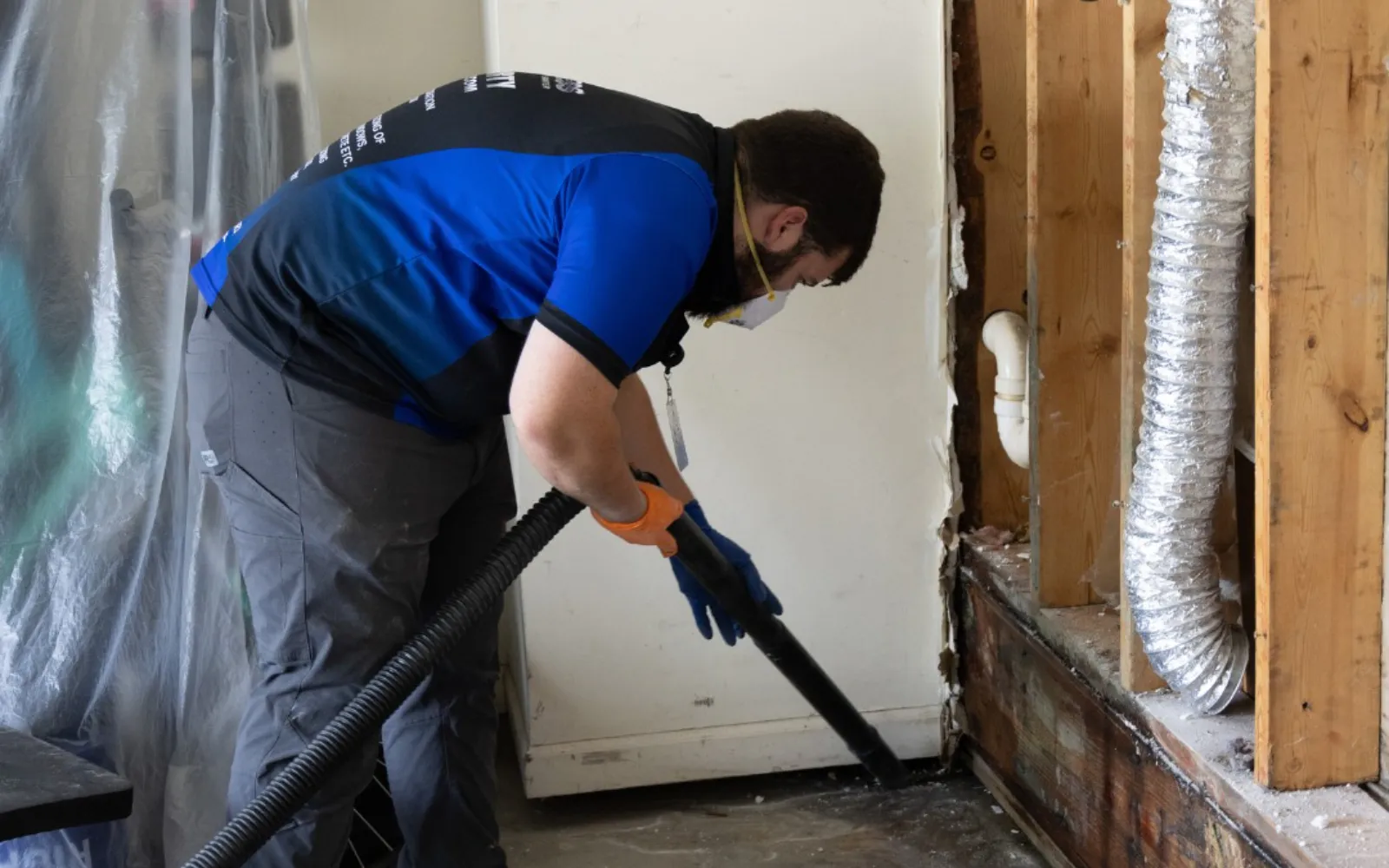
Caleb describes HEPA-filtered vacuums being used directly on surfaces during the remediation process.
“You’re pulling spores in, capturing them on the HEPA filter in the vacuum.”
Caleb Jones
The aim is simple: instead of disturbing material and allowing it to move somewhere else, capture it as part of the cleaning process.
2. Air scrubbers repeatedly filter room air
Professional air scrubbers work continuously within the controlled area, pulling air through HEPA filtration and returning filtered air to the space.
That can continue well beyond one pass through the machine.
“It’s just a continuous cycle. Many times you’ll run those for several days in an environment.”
Caleb Jones
That doesn’t mean “mold spores always stay airborne for several days.”
It means Spotless may keep professional filtration operating for several days on certain jobs because cleaning indoor air is a process, not a stopwatch exercise.
Our guide to what pulls mold spores out of the air goes deeper into HEPA filtration, air scrubbers and negative pressure.
3. Settled contamination still needs cleaning
If a mold spore lands on a tabletop, floor or piece of furniture, it hasn’t magically ceased to exist because it’s no longer airborne.
That’s where detailed cleaning becomes important.
Depending on the extent of the original contamination, remediation may include HEPA vacuuming and detailed surface cleaning to physically remove settled dust and particles rather than allowing them to be stirred up again later.
4. The mold source needs to be removed
None of the above compensates for an active mold colony.
Air scrubbers deal with particles in the air.
HEPA vacuums help capture contamination during cleaning.
Neither repairs the roof leak, failed plumbing connection or humidity problem that allowed mold to grow.
That broader relationship is covered in our guide to improving indoor air quality after mold remediation.
If the goal is cleaner air after mold removal, look for a remediation process that combines source control, detailed cleaning and filtration – not one that simply removes visible material and waits for the dust to settle.
Why “The Spores Have Settled” Doesn’t Mean the Cleanup Is Finished
Imagine you clean mold from an affected area on Monday.
By Tuesday, the air looks perfectly clear.
Of course it does. You couldn’t see individual mold spores in the first place.
Meanwhile, particles and ordinary household dust may have settled onto nearby flooring, furniture and contents.
Then someone moves a box.
The HVAC comes on.
The room gets vacuumed.
Some of that settled material may become airborne again.
That’s one reason professional post-remediation cleaning focuses on more than whatever happens to be floating through the room at a particular moment.
Caleb takes an especially broad view when the original contamination warrants it:
“We have to treat the entire house as an envelope and the HVAC system has to be treated as an envelope.”
Caleb Jones
That statement needs some context.
It doesn’t mean every tiny patch of bathroom mold calls for whole-home treatment. The response should match the extent of the problem.
But if mold contamination has spread beyond one isolated surface, or the HVAC system appears to be involved, then thinking only about the original visible patch can leave part of the problem unaddressed.
That’s also why the question “How long do mold spores stay in the air after cleaning?” isn’t quite enough on its own.
You also need to ask where those particles may have settled and whether the cleanup accounted for them.
If a significant mold-remediation project ended as soon as the visible material came out, ask what was done about airborne and settled contamination around the work area.
The Bigger Question: Is Something Still Producing Mold Spores?
It’s easy to become focused on the spores themselves.
But if you want to know whether a mold problem has actually been resolved, start further upstream.
Ask:
- Was the moisture source identified?
- Was it repaired?
- Was contaminated material properly removed or cleaned?
- Was the work area contained when necessary?
- Was suitable filtration used?
- Is there still a musty odor?
- Has mold started returning?
- Could an HVAC or hidden-building area be involved?
- Is the home still experiencing elevated humidity or recurring condensation?
Mold needs moisture to establish and grow indoors. The EPA describes moisture control as the key to mold control.
That matches what Caleb sees in the field:
“Humidity control and moisture control are so important in making sure that mold doesn’t have an environment to set up anymore.”
Caleb Jones
Reducing the number of airborne mold spores today doesn’t guarantee you’ll never have mold again.
If a crawl space remains damp, a pipe keeps leaking or condensation keeps forming around an HVAC system, you’ve still got the conditions that can support another problem.
So if you’re asking how long mold spores stay in the air after cleaning, the more useful long-term question is:
Has the home stopped giving mold somewhere to grow?
That’s what separates proper professional mold remediation in Lexington from surface-level cleanup. Spotless focuses on the mold source, moisture conditions, containment and the wider indoor environment instead of simply making the visible growth disappear.
If mold keeps coming back or your home still smells musty after cleaning, there may be more going on than a few leftover airborne spores. Spotless can inspect the property and help you identify what’s driving the problem.
Don’t Wait for Mold Spores to “Disappear”
There’s no reliable rule saying that every mold spore will be out of your home’s air after a particular number of hours.
Some particles settle.
Air movement can keep others airborne.
Settled dust can be disturbed again.
And if active mold or unresolved moisture remains somewhere in the building, new contamination may still be entering the environment.
That’s why a professional approach doesn’t depend on waiting.
It focuses on removing the mold source, controlling contamination while work is happening, using suitable HEPA filtration, cleaning settled particles and fixing the moisture conditions that allowed mold to grow.
The goal isn’t to create a permanently sterile house. Mold spores exist naturally around us.
The goal is to deal with abnormal indoor mold contamination thoroughly enough that you’re not simply watching the same problem return.
If you’re in Lexington or elsewhere in Central Kentucky and you’ve cleaned mold but still aren’t confident the problem is actually gone, Spotless can help you work out what’s happening before another round of surface cleaning starts the cycle again.
Spotless is the most trusted name in restoration in central Kentucky including Lexington, Nicholasville and surrounding communities.
Specializing in health-focused mold remediation and water damage restoration, we leave mold-affected clients with a healthier home.
Call 859-459-0424 and speak to a technician today!