
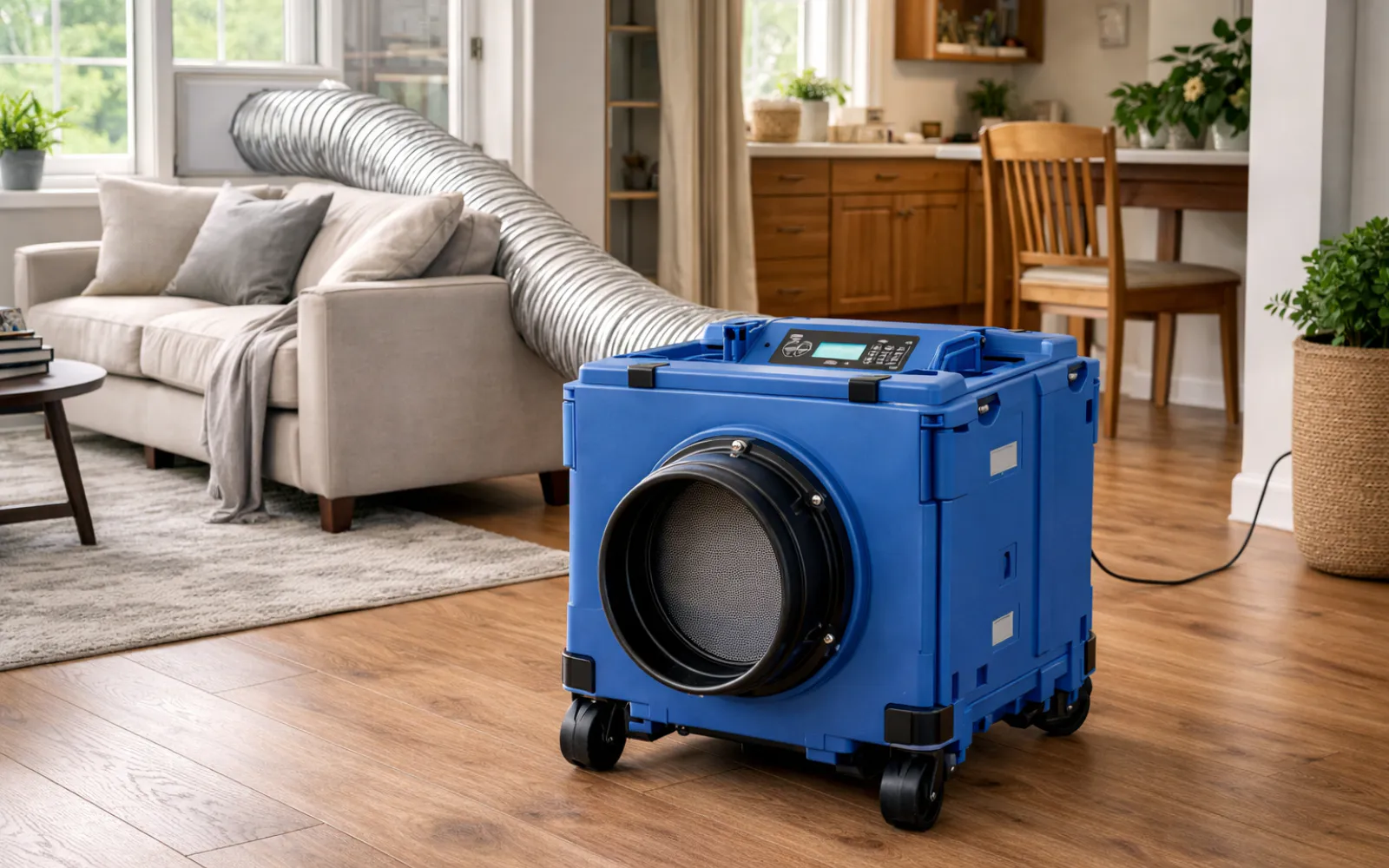
Can Air Purifiers Help with Mold? What They Can and Can’t Do
You’ve found mold in your home, or maybe you’ve recently had it removed. Now you’re looking at air purifiers and wondering whether putting one in the room will help.
The short answer is yes, a good air purifier can help reduce some airborne mold particles. But it can’t remove active mold growth or fix the moisture problem that allowed it to grow.
Those are two different things.
An air purifier works on what passes through the machine. It can’t reach behind drywall, repair a leaking pipe, dry out a damp crawl space or remove contaminated building materials.
At Spotless, Lead Inspector Caleb Jones works with professional air-filtration equipment as part of mold remediation projects, so he sees both the value and the limitations of filtration firsthand.
“We operate equipment like air scrubbers, which are big, you know, industrial air purifiers essentially with HEPA filters built into them.”
Caleb Jones
So, can air purifiers help with mold? Absolutely – but only when you understand what job you’re asking them to do.
- Yes, Air Purifiers Can Capture Some Airborne Mold Spores
- What an Air Purifier Cannot Do About Mold
- HEPA Air Purifier vs. Professional Air Scrubber: What's the Difference?
- When Does an Air Purifier Make Sense After Mold Remediation?
- What Should You Look for in an Air Purifier for Mold?
- Air Purifiers Work Best as Part of a Bigger Indoor Air Quality Plan
- A Helpful Tool, Not a Mold Solution
Yes, Air Purifiers Can Capture Some Airborne Mold Spores
A particle-filtering air purifier works on a fairly simple principle.
Air is pulled into the unit, passes through a filter, and then returns to the room. Particles caught by the filter stay behind rather than continuing to circulate.
Professional HEPA air scrubbers use the same basic principle on a larger, more controlled scale during mold remediation.
Caleb explains it this way:
“It’s capturing any mold spores that are landing on that filter and not allowing them to go through as it cycles clean air back into it.”
Caleb Jones
A true HEPA filter can theoretically remove at least 99.97% of airborne particles measuring 0.3 microns, including mold particles, according to the U.S. Environmental Protection Agency.
That number sounds impressive – and it is – but it’s also easy to misunderstand.
It doesn’t mean putting a HEPA purifier in a moldy room makes the room 99.97% mold-free.
The statistic describes how efficiently the filter captures particles of a certain size that actually pass through it. It doesn’t tell you how much mold is growing elsewhere in the home, whether contaminated dust is sitting on surfaces, or whether an unresolved leak is still feeding new growth.
A purifier in one bedroom can only filter the air it draws through the machine.
That’s why EPA guidance describes filtration as a supplement to source control, not a replacement for dealing with the pollutant at its source.
So yes, air purifiers can help with mold-related airborne particles. They’re particularly useful when filtration is one part of a bigger plan rather than the entire plan.
If the mold source has already been dealt with and your concern is reducing remaining airborne particles, HEPA filtration can be useful. If mold is still actively growing, filtration alone isn’t enough.
What an Air Purifier Cannot Do About Mold
This is where homeowners can end up spending a lot of money without actually solving the problem.
An air purifier can capture some airborne particles.
An air purifier can’t:
- remove a colony growing on drywall or framing;
- tear out contaminated insulation;
- repair a roof or plumbing leak;
- dry a wet crawl space;
- remove mold hidden behind a wall;
- clean settled contamination throughout a room;
- or solve excessive indoor humidity by itself.
The EPA is particularly clear about this. Portable air cleaners and HVAC filters may remove some particles generated by mold, but they do not solve a mold problem because they don’t eliminate the moisture conditions allowing the mold to grow.
That lines up closely with what Caleb tells Spotless clients:
“Humidity control and moisture control are so important in making sure that mold doesn’t have an environment to set up anymore.”
Caleb Jones
Think of the purifier as working downstream.
If a slow pipe leak is feeding mold behind your kitchen cabinets, that mold may continue releasing particles into the environment. You can filter some of those particles, but you’re still filtering around an active problem.
It’s a bit like putting buckets underneath a leaking roof without repairing the roof. The buckets may help with the immediate mess, but they haven’t solved what’s causing it.
That’s why proper professional mold remediation in Lexington starts with the source and the extent of the contamination.
The same principle runs through Spotless’ wider approach to improving indoor air quality after mold remediation.
If you’re running an air purifier because mold keeps returning or the room still smells musty, don’t spend months filtering around an unresolved moisture problem. Find out why the mold is there.
HEPA Air Purifier vs. Professional Air Scrubber: What’s the Difference?
A household air purifier and a professional air scrubber may both use HEPA filtration, but they aren’t being used for exactly the same job.
| Portable HEPA Air Purifier | Professional Air Scrubber |
| Designed for everyday room filtration | Used as part of professional remediation |
| Usually serves one room or defined area | Sized and positioned around controlled work areas |
| Filters particles that enter the machine | Supports active contamination control |
| Operated by the homeowner | Operated as remediation equipment |
| Doesn’t replace mold source removal | Used alongside source removal and cleaning |
During mold remediation, Spotless may operate HEPA air scrubbers inside containment while other work is taking place.
These machines continuously pull air through filtration.
“It’s just a continuous cycle. Many times you’ll run those for several days in an environment.”
Caleb Jones
Caleb describes this as a more passive form of air-quality treatment. You’re not relying on the particles to disappear by themselves; you’re repeatedly moving the air through filtration and trapping particles in the filter.
But even professional air scrubbing isn’t mold remediation by itself.
Containment, source removal, HEPA vacuuming, detailed cleaning and moisture correction all have different jobs to do.
That distinction is important because a homeowner asking whether an air purifier can help with mold may actually be asking one of two very different questions:
Can I improve everyday filtration after the mold has been dealt with?
Or:
Can I use this machine instead of dealing with the mold?
The answer to the first can be yes.
The answer to the second is no.
For everyday post-remediation filtration, a properly sized HEPA purifier may be useful. During active remediation, professional containment and air scrubbing serve a much broader purpose.
When Does an Air Purifier Make Sense After Mold Remediation?
Once the source has been addressed, air filtration can make much more sense.
The mold has been properly removed
If remediation is complete and your goal is ongoing particle filtration, a portable HEPA purifier may be a practical addition.
That doesn’t mean every homeowner needs one forever. It simply gives you another way to filter particles moving through the room.
You’re particularly concerned about indoor air quality
Some Spotless clients come to us because they’ve spent a long time worrying about the environment inside their home.
For those homeowners, filtration may form part of a wider post-remediation plan involving cleaning, HVAC maintenance and humidity management.
We need to be careful about what that means medically. An air purifier shouldn’t be presented as a treatment for mold-related illness or as a promise that symptoms will improve. Spotless works on the building environment; health concerns should also be discussed with an appropriately qualified healthcare professional.
You want ongoing whole-home or room filtration
Spotless’ service offering includes both freestanding room air-purification units and systems that can be incorporated into ductwork.
Whether either option makes sense depends on the property.
The building’s size, HVAC system, existing filtration, humidity conditions and history of contamination all matter.
That’s also why Caleb resists one-size-fits-all answers:
“I wish I could be just a perfect cure-all for everyone.”
Caleb Jones
There isn’t one box you can put in every house and declare the indoor environment solved.
If remediation is complete and you’re considering ongoing filtration, Spotless can help you look at the wider picture – HVAC condition, humidity, airflow and the original mold source – before you assume another machine is what the house needs.
What Should You Look for in an Air Purifier for Mold?
If you do decide to use a portable purifier, don’t get distracted by dramatic packaging promising to “destroy mold” or “purify everything.”
Start with what the machine can actually demonstrate.
Look for effective particle filtration
For airborne mold particles, true HEPA filtration is the most relevant starting point.
HEPA is a mechanical particle filter. It doesn’t depend on vague claims about “energizing” or “neutralizing” the air.
Make sure it’s sized for the room
A tiny purifier in a large open-plan living area can’t process the same volume of air as a properly sized unit.
EPA guidance recommends looking at the purifier’s Clean Air Delivery Rate (CADR) and making sure it’s appropriate for the room or area you’re treating. Higher fan speeds and longer operating periods generally increase the amount of air being filtered.
Think about replacement filters
Filters don’t last forever.
The EPA notes that overloaded, dirty filters don’t work effectively, so replacement availability and ongoing cost matter.
That’s something Caleb understands from the professional side too: Spotless changes the HEPA filters in its remediation air scrubbers between jobs.
Don’t block the airflow
Putting the purifier behind a sofa or underneath something that restricts the intake defeats the point.
Air needs to be able to reach and leave the machine freely.
Be cautious about intentional ozone generation
The EPA advises consumers to avoid air cleaners and HVAC filters designed to intentionally produce ozone, because ozone is a lung irritant.
That’s another good reason to focus on proven particle filtration rather than assuming newer or more technical-sounding means better.
And if you’re considering upgrading the filter inside your HVAC system, don’t simply install the most restrictive filter you can find. The system has to be able to handle the airflow resistance, so that conversation may be better had with a qualified HVAC contractor.
Don’t buy an air purifier simply because “mold” is printed on the box. Look at filtration, room sizing, maintenance requirements and – above all – whether an active mold source still exists.
Air Purifiers Work Best as Part of a Bigger Indoor Air Quality Plan
Air purifiers are attractive because they’re tangible.
You plug one in.
The fan starts.
Air moves through it.
You can hear that something is happening.
But mold problems often depend on things that are much less obvious.
Is there moisture behind the wall?
Is the crawl space excessively humid?
Is the HVAC system involved?
Is there contaminated dust elsewhere in the home?
Did anyone actually fix the leak?
Caleb spends a lot of time explaining exactly that problem to homeowners.
“The air quality… it’s typically an invisible problem.”
Caleb Jones
That’s why Spotless doesn’t look at filtration in isolation.
On appropriate projects, improving the indoor environment may involve source removal, containment, HEPA cleaning, air filtration, HVAC assessment, detailed surface cleaning and long-term moisture control.
The exact scope depends on the house.
The EPA takes the same broader view: the most effective way to improve indoor air is to reduce or remove sources of pollutants, with filtration used as a supplement rather than a substitute.
If you’ve already bought one purifier after another but the mold or musty odor keeps coming back, stop treating the air as though it’s the source. Spotless can help you find what’s feeding the problem.
A Helpful Tool, Not a Mold Solution
So, can air purifiers help with mold?
Yes.
A properly sized air purifier with effective particle filtration can help capture airborne mold particles that move through it. Professional HEPA air scrubbers also play an important role during controlled remediation.
But no purifier can remove a mold colony growing inside your wall.
It can’t repair a leak.
It can’t dry wet building materials.
And it can’t make an ongoing humidity problem disappear.
That’s why the order matters:
Fix the source. Remove the contamination. Clean the environment. Then use filtration where it adds value.
For homeowners in Lexington and across Central Kentucky, Spotless takes that whole-home approach because we know the goal isn’t simply to make one patch of mold disappear. It’s to understand why it happened, address the environment properly and give you a practical plan for keeping the home in better condition afterward.
Filter the air where it helps. Fix the source where it matters.
Spotless is the most trusted name in restoration in central Kentucky including Lexington, Nicholasville and surrounding communities.
Specializing in health-focused mold remediation and water damage restoration, we leave mold-affected clients with a healthier home.
Call 859-459-0424 and speak to a technician today!