
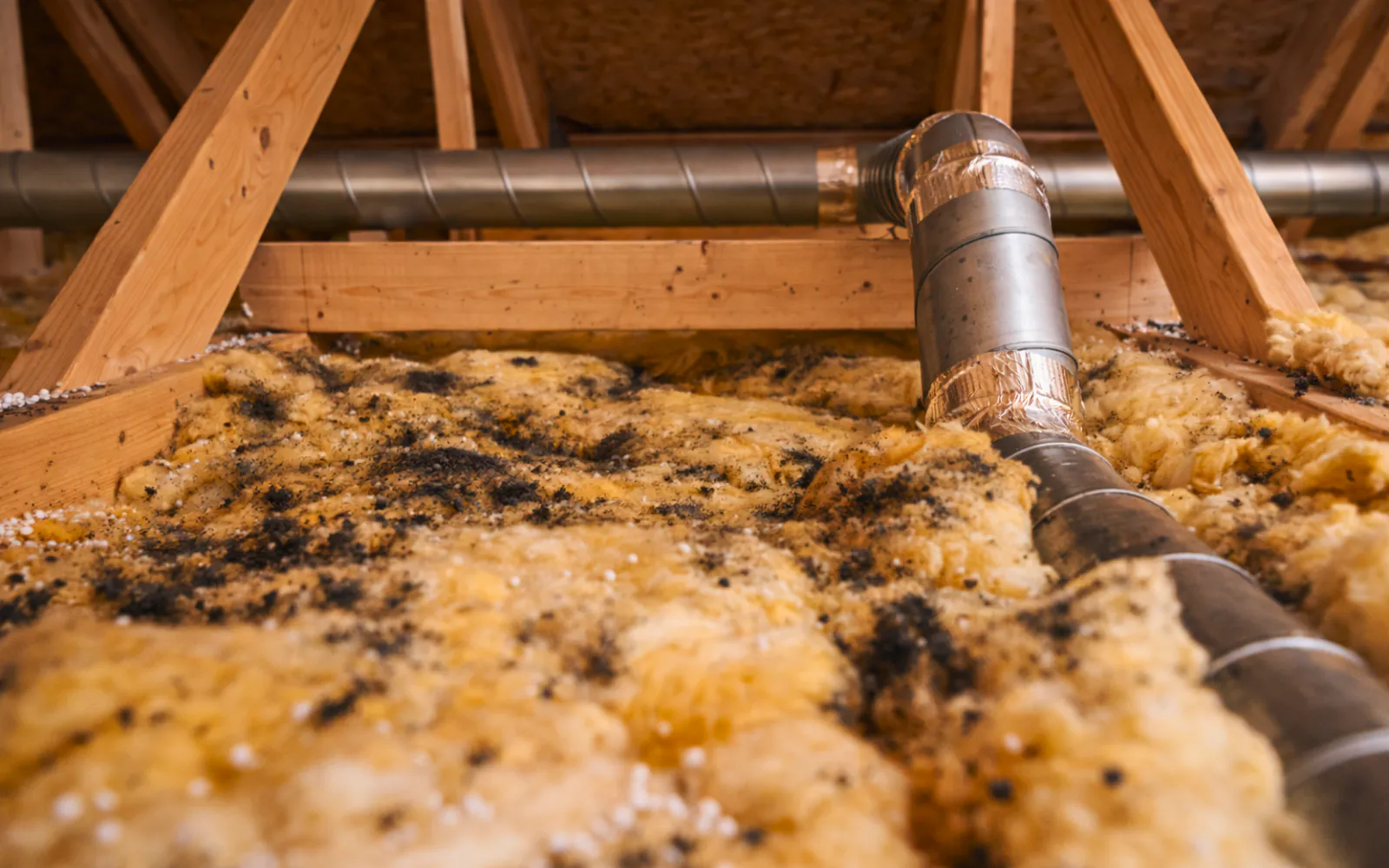
Black Mold in the Home: Risks, Warning Signs, and Safe Removal
You spot something dark around a window. Or maybe it’s on the basement framing, above a closet, or close to an old water stain you thought had dried months ago.
You search for “black mold,” and within a few minutes you’re reading about toxic mold, health problems and houses being ripped apart.
Is this dangerous? Is it making us sick? Can we sleep here tonight? Should I clean it?
Those are reasonable questions. But the first thing to understand is that dark-colored mold deserves attention without automatically becoming a reason to panic.
Caleb Jones, Lead Inspector at Spotless, hears the same concern from Lexington-area homeowners several times a week:
“I probably hear that terminology, ‘I think I have black mold,’ multiple times a week at this point…”
Caleb Jones
Part of Caleb’s job is separating what’s actually known about the property from what homeowners understandably fear might be happening.
Black mold in the home isn’t something to ignore. At the same time, color alone can’t tell you what species you’re looking at, what’s happening behind the surface, or how a particular person will respond to the environment.
What matters is the bigger picture: Where’s the moisture coming from? How extensive is the growth? What materials are affected? Could contamination be hidden? And can the problem be addressed without spreading it elsewhere?
That’s what we’ll walk through here.
Watch the full interview here!
Please note, Spotless evaluates and remediates mold conditions in homes; we don’t diagnose or treat medical conditions. If you’re concerned about personal symptoms, speak with a qualified healthcare professional.
- What Does “Black Mold” Actually Mean?
- The Moisture Source Often Tells Us More Than the Color
- Warning Signs of Black Mold in the Home
- Is Black Mold Dangerous? Health Concerns Without the Fearmongering
- Can You Keep Living in a House With Black Mold?
- Can You Remove Black Mold Yourself?
- Why Killing Mold Isn’t the Same as Remediating It
- What About Bleach?
- How Professional Black Mold Remediation Protects the Rest of Your Home
- How to Reduce the Chance of Black Mold Coming Back
- Black Mold Is a Problem to Investigate, Not a Reason to Panic
What Does “Black Mold” Actually Mean?
When homeowners talk about black mold in the home, they’re often thinking about Stachybotrys chartarum, sometimes referred to as “toxic black mold.”
The important distinction is that not every mold that looks black is Stachybotrys.
Mold can appear black, dark green, brown, gray or other colors depending on the species, surface and conditions. Looking at the color might tell you that something deserves investigation, but it can’t reliably tell you what organism is growing there.
“There’s a lot of molds that are black in color. You don’t know [what species it is] unless you do laboratory testing.”
Caleb Jones
That distinction matters because the words black mold carry so much emotional weight. A homeowner can see a dark patch and immediately assume the worst when, from an inspection standpoint, there’s more that needs to be established first.
The CDC takes a similarly practical approach. Its guidance says Stachybotrys chartarum and other molds may cause nonspecific health symptoms, but it isn’t generally necessary to identify the species before deciding that indoor mold and its moisture source need to be addressed. (Source: CDC)
The Moisture Source Often Tells Us More Than the Color
For Caleb, the type of suspected mold can influence where he investigates first, even if the fundamentals of remediation remain similar.
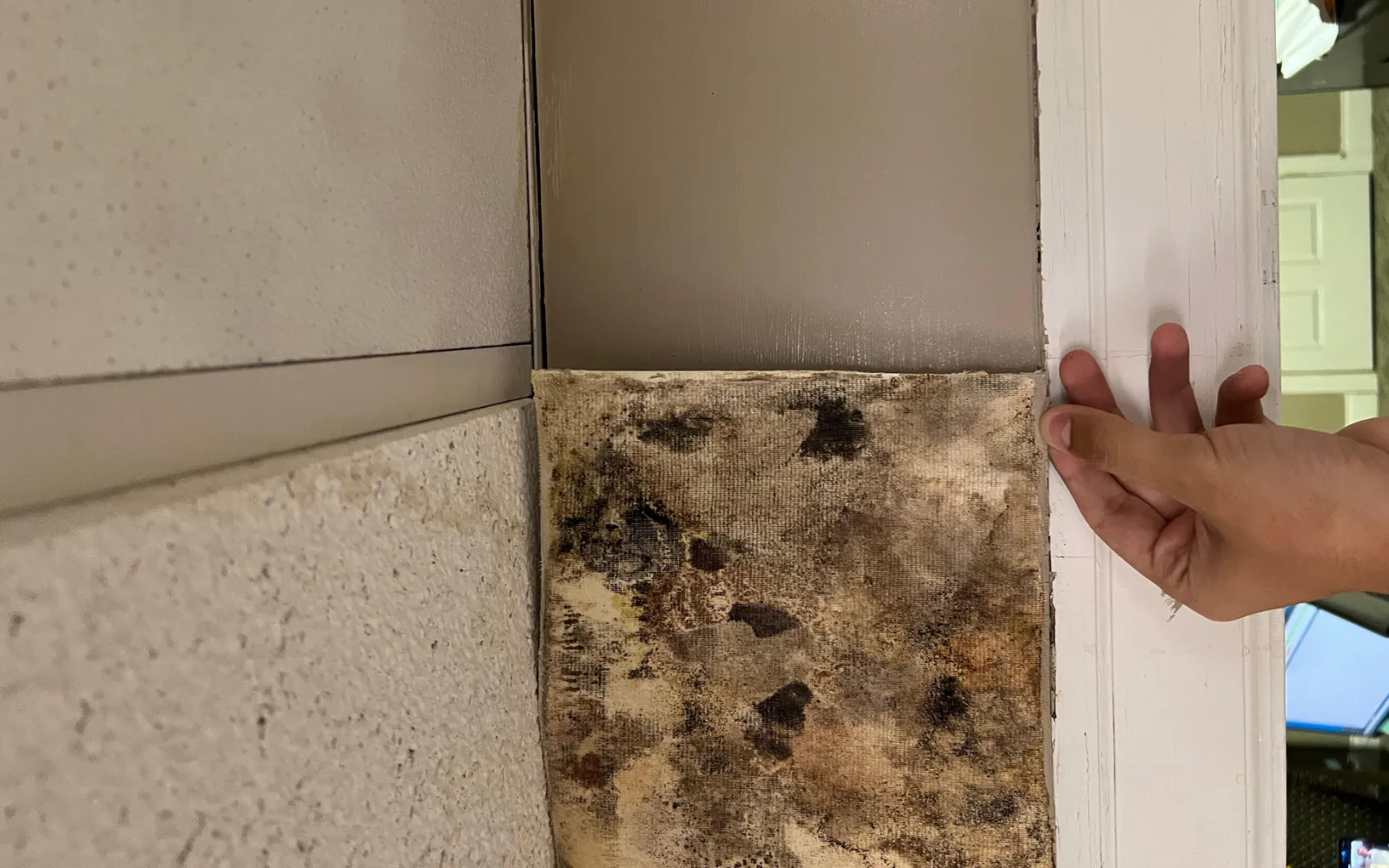
When there’s reason to suspect Stachybotrys, he pays particular attention to a history of water intrusion: leaks, flooding, repeatedly wet building materials or another direct water source.
If the pattern looks more like a broader humidity problem, HVAC conditions and humidity-related areas may move higher on his inspection list.
That leads to one of the most useful questions you can ask when you discover black mold in the home:
Why is this material wet enough for mold to grow here?
The EPA puts moisture control at the center of mold management: if you have mold, you need to clean up the mold and eliminate the moisture source. (Source: EPA)
A dark patch around a leaking window isn’t simply a stain to clean: The window may still be leaking, drywall could be affected beyond the visible edge and insulation inside the cavity may be contaminated.
The color catches your attention. The water source tells you where the investigation needs to go.
If you’ve found dark growth after a leak or water-damage event, a professional mold inspection in Lexington can help determine what’s happening beyond the visible surface and where the moisture is coming from.
Concerned about dark mold but not sure what you’re actually dealing with? Spotless can inspect the affected area and give you a clear next step before you start opening walls or throwing products at the problem.
Warning Signs of Black Mold in the Home
Visible black or dark growth is an obvious reason to pay attention, but Caleb often finds that some of the more useful clues are changes in the house itself.
A home doesn’t need to have an enormous black patch across the wall before something’s wrong.
In fact, when you’re looking for the early signs of black mold in the home, pay attention to:
- dark or unusual discoloration
- a persistent musty odor
- previous or recurring water damage
- staining below windows or plumbing
- baseboards separating from the wall
- ceilings beginning to buckle
- warped or buckled flooring
- moisture around a water heater
- leaks around windows
- suspicious conditions around HVAC equipment
- dark growth in closets and other rarely checked areas
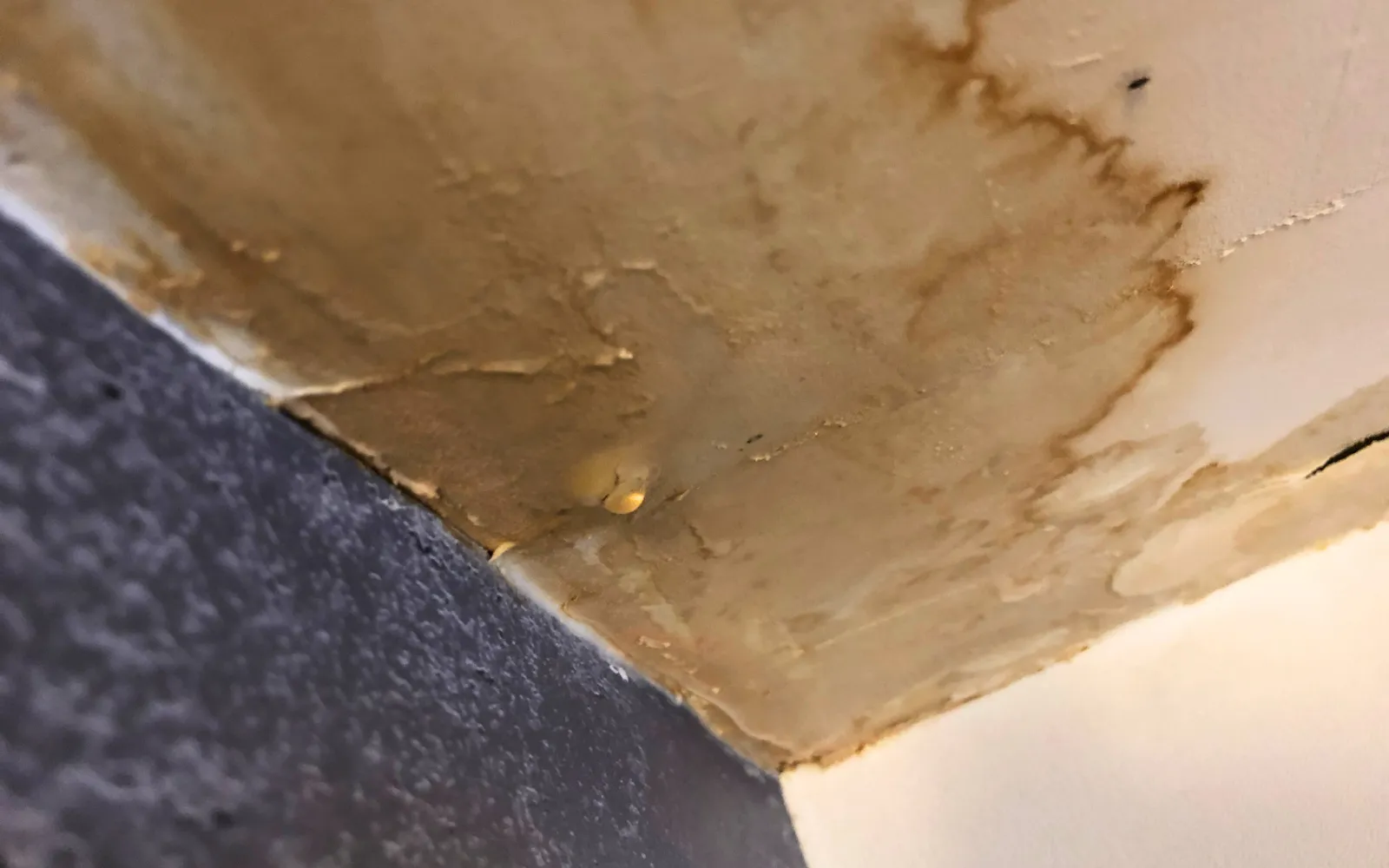
Caleb makes a simple point that’s surprisingly easy to overlook: homeowners spend every day inside their houses without necessarily looking at the house.
“Look at the closet ceiling that you haven’t looked at in six months. Look around your HVAC system, check your water heater, any sources of water, any sources of humidity, any areas that you just don’t look at very often.”
Caleb Jones
That doesn’t mean obsessively checking every corner each day. It means building some basic awareness into home maintenance.
If a wall should be flat and suddenly isn’t, something has changed.
If a baseboard starts pulling away, ask why.
If flooring begins to buckle, don’t assume it’s cosmetic.
If a ceiling stain keeps returning after being painted, the stain itself probably isn’t the real issue.
An Inspector’s Flashlight Trick
One of Caleb’s favorite techniques for checking certain surfaces is remarkably simple.
When he’s inspecting wood in an area where mold is suspected, he’ll sometimes darken the space and shine a powerful flashlight across the surface at an angle rather than pointing directly at it.
The angled light can make surface irregularities and suspected contamination much easier to see.
“If you shine the flashlight on it, it’ll look normal. But if you shine the flashlight down or up, you can actually see mold spores that are present without looking at it head on.”
Caleb Jones
It’s an inspection clue, not a laboratory identification method. A flashlight can’t tell you whether something is Stachybotrys, and homeowners shouldn’t assume every particle revealed under angled lighting is mold.
What the technique illustrates is something Caleb sees constantly: what’s obvious from six feet away may be only a small part of what an inspector notices up close.
He’ll also check water sources, look inside HVAC equipment, remove filters for a closer look, take photographs and, where useful, use a borescope to investigate areas that aren’t readily visible.
If you’ve noticed warping, unexplained staining, recurring odors, evidence of an old leak or dark growth around a moisture source, don’t wait for the problem to become dramatic. Finding the cause earlier can make the next decision much clearer.
Is Black Mold Dangerous? Health Concerns Without the Fearmongering
There’s no useful reason to pretend mold can’t affect health. There’s also no useful reason to tell every frightened homeowner that every headache or bad night’s sleep has been caused by a dark patch on a wall.
The evidence requires more nuance than that.

According to the CDC, exposure to damp and moldy environments may cause health effects or none at all. Reported effects can include stuffy nose, coughing, wheezing, sore throat, burning eyes and skin irritation. People with asthma or mold allergies may experience stronger reactions, while people with chronic lung disease or compromised immune systems may face additional risks. (Source: CDC)
And dampness or mold certainly aren’t rare household problems.
Research summarized by Lawrence Berkeley National Laboratory used a population-weighted average prevalence of 47% for dampness or mold across seven studies of U.S. homes. (Source: Lawrence Berkeley National Laboratory)
The same body of research estimated that 21% of current asthma, with confidence limits of 12% to 29%, was attributable at the population level to dampness or mold in homes. That doesn’t mean 21% of any individual person’s asthma was caused by their house; it’s an estimate across the population studied.
Pay Attention to Patterns, Not Self-Diagnosis
Because Spotless often works with people who are already concerned about their health, Caleb is careful about how he asks questions.
He doesn’t want someone deciding that every symptom they’ve ever experienced must suddenly be mold-related because an inspector showed up.
“A lot of what I do is explaining things in a way that gets the honest answer without leading clients down the wrong path.”
Caleb Jones
Instead, he looks for patterns.
Do you consistently feel worse in one part of your home?
Have you spent several days away recently, and did anything noticeably change?
Do you tend to feel better when you’re away from the property and worse after returning?
Did concerns begin after a leak, flood or recurring moisture problem?
Those patterns don’t diagnose mold-related illness. But they can give a homeowner and an inspector useful context about whether the building environment deserves a closer look.
And importantly, Caleb doesn’t believe the right response is to weaponize fear.
Can You Keep Living in a House With Black Mold?
There isn’t one blanket answer.
The amount and location of contamination matter. So does whether a bedroom is directly affected, whether HVAC pathways are involved, whether removal work is taking place, and whether someone in the property has a medical condition that may make exposure more concerning.
Caleb’s approach is to explain what he knows about the home, explain the work that needs to happen, and let the client make an informed decision alongside any relevant medical advice.
“I don’t want to be the fear monger that’s gonna come in and tell them that their house is not safe to live in.”
Caleb Jones
For someone who feels distinctly better away from the property, temporarily staying elsewhere may make them more comfortable while the issue is investigated or remediated. Other households may remain in unaffected portions of a home depending on the project and professional guidance.
If you’re worried because your home and your health both seem to be telling you something’s changed, you don’t have to jump to a diagnosis. Start with evidence: investigate the property and speak with a qualified healthcare professional about your personal symptoms.
Can You Remove Black Mold Yourself?
If you search for ways to remove black mold in the home, you’ll find almost everything imaginable recommended online: bleach, vinegar, sprays, natural cleaners and home-remedy mixtures.
There are situations where homeowners can handle small areas of mold themselves.
The EPA says that when a moldy area is less than about 10 square feet (roughly a three-foot-by-three-foot patch) homeowners can handle cleanup themselves in many cases. Larger areas, significant water damage and certain more complicated circumstances warrant a different approach. (Source: EPA)
That “in many cases” is important.
Ten square feet of superficial growth on an accessible hard surface is very different from a smaller visible patch that turns out to be the front edge of a wet wall cavity.
The question isn’t simply: How big is the black spot? It’s also: What’s behind it?
Why Killing Mold Isn’t the Same as Remediating It
Caleb has met plenty of homeowners who tried commercially available products before calling Spotless.
“I’ve had countless clients attempt home remedies and call us back whenever the issue gets worse.”
Caleb Jones
That doesn’t mean homeowners shouldn’t be capable of taking care of their own homes.
Caleb actually feels strongly about people remaining involved and informed.
The line changes when cleanup involves opening contaminated cavities, disturbing porous materials, controlling airborne particles, working with professional treatment products or trying to determine how far contamination has spread.
A proper response to black mold in the home usually asks five broader questions:
- What allowed the mold to grow?
- What material is actually contaminated?
- Can that material be cleaned or does it need to be removed?
- How do you keep debris and airborne particles from spreading during removal?
- How will you know the moisture problem has actually been corrected?
What About Bleach?
Caleb has a phrase he uses when clients tell him they’ve repeatedly sprayed mold with bleach:
“We call it ‘giving mold a haircut.”
Caleb Jones
The analogy describes something he sees in the field: the surface may look better for a while without the underlying mold-and-moisture problem actually being resolved.
His interview includes a more specific explanation about sodium hypochlorite, penetration into porous materials and regrowth. We’d be careful not to turn every part of that explanation into a universal chemical rule.
What official EPA guidance does make clear is that biocides such as bleach aren’t recommended as a routine mold-remediation method, particularly as a substitute for fixing moisture and physically cleaning or removing affected material. Porous materials may need to be discarded when they can’t be adequately cleaned and dried. (Source: EPA)
So the useful takeaway isn’t “bleach always feeds mold.”
It’s this:
Making a mold stain disappear isn’t the same as solving a mold problem.
If you don’t know whether the mold stops at the surface, especially around drywall, insulation, flooring or an old leak, don’t start opening materials blindly. A small opening can become a much bigger contamination-control problem once disturbed.
How Professional Black Mold Remediation Protects the Rest of Your Home
This is where Caleb’s description of a real-world remediation process becomes especially useful.
Imagine there’s confirmed black mold around a window that has been leaking.
To the homeowner, the obvious solution might be:
Cut the drywall out and get rid of it.
But the drywall coming out is only one small part of the job.
“A lot of what goes into what we do is not causing an issue elsewhere in the house.”
Caleb Jones
That sentence captures the difference between basic demolition and controlled health-focused mold remediation in Lexington KY.
Step 1: Control the Work Area Before Opening It
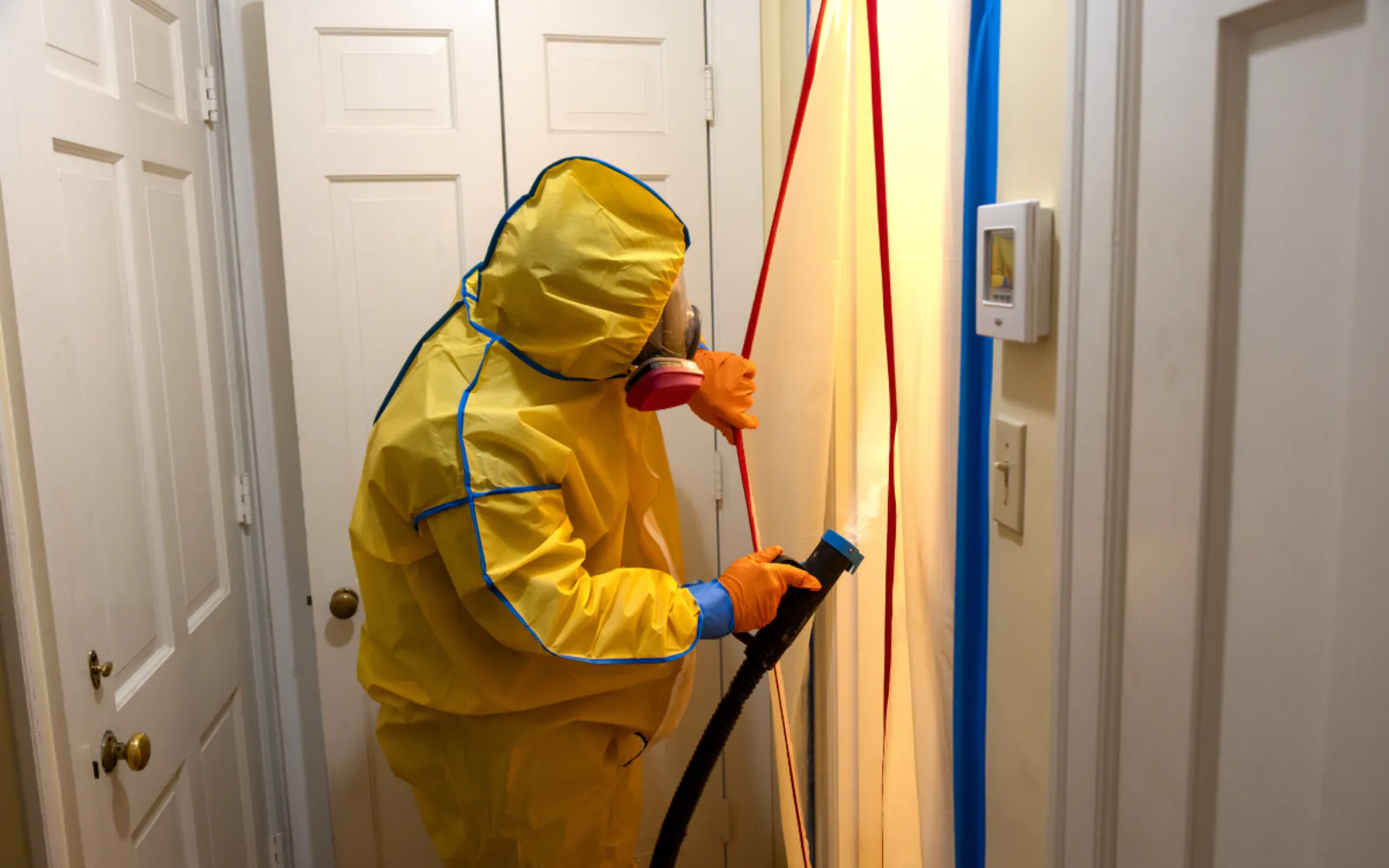
Caleb’s first step in the leaking-window example is containment.
Depending on the situation, that could mean creating a contained area around the work itself or isolating a larger portion of the room with plastic barriers.
Why do that first?
Because once contaminated drywall, insulation or other material is disturbed, you don’t want particles and debris traveling freely into cleaner areas of the property.
The aim is to keep a local problem local.
Step 2: Establish Negative Air Pressure
Next comes air control.
Caleb describes setting up negative air pressure so air moves toward the controlled work area and filtration/exhaust setup rather than allowing contaminated air from the work zone to move freely into adjoining spaces.
In plain English, you’re trying to control where the air goes while contaminated materials are being disturbed.
That matters because mold remediation isn’t simply about what’s attached to the drywall. It’s also about what happens while that drywall is being cut, handled and taken out of the property.
Spotless’ current remediation process includes containment barriers, negative air pressure and HEPA filtration as core parts of controlled removal.
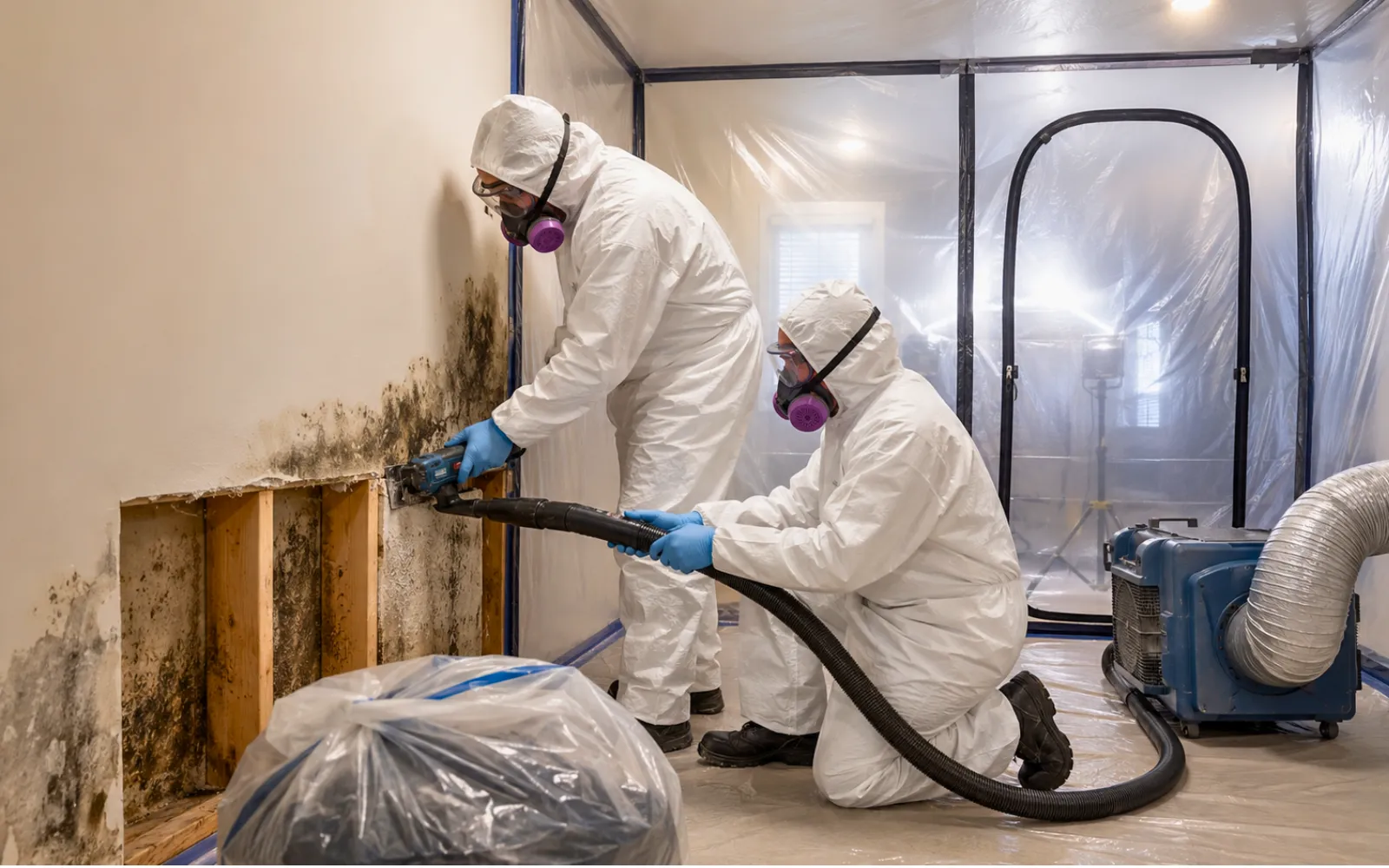
Step 3: Remove Materials Without Spreading the Problem
Caleb gets very specific about how his team handles the removal itself.
In his window example, the process can involve HEPA vacuuming while cuts are being made, removing affected insulation, and bagging contaminated drywall inside the containment area before it’s carried through the rest of the home.
That detail is easy to underestimate.
If you cut contaminated material out perfectly but then carry dusty, unbagged debris down a hallway, through a living room and out the front door, you’ve ignored a major part of contamination control.
Good remediation is as much about the journey out of the house as the demolition itself.
Step 4: Inspect What Was Hidden
Opening the cavity also gives the remediation team information the visible surface couldn’t provide.
Is the framing affected?
Is insulation contaminated?
Can daylight be seen around the window where water has been entering?
Is there an obvious puncture or failed seal?
Does the contamination extend beyond the original cut?
The water source is documented so the homeowner knows what must be repaired.
That last part is truly critical. If the window keeps leaking after remediation, you haven’t solved the conditions that allowed black mold in the home to develop in the first place.
Step 5: HEPA Clean and Treat Appropriate Materials
Once contaminated porous materials that need removal are out, the remaining exposed building materials can be HEPA vacuumed and treated according to the scope of work.
This is also where a company’s experience matters.
Not every piece of material necessarily needs to be ripped out. Equally, not every mold-affected material can simply be sprayed and left in place.
The decision depends on the material, contamination, condition and whether it can genuinely be cleaned.
Step 6: Think Beyond the Hole in the Wall
Some projects raise broader indoor-air-quality or cross-contamination concerns, particularly when contamination may have moved through the house or HVAC pathways.
That’s one of the ways Spotless’ approach differs from a simple tear-out contractor. The company’s documented focus includes air quality, containment and preventing cross-contamination, particularly for clients who are already concerned about how their indoor environment may be affecting them.
That doesn’t mean fogging, an air purifier or another air-quality treatment magically fixes a mold source. The source and contaminated materials still need to be dealt with.
The point is to consider the home as an environment, not just stare at the square of drywall where the problem first became visible.
If black mold in your home extends into drywall, framing, insulation or areas close to HVAC, the question isn’t simply what product will kill it. The question is how to remove what needs removing without turning one affected area into a much wider problem.
How to Reduce the Chance of Black Mold Coming Back
A mold remediation project shouldn’t be judged only by whether the black marks disappeared.
If the same conditions remain, the home can end up right back where it started.
When black mold in the home has been remediated, focus on four things.
1. Fix the Moisture Source
A leaking window needs repairing.
A plumbing leak needs fixing.
A roof problem needs correcting.
Wet materials need drying.
The EPA’s guidance is straightforward: moisture control is the key to mold control.
Without that, cleanup is being asked to solve a problem the building is continuing to create.
2. Keep Humidity Under Control
Not every mold problem is caused by a dramatic leak. Elevated humidity can also create conditions that support growth.
The EPA recommends keeping indoor relative humidity below 60%, ideally between 30% and 50% where possible.
A simple humidity meter can help you keep an eye on conditions in basements and other problem areas.
3. Check the Parts of the Home You Usually Ignore
Go back to Caleb’s advice.
Look at the closet ceiling.
Look around the HVAC.
Look around your water heater.
Pay attention to the area where you had a leak six months ago.
Look at baseboards and flooring.
And pay attention to how you feel.
“If people were more attentive to their bodies and they were more attentive to their homes, then a lot of these problems would get caught pretty early.”
Caleb Jones
You’re not looking for reasons to be frightened. You’re looking for small changes before they turn into expensive ones.
4. Consider Independent Post-Remediation Verification
One of Caleb’s strongest trust-building comments in the interview comes when he’s asked about having remediation independently checked.
He doesn’t resist the idea. He actively encourages it.
“I love post-testing verification. I think it keeps mitigation companies in check and makes people feel at peace that the work was done properly.”
Caleb Jones
Spotless itself has also stated that it sees an ethical problem with clearing its own remediation work and is comfortable with independent verification.
That’s worth remembering when choosing a remediation company.
A company confident in its process shouldn’t be threatened by reasonable independent verification.
Successful black mold remediation shouldn’t end with “the wall looks clean.” Ask what caused the mold, what was done to correct that source, how cross-contamination was controlled, and what evidence shows the affected area is ready to move forward.
Black Mold Is a Problem to Investigate, Not a Reason to Panic
Finding black mold in your home is unsettling.
But the most useful response isn’t panic, and it isn’t immediately reaching for the strongest cleaner under the kitchen sink.
Start with what you can establish.
- Where is the moisture coming from?
- How far does the visible growth appear to extend?
- Is the material porous?
- Has there been water damage?
- Are walls, floors or ceilings changing shape?
- Could contamination be hidden behind the surface?
- And if material needs to be removed, how will that happen without spreading contamination into cleaner parts of the home?
Most importantly, don’t let the word black distract you from the real problem. You can’t reliably identify mold species by color alone, and the moisture and contamination need attention regardless of whether a laboratory result eventually says Stachybotrys or something else.
For homeowners in Lexington and throughout Central Kentucky, Spotless brings more than 30 years of company experience, IICRC-certified expertise and a health-focused remediation approach that looks beyond the visible mold.
Concerned about black mold in your Lexington-area home? Schedule an inspection with Spotless. We’ll help you understand what’s happening, where the moisture is coming from, what may need to be removed, and what can be safely saved.
Spotless is the most trusted name in restoration in central Kentucky including Lexington, Nicholasville and surrounding communities.
Specializing in health-focused mold remediation and water damage restoration, we leave mold-affected clients with a healthier home.
Call 859-459-0424 and speak to a technician today!