
Can I Remove Black Mold Myself? When to Stop and Call a Professional
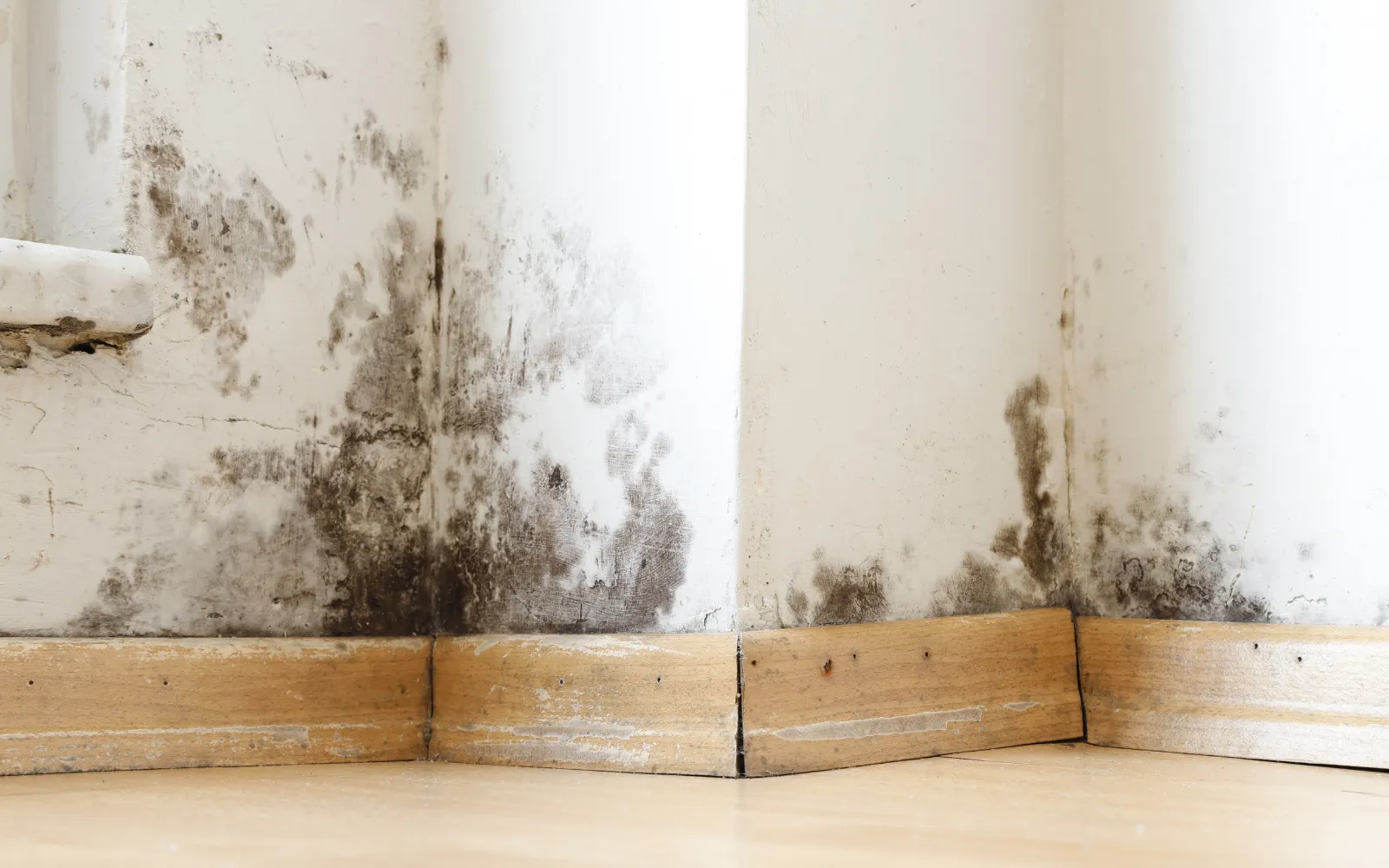
You find a small dark patch behind a piece of furniture or beside a window.
Your first reaction probably isn’t, I need an entire remediation crew here.
It’s more likely:
Can’t I just clean this myself?
Sometimes, you can.
A genuinely small, straightforward mold problem may be something a homeowner can handle without professional remediation. The problem is knowing when “small” on the surface is hiding something more complicated behind it.
DIY black mold removal becomes a different proposition when there’s significant water damage, mold inside porous building materials, possible HVAC involvement, hidden contamination or a need to start cutting into walls and ceilings.
And despite the title of this article, the decision shouldn’t rest on color alone. Caleb Jones, Lead Inspector at Spotless, regularly reminds homeowners that several types of mold can appear black. You can’t reliably identify Stachybotrys chartarum just by looking at a dark patch.
Caleb also isn’t against homeowners doing things themselves.
Quite the opposite.
“I want people to be able to still do that. When it gets to the point of doing the science and the actual chemical usage and different things like that to deal with the mold, that’s where I draw the line in the sand.”
Caleb Jones
So, where exactly is that line?
- How Much Black Mold Can You Remove Yourself?
- A Small Surface Problem Is Different From Mold Inside a Wall
- The Biggest DIY Risk Isn’t Just the Mold You Can See
- If You Do Clean a Small Mold Area, Protect Yourself
- What About Bleach, Vinegar and Store-Bought Mold Sprays?
- Seven Signs It’s Time to Stop DIY and Call a Professional
- DIY Mold Cleanup Has a Place, But Knowing Its Limits Matters More
How Much Black Mold Can You Remove Yourself?
If you’re asking, “Can I remove black mold myself?”, one useful place to start is with the EPA’s homeowner guidance.
The EPA says that when the moldy area is less than about 10 square feet (roughly a 3-foot-by-3-foot patch) you can handle the job yourself in most cases. There are important exceptions, including substantial water damage and situations where the HVAC system may be contaminated. (Source: EPA)
That makes 10 square feet a useful reference point.
It isn’t a magic safety line.
Imagine two different mold problems.
In the first, there’s a small amount of superficial mold on an accessible hard surface. The leak that caused it has already been repaired, the material is dry and there’s no evidence that anything behind the surface is affected.
In the second, the visible patch is actually smaller, but it’s on swollen drywall beneath a window that’s leaked repeatedly. The insulation behind it may be wet.
Those are very different jobs.
The visible size of the patch tells you something. It doesn’t tell you everything.
Caleb’s inspection approach is built around that wider context. He checks water sources, building materials, HVAC areas and evidence of previous leaks because the mold you can see may only be the part that finally became visible.
“I’ll check all of the water sources whenever I go into a home. I’ll check the interior of the HVAC system whenever I go into a home.”
Caleb Jones
So before you reach for a cleaner, ask yourself:
Do I actually understand why this mold grew here?
If the source of the moisture is still unknown or still active, cleaning the visible patch isn’t the end of the job.
A Small Surface Problem Is Different From Mold Inside a Wall
There are situations where DIY cleanup is much more realistic.
For example, the problem may be relatively straightforward when:
- the mold is genuinely confined to a small area
- the moisture source has already been corrected
- the surface is accessible
- the material can be cleaned and fully dried
- there’s no reason to suspect mold behind the surface
- HVAC isn’t involved
- no demolition is required
That’s very different from discovering mold on water-damaged drywall, insulation, ceiling material or other porous building materials.
The EPA advises cleaning mold from hard surfaces and drying them completely. It also notes that absorbent or porous moldy materials may need to be discarded because mold can grow within spaces that are difficult or impossible to clean completely. (Source: EPA)
Caleb sees the consequences of that distinction regularly.
“I’ve had countless clients attempt home remedies and call us back whenever the issue gets worse.”
Caleb Jones
That isn’t proof that every DIY mold cleanup fails. Caleb’s seeing the group of homeowners whose problem didn’t turn out to be a simple surface-cleaning job.
Maybe the mold kept returning.
Maybe the wall was wet.
Maybe the visible discoloration was only one piece of a bigger cavity problem.
And there’s an important practical line here:
If finding out how much mold you have requires cutting open the building, you’ve already moved beyond ordinary cleaning.
If DIY black mold removal means pulling insulation, cutting drywall or opening a wet cavity, stop before you turn a contained problem into an exposed one.
The Biggest DIY Risk Isn’t Just the Mold You Can See
Caleb gives a useful example from the interview.
Say there’s confirmed mold around a window that’s been leaking.
A homeowner might look at the drywall and think:
Fine. I’ll cut that section out.
But that’s only the demolition part.
Before Caleb’s team opens the wall, they first establish containment around the work area.
Then they create negative air pressure to help control air movement. As material is cut, they use HEPA vacuuming. Mold-affected drywall is bagged inside the containment area before being carried through the rest of the house. Insulation may need to be removed, exposed materials cleaned and treated, and the source of the water intrusion documented.
“A lot of what goes into what we do is not causing an issue elsewhere in the house.”
Caleb Jones
That’s the part DIY tutorials can make look deceptively simple.
Cutting drywall isn’t difficult.
Cutting contaminated drywall without spreading dust and debris through cleaner parts of your home is a different job.
Professional remediation isn’t simply get moldy thing out of house.
It’s closer to:
- Control the work area.
- Control the air.
- Remove affected material carefully.
- Keep contaminated material contained on the way out.
- Clean what remains.
- Find and document the moisture source.
That distinction matters particularly when the affected area is beside a hallway, bedroom, living space or HVAC pathway.
EPA remediation guidance also emphasizes containment as contamination becomes more extensive because the goal is to prevent mold and mold-contaminated dust from spreading into unaffected areas.
If your DIY plan involves carrying exposed moldy drywall through the house or opening a contaminated cavity without controlling the work area, that’s a strong sign to call a professional.
If You Do Clean a Small Mold Area, Protect Yourself
Even a small cleanup deserves basic precautions.
The CDC recommends wearing at least a NIOSH-approved N95 respirator, protective gloves and goggles or other suitable eye protection while cleaning mold. For longer periods of cleanup or work such as tearing out moldy drywall, CDC recommends considering a half-face or full-face respirator that provides greater protection. (Source: CDC)
That advice matters because cleaning mold can disturb particles that were previously sitting on a surface.
But PPE has limits.
An N95 helps protect the person wearing it.
Gloves help protect your hands.
Goggles help protect your eyes.
None of those things creates containment around the room or controls where contaminated debris travels.
Caleb makes the training side of professional remediation clear:
“All of our people are trained to handle these things and to handle the mold, and there’s a lot that goes into it.”
Caleb Jones
So don’t make the mistake of thinking:
I bought a good mask, therefore this is now a DIY job.
PPE is one part of safe cleanup. The condition of the building and complexity of the work still determine whether you should be doing it yourself.
If you need demolition, specialized remediation products or contamination control in addition to PPE, protecting yourself is only one part of the problem.
What About Bleach, Vinegar and Store-Bought Mold Sprays?
This is where the internet gets noisy and dangerous.
Search for DIY black mold removal and you’ll quickly find recommendations for bleach, vinegar and almost every mold spray on the shelf.
Caleb says Spotless has done its own internal testing with some publicly available products and home remedies and hasn’t been impressed with all of the results.
That’s Spotless’ field experience, rather than independent published research, but it also reflects what he sees when homeowners call after repeated DIY treatment.
Bleach comes up particularly often.
Caleb has a memorable description for what he believes homeowners sometimes achieve when they repeatedly treat mold on porous material with bleach:
“We call it like giving mold a haircut.”
Caleb Jones
His point is that the surface can look dramatically better without the underlying moisture and contaminated material necessarily being dealt with.
We wouldn’t turn Caleb’s analogy into the blanket claim that bleach always “feeds” mold or always makes it grow back stronger.
Official guidance is more useful here.
The EPA’s core message is that the key to mold control is moisture control. Mold must be cleaned up, but the source of moisture also needs to be eliminated.
That means the better question isn’t:
Which household product kills mold best?
It’s:
What material is mold growing on, why is it wet, and can that material actually be cleaned?
Before choosing a cleaner, work out whether you’re dealing with a cleanable surface or a mold-affected building material. The bottle you use comes after that decision, not before it.
Seven Signs It’s Time to Stop DIY and Call a Professional
Sometimes the hardest part is knowing when to put the tools down.
If you’ve already started asking yourself whether this is becoming more than a weekend cleaning job, look for these warning signs.
1. The mold is more extensive than a small patch
EPA’s homeowner guidance uses about 10 square feet as the general point below which DIY cleanup is possible in most cases.
If mold covers a larger area, professional evaluation starts making much more sense.
2. There’s substantial water damage
A small patch caused by condensation is one thing.
A wall affected by a plumbing leak, flooding or repeated window intrusion can hide a much larger moisture problem.
3. The mold keeps coming back
You clean it. It looks fine.
Weeks or months later, it’s back in the same spot.
That usually tells you that something in the underlying conditions hasn’t changed.
4. Porous building materials need to come out
Drywall, insulation and other absorbent materials can create challenges that wiping an accessible hard surface doesn’t.
If you need to start demolition, reassess.
5. You suspect HVAC involvement
The EPA specifically lists possible HVAC contamination as a situation where homeowners should be cautious about proceeding on their own.
Caleb also routinely checks accessible parts of HVAC systems during mold inspections.
6. Removing the material could spread contamination
Ask yourself a brutally practical question:
What happens to this drywall after I cut it out?
If the answer is “I carry it uncovered through three rooms and out the front door,” you’ve found part of the problem.
7. You still don’t know where the water is coming from
You can’t confidently prevent recurrence if you don’t understand what created the conditions for mold growth.
This is ultimately where Caleb draws his line.
“When it gets to the point of doing the science and the actual chemical usage and different things like that to deal with the mold, that’s where I draw the line in the sand and try to encourage people to work with a professional.”
Caleb Jones
Spotless’ approach to professional mold remediation in Lexington KY is built around more than removing whatever looks moldy. The team focuses on containment, cross-contamination control, HEPA cleaning and identifying the moisture source—an approach that reflects Spotless’ documented emphasis on health-focused remediation rather than basic tear-out.
If several of these warning signs describe your home, stop experimenting with cleaners. Get a professional scope so you know what needs to come out, what can potentially be saved and how the work area should be controlled.
DIY Mold Cleanup Has a Place, But Knowing Its Limits Matters More
So, can you remove black mold yourself?
Sometimes, yes.
If the mold problem is genuinely small, the moisture source is fixed, the material can be properly cleaned and the job doesn’t require demolition or contamination control, EPA guidance says DIY cleanup may be reasonable.
But the answer changes quickly when mold is tied to significant water damage, porous building materials, HVAC concerns or contamination hidden behind the surface.
That isn’t about making homeowners afraid to touch their own houses.
Caleb actually wants homeowners to remain capable and involved.
Knowing when a repair has moved beyond your tools, equipment or experience is part of that capability.
If you’re in Lexington or Central Kentucky and you’re looking at a mold problem thinking I’m not sure whether I should open this up, contact Spotless for professional mold remediation in Lexington KY. We can help determine how far the problem extends, what’s feeding it and what a controlled remediation would actually involve.
Spotless is the most trusted name in restoration in central Kentucky including Lexington, Nicholasville and surrounding communities.
Specializing in health-focused mold remediation and water damage restoration, we leave mold-affected clients with a healthier home.
Call 859-459-0424 and speak to a technician today!