
How to Air Test for Mold in Your Home
Air testing for mold can be helpful when something feels off in your home but you can’t see obvious mold growth.
Maybe there’s a musty smell that keeps coming back. Maybe one room feels different from the rest of the house. Maybe your HVAC system smells damp when it turns on. Or maybe you’ve had water damage in the past and you’re worried there may be hidden mold affecting the air.
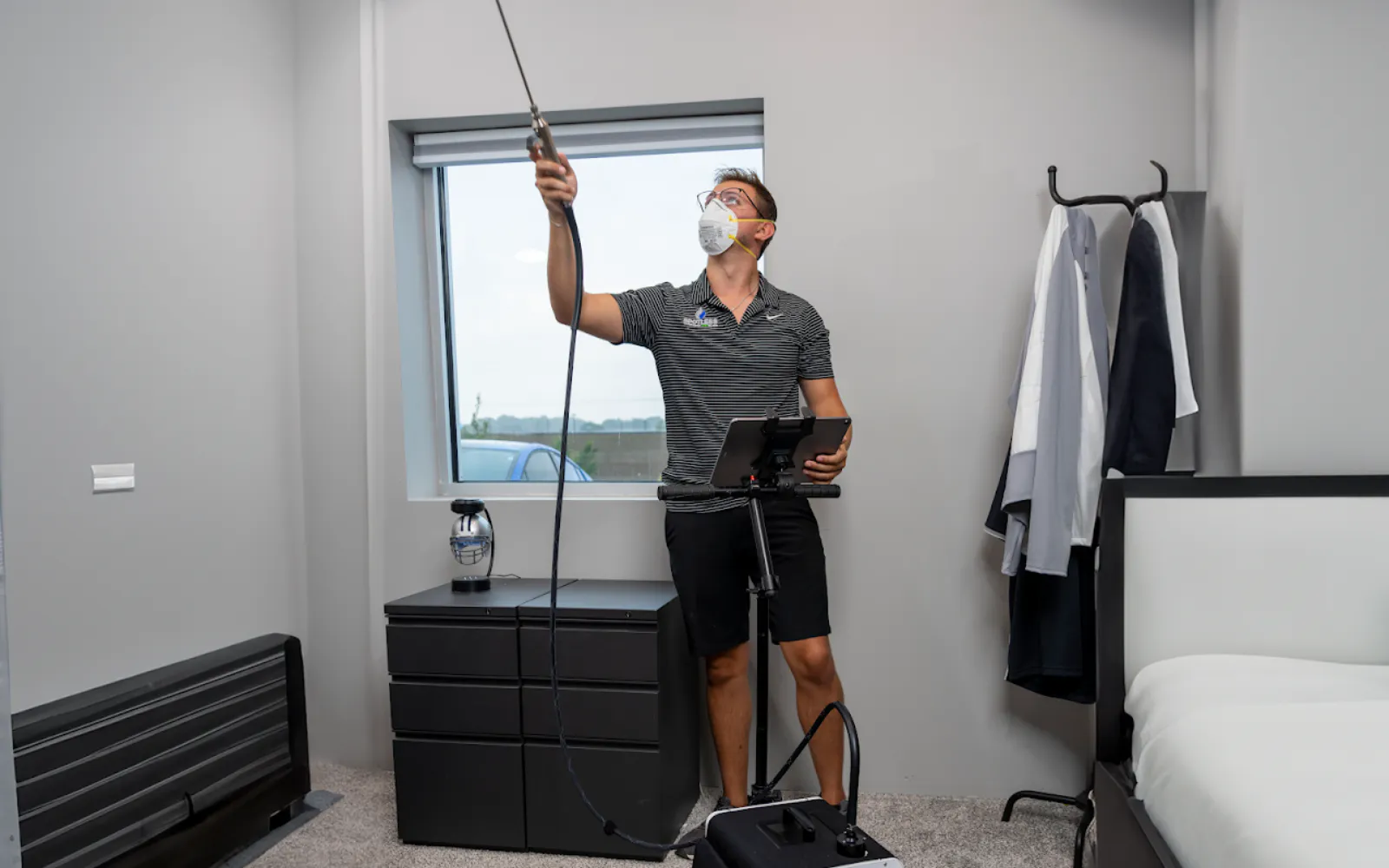
Caleb Jones, Lead Inspector at Spotless, uses air testing as one part of a larger inspection process — not as a standalone answer.
“We can do air captures inside and outside the homes to figure out what type of mold that the client is dealing with.”
Caleb Jones
This guide explains how to air test for mold, when it makes sense, what the results can and can’t tell you, and why mold air testing works best when it’s paired with moisture detection, visual inspection, and source investigation.
What Is Mold Air Testing?
Mold air testing is a process of collecting air samples to understand what may be circulating inside the home. Depending on the method used, samples may be sent to a third-party lab or evaluated with on-site air quality equipment.
The goal is usually to compare indoor air with outdoor air, identify whether mold spores or mold-like particles are elevated, and help determine whether further investigation is needed.
Air testing can be useful when there’s no obvious visible mold but the homeowner has concerns about odor, indoor air quality, past water damage, HVAC issues, or possible hidden mold.
Caleb explains that testing may involve both air and surface samples.
“If you want to have any lab test results certified by a third-party lab, I will take like a swab sample of crawlspace or an HVAC system or we can do air captures inside and outside the homes.”
Caleb Jones
But mold air testing is not a simple pass/fail test. The EPA states that no EPA or federal limits have been set for mold or mold spores, so sampling can’t be used to check compliance with federal mold standards. Source: EPA, Mold Testing or Sampling.
That’s why interpretation matters. A mold air test should be understood alongside inspection findings, moisture readings, room conditions, and the homeowner’s concerns.
If you’re relying on air testing to make a decision, make sure the test is paired with a real inspection — not just a number on a lab report.
For the bigger picture, read our guide to hidden mold in your home.
When Does Air Testing for Mold Make Sense?
Air testing for mold can make sense when there are signs of a possible mold problem, but the source isn’t obvious.
It’s especially useful when the concern is about what may be moving through the air rather than what’s visible on one surface. For example, a homeowner may smell mold but not see it, or they may suspect an HVAC issue, crawl space problem, or hidden moisture source.
Air testing may be helpful when there’s:
- A persistent musty smell with no visible mold
- A moldy odor from vents or HVAC equipment
- Previous water damage
- Crawl space or attic concerns
- Suspected hidden mold behind walls or under floors
- A moldy-looking HVAC filter
- Symptoms that seem worse indoors
- A medical provider asking for environmental information
- A need for documentation before deciding next steps
Spotless doesn’t diagnose medical conditions. We inspect and remediate the home environment. If you’re dealing with ongoing symptoms, it’s important to speak with a qualified medical professional.
That said, Caleb often uses lab testing when a homeowner wants confirmation or when visual identification isn’t enough.
“And if they just want that certification, like I’m not really sure if it is mold and it’s not something that I can visually identify, then obviously I’ll do the lab testing at a cost.”
Caleb Jones
Air testing can be useful, but it shouldn’t distract from the most important question: where is the moisture or contamination coming from?
If you smell mold but can’t see it, air testing may help — but the first step is understanding where moisture or contamination may be coming from.
For odor clues, read what can be mistaken for mold smell.
How Professional Mold Air Testing Works
Professional mold air testing should start with the inspection, not the equipment.
Before samples are taken, the inspector should ask questions: Where is the smell strongest? When did it start? Has there been a leak? Does the odor change after rain? Does it get worse when the HVAC runs? Are there certain rooms that feel more humid or irritating?
From there, air testing may follow a process like this:
- Start with the homeowner’s concerns. The testing plan should be based on what’s actually happening in the house.
- Inspect high-risk areas. Crawl spaces, attics, HVAC systems, basements, plumbing areas, and previous water damage areas should be considered.
- Choose sample locations. The inspector may sample rooms with odor, suspected moisture, HVAC concerns, or occupant concerns.
- Take an outdoor baseline sample. Outdoor air helps provide context for what’s normal on that day.
- Collect indoor air samples. These may be taken in specific rooms or areas of concern.
- Send samples to a lab when needed. Lab analysis may help identify mold types and concentrations.
- Interpret results with the inspection findings. Air testing should support the bigger investigation.
Caleb brings both swab testing and air quality captures to inspections when testing is appropriate.
“I usually take swab testing with me and air quality captures.”
Caleb Jones
Spotless may also use on-site air quality equipment when it makes sense. That can give faster information, though it may not replace lab testing when mold type identification is needed.
Professional mold testing should answer a specific question: what’s in the air, where it may be coming from, and what should happen next.
To schedule local help, learn more about mold inspection in Lexington KY.
What Are Quiescent and Resuspension Air Scans?
Some air quality tools can test the room in different conditions. Caleb described this when explaining Spotless’ Instascope, an on-site air quality tool that can help evaluate indoor air quickly.
Quiescent scan
A quiescent scan looks at the air as it is when the inspector enters the room. No deliberate disturbance. No moving furniture around. No stirring up dust.
It gives a snapshot of the normal room conditions at that moment.
Resuspension scan
A resuspension scan looks at what may become airborne when settled particles are disturbed. That may involve moving furniture, turning on fans, or otherwise disturbing the room in a controlled way.
Caleb explains the difference this way:
“Per room you do two scans, one quiescent, which is just standard, no disruption… And then a resuspension scan, which is when I start messing with things to disturb settled spores.”
Caleb Jones
This can be useful because mold-related particles may not always be floating in the air at the exact moment of a standard sample. Some particles may be settled in dust, furniture, carpets, contents, or HVAC-affected areas.
The Instascope can also measure bacteria load, pollen load, and VOCs, which matters because not every indoor air issue is mold. Its limitation is that it does not identify the exact type of mold present.
If your concern is hidden or settled contamination, ask whether on-site air quality scanning or lab-based air testing makes more sense for your situation.
For HVAC-related concerns, read mold in air ducts.
What Air Testing Can and Can’t Tell You
Air testing can be valuable, but it has limits.
It can help show whether mold spores or mold-like particles are present in sampled air. It can compare one room with another. It can compare indoor findings against outdoor baseline conditions. It can support a broader inspection when there’s a musty smell, HVAC concern, or suspected hidden mold.
But it can’t see inside walls. It can’t always tell you exactly where mold is coming from. It may miss hidden mold if spores are not airborne during the sampling window. And it should never replace moisture detection or source investigation.
Caleb says this plainly:
“I can only access what I can access. I can only tell what the tools are gonna tell me.”
Caleb Jones
That’s why a clean or unclear air test doesn’t always mean there’s no hidden mold. If the home still smells musty, if there’s evidence of water damage, or if certain rooms continue to feel damp or irritating, the investigation shouldn’t stop just because one test didn’t give a dramatic answer.
CDC/NIOSH also notes that there are no health-based standards for mold or other biological agents in indoor air and does not recommend routine air sampling for mold as part of building air quality evaluations. Source: CDC/NIOSH, Mold Testing and Remediation.
That doesn’t mean testing is useless. It means testing should be used for the right reason.
A clean or unclear air test doesn’t always mean there’s no hidden mold. If the signs are still there, keep investigating the source.
For visual clues, read signs of hidden mold in walls, ceilings, and floors.
Should You Use a DIY Mold Air Test Kit?
DIY mold air test kits can seem convenient, but they can be misleading without the right sampling plan and interpretation.
Mold spores exist naturally in many indoor and outdoor environments. Finding some mold on a test doesn’t always tell you whether there’s an active problem, where the source is, or what should happen next.
The EPA recommends that mold sampling be conducted by professionals who have experience with sampling protocols, sampling methods, and interpreting results. Source: EPA, Is Sampling/Testing for Mold Necessary?.
That’s especially important if you’re dealing with a hidden mold concern. A DIY kit may collect something, but it won’t inspect the crawl space, check the HVAC system, look for moisture behind a wall, evaluate humidity, or explain whether the test result matches the conditions in the home.
Caleb’s concern about the industry applies here too:
“I think there’s a lack of transparency in my industry.”
Caleb Jones
A test without explanation can leave you more confused than when you started.
Before spending money on a DIY kit, call Spotless and ask whether air testing is actually the right next step for your home.
If you’re comparing testing options, read ERMI mold testing.
What to Do After Mold Air Testing
Mold air testing should lead to a decision. It shouldn’t leave you with a lab report and no plan.
After testing, the next steps may include:
- Reviewing the results alongside the inspection findings.
- Comparing indoor samples with outdoor baseline conditions.
- Looking for moisture sources.
- Inspecting high-risk areas like HVAC systems, crawl spaces, attics, plumbing zones, walls, and floors.
- Using swabs, additional air testing, ERMI, Mold Dog Network, or an industrial hygienist if the situation calls for it.
- Moving into controlled remediation if findings support it.
- Considering post-remediation testing through an appropriate third party when needed.
The most important thing is to connect the data to the source. If testing shows a concern but nobody identifies where the moisture or contamination is coming from, the problem may continue.
Caleb’s approach is to solve the issue correctly from the beginning.
“I try to approach the project from a standpoint of do it correctly the first time and make sure you’re covering all your bases.”
Caleb Jones
If mold is confirmed, Spotless provides health-focused mold remediation in Lexington KY designed to address the source, control cross-contamination, and protect indoor air quality.
If there’s strong concern but little visible evidence, advanced hidden mold detection through Mold Dog Network may help identify areas that need further investigation.
If your air test points to a mold concern, Spotless can help connect the results to a clear inspection and remediation plan.
Final Thoughts
Mold air testing can be helpful, but it works best as part of a full inspection.
It can show what may be present in sampled air, compare indoor and outdoor conditions, and support decisions when mold is suspected but not visible. But it can’t see inside walls, replace moisture detection, or tell the whole story by itself.
The best approach is to use air testing as one tool in a larger investigation.
“Yes, we can fix this. This is the cost associated with it. There’s a light at the end of the tunnel.”
Caleb Jones
Spotless is a locally owned, IICRC-certified mold remediation and water damage restoration company serving Lexington and Central Kentucky. With more than 30 years of experience, our team helps homeowners investigate hidden mold, understand indoor air quality concerns, and move forward with a clear plan.
If you’re wondering how to air test for mold in your home, you don’t have to figure it out alone. Call Spotless to schedule a mold inspection and testing consultation.
Spotless is the most trusted name in restoration in central Kentucky including Lexington, Nicholasville and surrounding communities.
Specializing in health-focused mold remediation and water damage restoration, we leave mold-affected clients with a healthier home.
Call 859-459-0424 and speak to a technician today!