
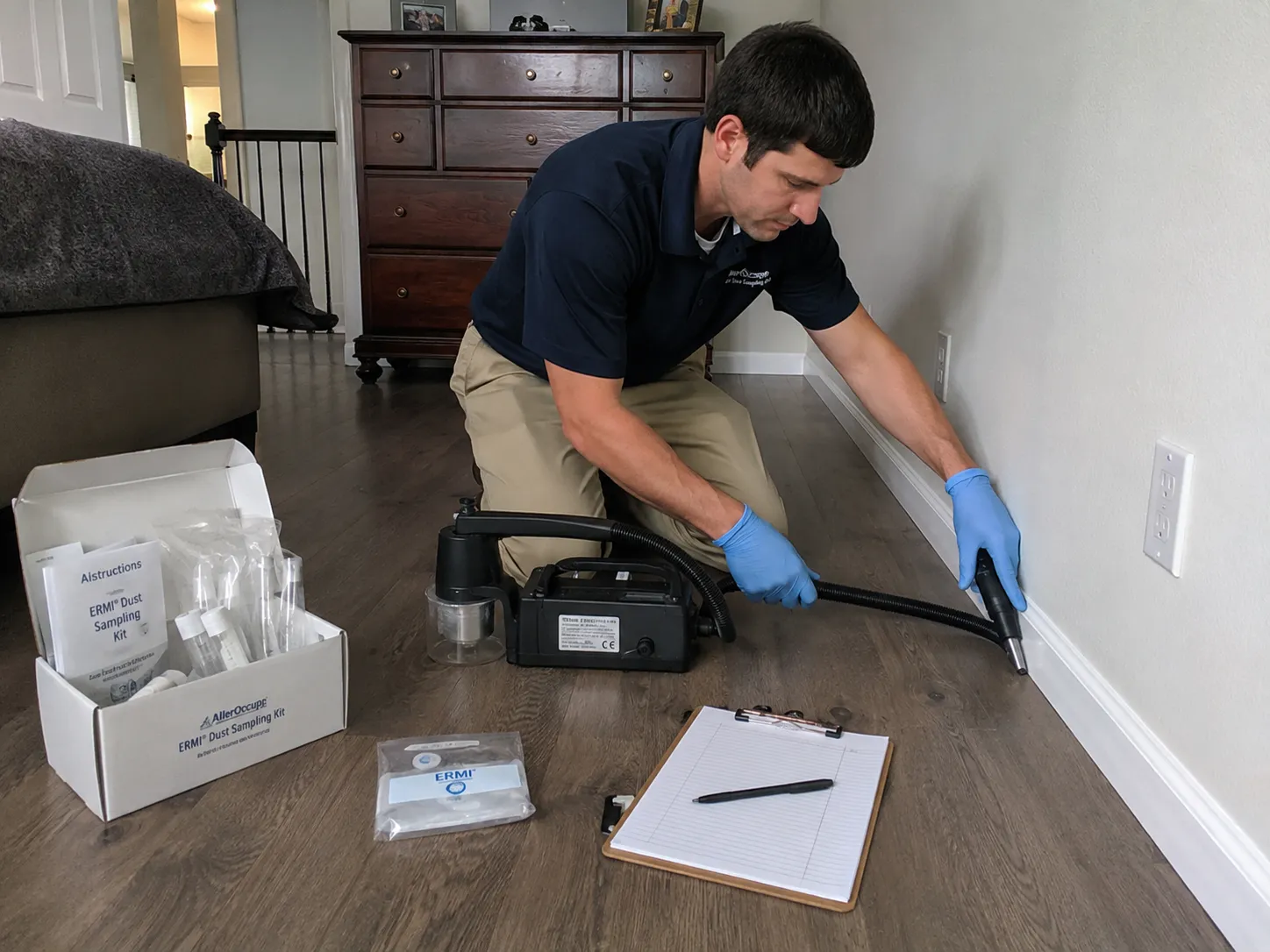
ERMI Mold Testing: What It Is and When It Makes Sense
ERMI mold testing can sound like the answer when you’re worried about hidden mold.
Maybe you’ve already had an air test that didn’t explain what you’re feeling. Maybe there’s a musty smell that keeps coming back. Maybe you’re mold-sensitive, working with a functional doctor, or trying to understand whether your home has a deeper contamination issue.
It’s completely understandable to want more data.
But ERMI isn’t a magic “safe or unsafe” test, and it shouldn’t be used as the only basis for a major remediation decision. Like any mold test, it has to be interpreted in context.
Caleb Jones, Lead Inspector at Spotless, is direct about the limits of every inspection and testing method.
“I can only access what I can access. I can only tell what the tools are gonna tell me.”
Caleb Jones
This guide explains what ERMI mold testing is, how it works, when it may be useful, when it may not be the right first step, and how Spotless connects testing results to a real inspection and remediation plan.
What Is ERMI Mold Testing?
ERMI stands for Environmental Relative Moldiness Index. It was developed by EPA scientists as a research tool to estimate mold contamination in homes by analyzing mold DNA found in dust.
That part matters: ERMI is usually a dust test, not an air test. Instead of capturing what’s floating in the air during one short sample window, ERMI looks at settled dust, which may give a longer-term picture of what has been present in the home.
EPA describes ERMI as a research tool for estimating mold contamination and says it has been peer reviewed for research purposes, but not validated for non-research purposes.
In plain English: ERMI can provide detailed information, but it shouldn’t be treated as a standalone diagnosis of your home.
Caleb’s approach to testing is similar. Spotless uses testing when it answers a clear question.
“If you want to have any lab test results certified by a third-party lab, I will take like a swab sample of crawlspace or an HVAC system or we can do air captures inside and outside the homes.”
Caleb Jones
ERMI may be one option to discuss, but the better first question is: What are we trying to find out?
If you’re considering ERMI mold testing, start by asking what question you need the test to answer — and whether inspection should come first.
For the wider picture, read our guide to hidden mold in your home.
How ERMI Testing Works
ERMI testing starts with a dust sample. That dust is sent to a lab, where DNA-based methods are used to identify and quantify selected mold species.
The ERMI method looks at 36 molds: 26 Group 1 molds associated with water-damaged homes and 10 Group 2 molds commonly found in homes regardless of water damage. A PubMed-indexed study describing ERMI’s use in national housing data explains that dust samples were analyzed with qPCR assays for those 36 common indoor molds.
The lab then calculates an ERMI score or index. That score is meant to compare the dust sample against a reference scale.
A simplified ERMI process looks like this:
- Dust is collected from the home.
- The lab analyzes mold DNA.
- Selected mold species are quantified.
- Group 1 and Group 2 molds are compared.
- An ERMI score is calculated.
- Results are interpreted alongside the home’s history and inspection findings.
This is different from air testing. Air testing tells you what was airborne during a specific sample period. ERMI looks at dust, which may reflect what has settled over time.
“I usually take swab testing with me and air quality captures.”
Caleb Jones
That’s the key: different tests answer different questions. ERMI may tell you something about settled dust, but it won’t automatically tell you where the source is, whether there’s active moisture, or what should be removed.
ERMI results are most useful when they’re interpreted alongside the home’s moisture history, visual findings, and inspection data.
If you’re comparing testing options, read how to air test for mold.
ERMI vs Air Testing vs Swab Testing
ERMI isn’t automatically better than air testing or swab testing. It’s different.
Each testing method has a place, depending on what you’re trying to confirm.
| Test type | What it samples | Best for | Limitations |
| ERMI | Settled dust | Longer-term mold DNA picture | Not validated by EPA for routine non-research home decisions |
| Air testing | Airborne particles during the sample window | What’s circulating at that moment | May miss settled or hidden contamination |
| Swab/tape testing | A specific surface | Confirming suspicious visible material | Only tells you about the sampled spot |
| Visual/moisture inspection | Building conditions and materials | Finding the likely source | Can’t see inside every cavity |
Caleb may recommend lab testing when something needs confirmation, especially if the material isn’t easy to identify visually.
“And if they just want that certification, if I’m not really sure if it is mold and it’s not something that I can visually identify, then obviously I’ll do the lab testing at a cost.”
Caleb Jones
The mistake is treating a test result like the whole story.
A high ERMI score may tell you the home has concerning mold DNA in dust, but it doesn’t show you the leaking pipe, wet crawl space, attic roof leak, HVAC issue, or contaminated wall cavity. A low or moderate score doesn’t automatically rule out a hidden source either.
The right mold test depends on the question: what’s airborne, what’s on a surface, what’s in dust, or where the moisture source is.
For related clues, read what can be mistaken for mold smell and signs of hidden mold in walls, ceilings, and floors.
When ERMI Mold Testing May Make Sense
ERMI mold testing may be worth discussing when a homeowner needs more environmental data than a basic inspection or single air sample can provide.
It may make sense to discuss ERMI when:
- There’s a persistent musty smell with no clear visible source.
- You’re mold-sensitive and want more detailed environmental information.
- There has been prior water damage or more than one remediation attempt.
- Air test results don’t match what’s happening in the home.
- A qualified medical provider has asked for environmental context.
- The home has a complex moisture history.
- You’re trying to understand whether settled dust may reflect past or hidden contamination.
Notice the wording: may make sense to discuss. Not “everyone needs ERMI.”
Caleb knows how intimidating testing can feel for homeowners dealing with mold for the first time.
“It’s usually my client’s first time ever dealing with mold. So it can be an intimidating thing.”
Caleb Jones
That’s why Spotless doesn’t want homeowners collecting tests just because they’re scared. The goal is to choose the right next step for the actual home, not chase every possible data point.
ERMI may be helpful in some hidden mold situations, but it should not replace moisture detection, visual inspection, HVAC evaluation, or source identification.
If you’re overwhelmed by testing options, Spotless can help you choose the method that matches your home — not just the test that sounds most advanced.
For local help, learn more about mold testing in Lexington KY.
When ERMI Testing May Not Be the Right First Step
ERMI testing is not always the best place to start.
If visible mold is already present, EPA guidance says sampling is usually unnecessary; the priority is fixing the moisture problem and removing the mold. EPA also states that no EPA or federal limits have been set for mold or mold spores, so sampling can’t prove a building meets federal mold standards.
EPA’s specific answer on ERMI is even more cautious: ERMI is a research tool and is not recommended except as a research tool.
That doesn’t mean homeowners can’t ever discuss ERMI with qualified professionals. It means the test should be used carefully, with context, and with a clear reason.
ERMI may not be the right first step if:
- You already have visible mold that needs proper removal.
- There’s active water intrusion that needs fixing first.
- You’re hoping for a simple “safe/unsafe” answer.
- You don’t have anyone qualified to interpret the report.
- You’re likely to make major remediation decisions from the score alone.
- The source of moisture hasn’t been investigated.
Caleb avoids fear-based selling because mold is already stressful enough.
“This is a very easy industry to use fear tactics and stuff in. I try to avoid doing that.”
Caleb Jones
Before ordering ERMI because you’re scared, get a calm inspection plan that identifies moisture, visible clues, and the most useful next test.
If odor is the main concern, read what black mold smells like.
How Spotless Interprets Testing as Part of the Bigger Picture
Spotless doesn’t treat any single mold test as the entire answer.
A test can be useful. But the real question is: What does this result mean inside this specific home?
Caleb’s inspection process may include homeowner concerns, visual findings, moisture readings, humidity checks, HVAC evaluation, swabs, air captures, and on-site air quality tools when appropriate. If there’s strong concern but the source remains unclear, the next step may involve Mold Dog Network, an industrial hygienist, or more targeted inspection.
Just as importantly, Caleb wants homeowners involved in the process.
“I want my clients to be as much of a part of the inspection as possible because I think there’s a lack of transparency in my industry.”
Caleb Jones
That transparency matters because testing can feel overwhelming. You may have a report full of species names, numbers, and scores, but still not know what to do next.
Spotless’ job is to help connect the dots:
- What are you noticing in the home?
- What moisture history does the house have?
- What areas are most likely to be affected?
- What does the test actually show?
- Does the result match the inspection findings?
- Do we need more targeted testing or detection?
- Is controlled remediation needed?
A good mold testing plan should leave you clearer, calmer, and closer to a solution — not more confused.
To schedule local support, visit mold inspection in Lexington KY.
What to Do After an ERMI Test
If you already have ERMI results, don’t panic over the score alone.
A report is useful only when it helps you make a better decision. The next step is to connect that information to the home.
Here’s a practical path:
- Review the ERMI report with someone qualified to interpret it.
- Compare the results with the home’s history, odors, moisture, and visible signs.
- Inspect likely sources: crawl spaces, attics, HVAC systems, plumbing areas, walls, floors, and basements.
- Check for active moisture or humidity issues.
- Consider air testing, swabs, Mold Dog Network, or an industrial hygienist if the source remains unclear.
- Fix moisture sources before or during remediation planning.
- Move into controlled remediation if findings support it.
Testing without source identification can keep homeowners stuck. You may know something is wrong, but still not know where it is or how to fix it.
Caleb’s philosophy is to do the work properly from the beginning.
“I try to approach the project from a standpoint of do it correctly the first time and make sure you’re covering all your bases.”
Caleb Jones
If ERMI or other testing points to a mold concern, Spotless provides health-focused mold remediation in Lexington KY to help identify the source, control cross-contamination, and remediate affected areas properly.
If the likely source is hidden behind walls, cabinets, showers, or other cavities, advanced hidden mold detection through Mold Dog Network may also be worth discussing.
If your ERMI results have left you worried or unsure, call Spotless for a practical inspection plan and clear next steps.
Final Thoughts
ERMI mold testing can provide useful dust-based mold DNA information, especially in complex homes where hidden mold is a serious concern.
But it is not a standalone diagnosis. It does not replace inspection, moisture readings, source identification, or a thoughtful remediation plan. EPA describes ERMI as a research tool, and homeowners should be careful about making major decisions from ERMI results alone.
The best next step depends on what you need to know.
Spotless is a locally owned, IICRC-certified mold remediation and water damage restoration company serving Lexington and Central Kentucky. With more than 30 years of experience, our team helps homeowners investigate mold concerns, understand testing options, and move forward with a clear plan.
If you’re considering ERMI mold testing, you don’t have to sort through it alone. Call Spotless to schedule a mold inspection and talk through the right next step for your home.
Spotless is the most trusted name in restoration in central Kentucky including Lexington, Nicholasville and surrounding communities.
Specializing in health-focused mold remediation and water damage restoration, we leave mold-affected clients with a healthier home.
Call 859-459-0424 and speak to a technician today!