
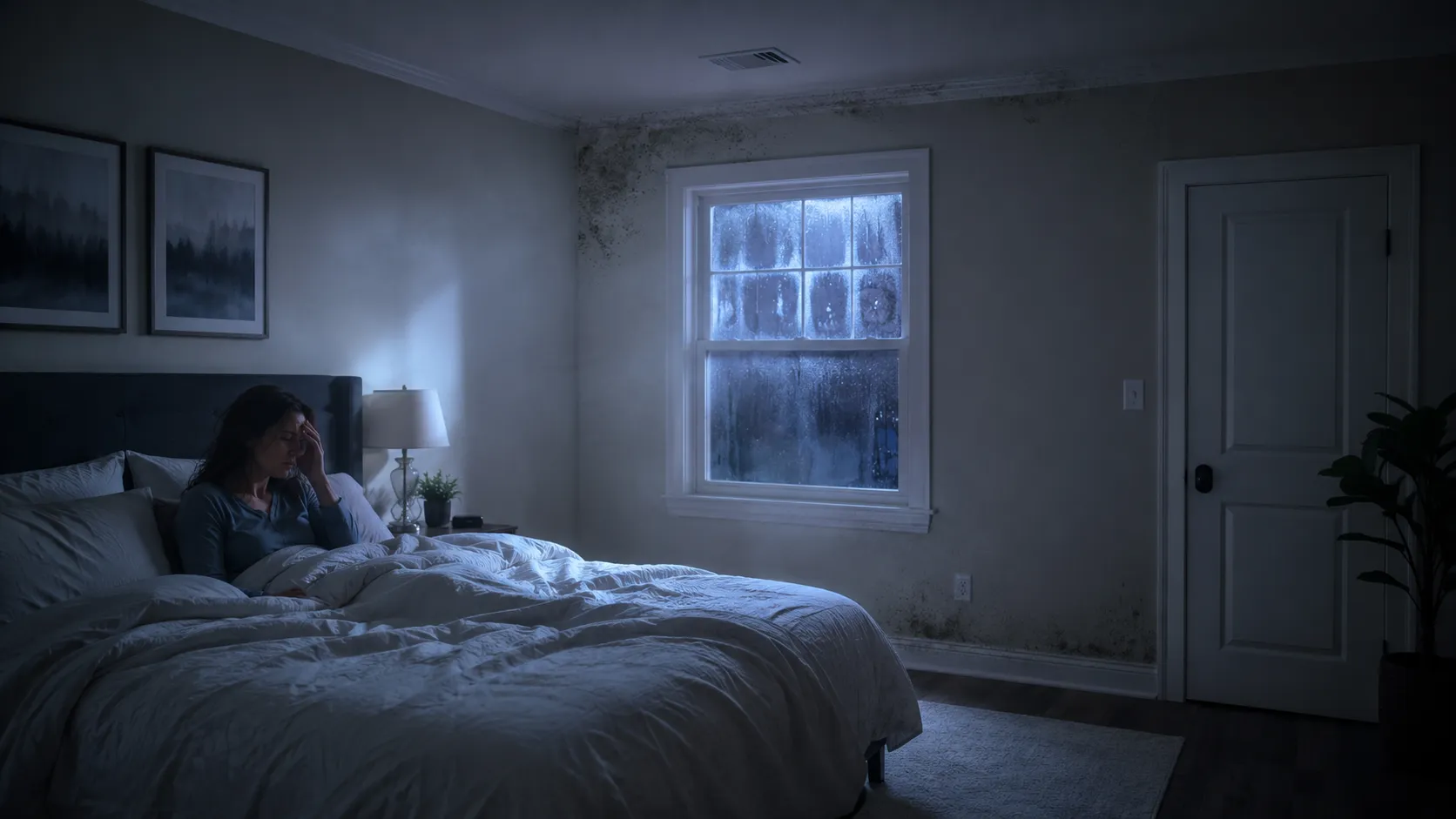
Bedroom Mold Growth: Why Symptoms Can Feel Worse at Night
When your bedroom starts to feel like the room that makes you feel worse, it can be deeply unsettling.
Maybe you wake up congested. Maybe your throat feels irritated in the morning. Maybe you cough more at night, sleep poorly, or notice a musty smell when the door has been closed for a while. And if you can’t see mold on the walls, it’s easy to wonder whether you’re imagining it.
You’re not wrong to pay attention.
Bedroom mold growth can be visible, but it can also hide behind walls, inside closets, around windows, in flooring, above ceilings, or in the HVAC system feeding air into the room. Sometimes the bedroom isn’t even the original source — it’s just where the problem becomes most noticeable because you spend hours there.
Caleb Jones, Lead Inspector at Spotless, understands why this feels personal.
“It’s an emotional thing whenever your safest space in this world is not feeling safe anymore.”
Caleb Jones
This guide explains why symptoms may feel worse at night, where mold can hide in bedrooms, and when it’s time to schedule a professional inspection.
- Can Bedroom Mold Make Symptoms Feel Worse at Night?
- Why the Bedroom Can Reveal a Mold Problem First
- Where Mold Hides in Bedrooms
- How HVAC and Crawl Space Air Can Affect Bedroom Air Quality
- Bedroom Mold Signs Homeowners Should Look For
- How Spotless Inspects a Bedroom Mold Concern
- What to Do If You Suspect Mold in Your Bedroom
- Final Thoughts
Can Bedroom Mold Make Symptoms Feel Worse at Night?
Mold doesn’t affect everyone the same way. Some people may notice very little. Others, especially people with asthma, mold allergies, respiratory sensitivity, immune concerns, or a history of mold sensitivity, may feel worse in damp or mold-affected indoor environments.
The CDC says mold can cause symptoms such as stuffy nose, sore throat, coughing or wheezing, burning eyes, or skin rash. People with asthma or mold allergies may have more severe reactions. Source: CDC, Mold.
That doesn’t mean mold is the cause of every nighttime symptom. Spotless doesn’t diagnose medical conditions, and anyone dealing with ongoing symptoms should speak with a qualified medical professional.
But from a home-environment perspective, bedroom mold growth is worth investigating if your symptoms seem worse after sleeping, when the bedroom door is closed, or when the HVAC runs overnight.
One reason bedroom concerns can feel stronger at night is exposure time. The EPA notes that Americans spend approximately 90% of their time indoors, making indoor air quality especially important. Source: EPA, Indoor Air Quality Exposure and Characterization Research.
When you spend seven or eight hours in one room, breathing the same air, small indoor air problems can feel more noticeable.
Caleb has seen how meaningful it can be when homeowners finally connect their indoor environment to the problem they’ve been trying to solve.
“I’ve worked with a lot of really sick people that have called back six months later or a year later and say, my gosh, we feel so much better.”
Caleb Jones
If you consistently feel worse in your bedroom, don’t assume it’s “just allergies.” A mold inspection can help determine whether your room or air pathways need attention.
For the broader hidden mold picture, read hidden mold in your home.
Why the Bedroom Can Reveal a Mold Problem First
Bedrooms are different from other rooms because you spend long, uninterrupted stretches of time there.
The door may be closed. Windows may stay shut. The HVAC may run overnight. Bedding, curtains, carpet, rugs, upholstered furniture, closets, and dust can all hold odors and particles. If humidity is high or air circulation is poor, the room may feel stale by morning.
That doesn’t mean the bedroom is always the source of the mold. Sometimes it’s simply where the symptoms, odors, or air quality issues become hardest to ignore.
Air may be coming into the bedroom from:
- HVAC ducts or vents
- A crawl space below
- An attic above
- A bathroom wall nearby
- A closet on an exterior wall
- Gaps around framing, floors, or wall cavities
- Damp carpet or flooring
Caleb explains that homes can share air with spaces homeowners rarely think about, especially crawl spaces and attics.
“Your home does typically share airspace with the crawlspace through the stack effect.”
Caleb Jones
The stack effect is a building-science concept that means air can be pulled from lower or hidden spaces into the living area as air moves through the home. In simple terms, your bedroom may be affected by air that started somewhere else.
If the bedroom is where you notice symptoms, odors, or poor sleep first, Spotless can help trace whether the issue starts in the room or somewhere feeding air into it.
If odor is one of your first clues, read what black mold smells like.
Where Mold Hides in Bedrooms
Bedroom mold growth isn’t always obvious. You may never see a dramatic black patch on the wall. Instead, there may be subtle clues: discoloration, condensation, closet odor, staining, warped flooring, or a musty smell that gets stronger when the room is closed up.
Caleb often starts inspections in areas homeowners don’t usually enter because those spaces can reveal what’s really happening behind the living area.
“I usually start with areas that are accessible that the homeowner doesn’t usually go into, which would be a crawl space, an attic, an unfinished basement.”
Caleb Jones
Here are the bedroom-related hiding places worth paying attention to:
Closets
Closets often have poor airflow, especially when they’re packed full of clothes, shoes, boxes, or stored items. If the closet is on an exterior wall, condensation or insulation issues can create a damp environment. A roof leak, wall leak, or attic issue may also show up as closet odor before obvious damage appears.
Windows and exterior walls
Condensation around windows can raise humidity near drywall, trim, curtains, and flooring. Exterior walls behind furniture can also become problem areas when air doesn’t circulate well.
Ceilings
A bedroom ceiling stain may point to an attic issue, roof leak, bathroom leak from above, or HVAC condensation. Small ceiling stains shouldn’t be painted over until the moisture source is understood.
Carpet and flooring
Carpet and padding can hold moisture from spills, leaks, humidity, or crawl space moisture below. Wood or laminate floors may cup, buckle, or separate near moisture sources.
Bathroom-adjacent walls
If a bedroom shares a wall with a bathroom, hidden leaks from a shower, toilet, vanity, or plumbing line may affect the bedroom wall cavity.
HVAC vents and filters
If the HVAC system is contaminated, a bedroom can receive moldy or musty air even when the room itself looks clean.
If your bedroom smells musty but the walls look clean, the source may still be nearby — behind materials, above the ceiling, below the floor, or inside the air system.
For more visual clues, read signs of hidden mold in walls, ceilings, and floors.
How HVAC and Crawl Space Air Can Affect Bedroom Air Quality
In Kentucky homes, HVAC systems and crawl spaces deserve special attention.
Caleb specifically looks at crawl spaces and HVAC systems on his inspections because the home’s air pathways may travel through spaces homeowners rarely check. He explained that in Kentucky, HVAC systems are often located in or routed through crawl spaces, which can create problems when the crawl space is damp or contaminated.
“Particularly in Kentucky, we tend to put our HVAC systems in crawl spaces, which can lead to a lot of issues of a client starting to feel sick in their home but not being able to see anything.”
Caleb Jones
That’s important for bedroom mold concerns because the bedroom may be downstream from the actual source.
If crawl space air is contaminated and the HVAC system has leaks, gaps, dirty components, or poor seals, particles and odors may move through the air system. Caleb also described finding a recently installed HVAC filter covered in mold during an inspection, which immediately gave the homeowner an explanation for some of the concerns in the home.
HVAC-related mold or odor may be more noticeable when:
- The system first turns on
- The bedroom door is closed overnight
- Vents blow directly toward the bed
- The room feels stuffy by morning
- Filters look dirty or moldy
- The crawl space smells damp or musty
- Symptoms seem worse when air is circulating
If symptoms or odors worsen when the HVAC runs, Spotless can inspect both the system and the crawl space or attic areas that may be feeding the air.
For more detail, read mold in air ducts.
Bedroom Mold Signs Homeowners Should Look For
You don’t need to tear your bedroom apart to look for clues. In fact, you shouldn’t disturb suspected mold without containment.
Start with safe, visible signs.
Caleb says unusual colors are worth checking, even when the growth doesn’t look like the classic “black mold” image people have in mind.
“Any colors that are not supposed to be in your home, you know, that’s worthwhile checking out.”
Caleb Jones
Look for:
- A musty smell that’s strongest in the bedroom
- Condensation on windows
- Stains or spotting on walls or ceilings
- Discoloration behind furniture
- Closet odor
- Warped flooring near an adjacent bathroom
- Damp carpet or rugs
- Moldy-looking HVAC vents or filters
- Paint bubbling or peeling
- Symptoms that feel worse after sleeping
- A history of roof leaks, plumbing leaks, or water damage
Keep in mind that mold may not always be the cause. Dust, VOCs, dirty HVAC components, pests, sewer gas, damp carpet, or poor ventilation can also create odors or irritation.
If you’re seeing bedroom mold signs, take photos and avoid disturbing the area until it can be inspected safely.
If you’re unsure whether the odor is mold-related, read what can be mistaken for mold smell.
How Spotless Inspects a Bedroom Mold Concern
A good bedroom mold inspection shouldn’t stop at the bedroom wall.
At Spotless, Caleb looks at the room, the surrounding spaces, and the systems that may be feeding air into the room. That may include the HVAC system, crawl space, attic, bathroom-adjacent walls, closets, windows, flooring, and nearby plumbing.
The inspection may include:
- Listening to when symptoms or odors happen.
- Checking walls, ceilings, windows, closets, floors, and vents.
- Looking for moisture near bathrooms, windows, and exterior walls.
- Inspecting crawl spaces, attics, unfinished basements, and HVAC systems when relevant.
- Using moisture meters and humidity readings.
- Using swabs, air testing, or on-site air quality tools when needed.
- Recommending controlled remediation only when findings support it.
Caleb wants homeowners involved in the process because mold inspections can feel intimidating.
“I want my clients to be as much of a part of the inspection as possible because I think there’s a lack of transparency in my industry.”
Caleb Jones
We get it. When the room you sleep in feels wrong, you don’t need scare tactics. You need clear answers, careful inspection, and a plan that makes sense.
If visible evidence is minimal but the concern is strong, advanced hidden mold detection through Mold Dog Network may help identify hidden areas that need further evaluation.
A bedroom mold inspection should give you clarity about the room, the air pathways, and the source — not just a quick glance at the wall.
To schedule local help, visit mold inspection in Lexington KY.
What to Do If You Suspect Mold in Your Bedroom
If you suspect mold in your bedroom, don’t panic, but don’t ignore it either.
Start with a calm, practical plan:
- If you’re concerned or sensitive, avoid sleeping next to visible or suspected mold until it’s evaluated.
- Don’t scrape, spray, sand, or disturb suspected mold.
- Note whether symptoms or odors are worse at night, in the morning, after rain, or when the HVAC runs.
- Check safe visible areas: windows, closets, vents, exterior walls, flooring, and nearby bathroom walls.
- Look under adjacent sinks or around toilets if the bedroom shares a wall with a bathroom.
- Improve ventilation temporarily if appropriate, but don’t treat that as the fix.
- Schedule a professional mold inspection.
- If mold is confirmed, move into health-focused remediation that addresses the source.
Caleb’s goal is to solve the problem properly the first time.
“I try to approach the project from a standpoint of do it correctly the first time and make sure you’re covering all your bases.”
Caleb Jones
That means finding the moisture source, understanding how air is moving through the home, controlling cross-contamination, and removing or treating affected materials properly.
Spotless provides health-focused mold remediation in Lexington KY for homeowners who need more than a surface-level cleanup.
If your bedroom no longer feels like a safe place to rest, call Spotless for a careful mold inspection and a clear next step.
Final Thoughts
Bedroom symptoms can feel worse at night for several reasons: long exposure time, closed-door conditions, limited ventilation, HVAC pathways, dust, humidity, hidden moisture, or mold growth in nearby spaces.
Mold is not the only possible cause, but persistent bedroom odors, visible staining, dampness, or symptoms that seem worse after sleeping deserve investigation.
“Yes, we can fix this. There’s a cost associated with it, but there’s a light at the end of the tunnel.”
Caleb Jones
Spotless is a locally owned, IICRC-certified mold remediation and water damage restoration company serving Lexington and Central Kentucky. With more than 30 years of experience, our team helps homeowners investigate bedroom mold concerns, indoor air quality issues, hidden moisture, and the air pathways that may be affecting the room.
If your bedroom doesn’t feel like a healthy place to sleep, you don’t have to keep guessing. Call Spotless to schedule a mold inspection and get a clear plan for what to do next.
Spotless is the most trusted name in restoration in central Kentucky including Lexington, Nicholasville and surrounding communities.
Specializing in health-focused mold remediation and water damage restoration, we leave mold-affected clients with a healthier home.
Call 859-459-0424 and speak to a technician today!