
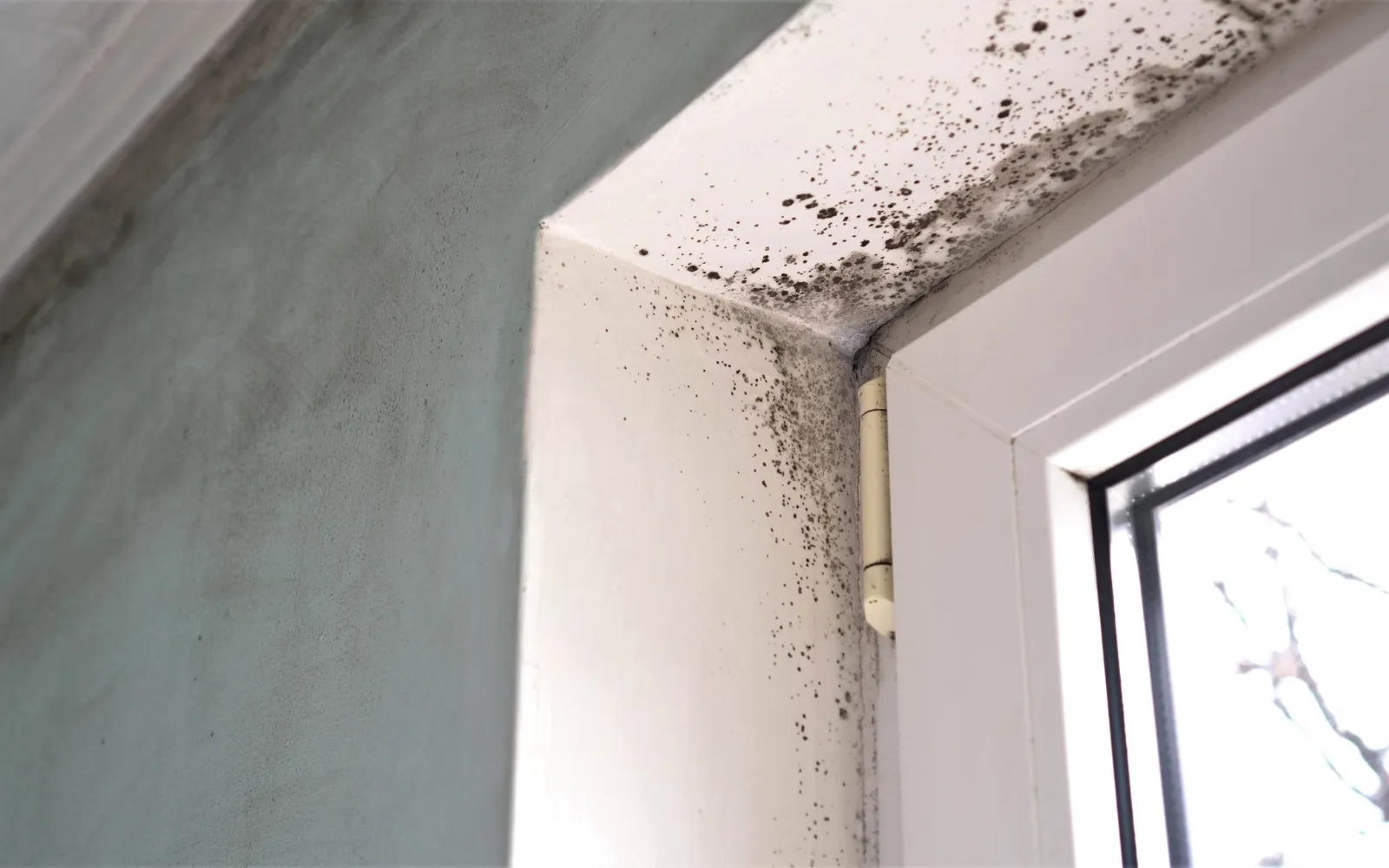
When Should You Walk Away from a House with Mold?
You love the house.
The neighborhood works. The layout works. You can picture yourself living there.
Then the inspection turns up mold.
Suddenly, you’re no longer wondering where the sofa will go. You’re wondering whether buying the property would be a very expensive mistake.
Should you walk away?
Mold by itself isn’t automatically a reason to abandon a house purchase. Many mold problems can be remediated. What matters is whether you understand the moisture source, the extent of the contamination, which materials are affected and what it’ll realistically take to put the property right.
There’s also no sensible rule that says black mold means walk away. Caleb Jones, Lead Inspector at Spotless, regularly explains that many molds can appear dark, so color alone doesn’t tell you the species or the scale of the problem.
The better rule is simpler:
Don’t decide from the word “mold.” Decide from the scope of the problem you’d actually be buying.
- Mold Doesn’t Automatically Mean the House Is Ruined
- First, Find Out How Big the Mold Problem Really Is
- Consider Walking Away When Nobody Can Explain the Moisture Source
- Make Sure the Real Cost Still Makes Sense
- Don’t Forget About What’s Inside the House
- Being Unable to Investigate Can Be a Bigger Red Flag Than the Mold Itself
- If the Mold Is Remediated Before Closing, How Will You Know the Work Is Done?
- Walk Away From Unacceptable Risk, Not Simply From the Word “Mold”
Mold Doesn’t Automatically Mean the House Is Ruined
Discovering mold can make an otherwise attractive house suddenly feel contaminated beyond repair.
That usually isn’t a useful assumption.
Caleb has encountered mold across the entire spectrum of residential properties, from recently constructed homes to buildings that have been standing for generations.
“Mold can happen in any house, any format, any age of home.”
Caleb Jones
His point isn’t that every mold problem is minor.
It’s that mold isn’t proof that a house is dirty, neglected or fundamentally unsalvageable.
Water gets where it shouldn’t.
Windows leak. Roofs fail. Plumbing develops problems. Basements take on water. Humidity gets out of control.
The real questions are:
- Where did the moisture come from?
- Is that source still active?
- How far did the water travel?
- What materials became contaminated?
- Is the mold genuinely localized?
- What has to be removed or repaired?
Federal mold guidance similarly emphasizes assessing both the extent of contamination and any continuing moisture problem before remediation is planned. EPA’s current remediation guidance says size and material type should influence the techniques used.
So when you’re deciding when you should walk away from a house with mold, finding mold isn’t necessarily the dividing line.
Finding a mold problem you can’t properly define may be.
Before walking away from a house you otherwise want – or buying because someone tells you the mold is “minor” – find out what got wet and how much of the building is actually affected.
First, Find Out How Big the Mold Problem Really Is
There’s a major difference between a clearly defined patch caused by a repaired leak and evidence of moisture problems throughout several parts of a house.
That difference matters far more than whether the growth happens to look black.
A localized problem may be more straightforward when:
- the source of moisture is obvious
- the source can be repaired
- the affected materials are clearly identified
- there’s no evidence of contamination elsewhere
- the remediation scope can be defined before you buy
More uncertainty enters the picture when:
- mold appears in several rooms
- there’s a history of extensive water damage
- walls, ceilings or floors show moisture-related changes
- several hidden cavities may be involved
- HVAC contamination is suspected
- nobody can confidently explain where the affected area begins and ends
Caleb routinely looks well beyond the first visible patch during residential inspections.
“I’ll check all of the water sources whenever I go into a home. I’ll check the interior of the HVAC system whenever I go into a home.”
Caleb Jones
He may also use photographs, a borescope and physical building clues to investigate areas that aren’t obvious from the middle of the room.
Size gives you context but not a buying rule
EPA remediation guidance broadly categorizes mold projects as small when they involve less than 10 square feet, medium at 10–100 square feet, and large when they exceed 100 square feet. EPA says medium and large projects call for a remediation manager and stresses that professional judgment matters, particularly on complex jobs. (Source: EPA)
Those numbers are useful for understanding remediation complexity.
They are not “safe house” or “walk-away” thresholds. EPA explains that its area-based remediation guidelines are intended to help select appropriate cleanup techniques rather than represent a specific health-effect cutoff.
So don’t reduce your home-buying decision to square footage.
A relatively small visible area may still sit in front of a much larger wet cavity.
If nobody can tell you whether the mold stops at one wall or continues through multiple spaces, don’t evaluate the deal as though you’re accepting a small cleanup. Resolve the uncertainty before you price the risk.
Consider Walking Away When Nobody Can Explain the Moisture Source
This is one of the biggest red flags.
Imagine the seller has already cleaned the wall.
Maybe it has even been freshly painted.
But when you ask why mold was growing there, nobody knows.
Was there a roof leak? Plumbing problem? Window failure? Basement water intrusion? Condensation?
You don’t get an answer.
That matters because remediation without moisture correction is incomplete.
Caleb puts much more emphasis on tracing water intrusion when the mold pattern suggests wet building materials or repeated water damage.
“It’s a lot more emphasis on finding the source of what is causing that water damage.”
Caleb Jones
That investigation-first approach runs through his interview.
EPA makes moisture control central to its own homeowner guidance as well. If mold is present, both the mold and the water or moisture problem need to be addressed.
A leaking window that can be repaired before a clearly scoped remediation is one thing.
A basement wall that repeatedly becomes wet for a reason nobody can identify is another.
A house doesn’t necessarily become a bad purchase because it had water damage.
It becomes much harder to evaluate when you can’t determine whether the source has actually been corrected.
If the moisture source is still a mystery when you’re deciding whether to buy, treat that uncertainty as part of the property, not as a problem you can automatically assume remediation will solve.
Make Sure the Real Cost Still Makes Sense
A mold-remediation estimate isn’t always the total cost of taking on a mold-affected house.
Consider the whole equation:
Purchase price + moisture-source repair + mold remediation + reconstruction + affected contents + temporary accommodation if needed + contingency for anything discovered once materials are opened.
Say mold is found beneath a leaking window.
Caleb describes a remediation process that can involve establishing containment, creating negative air pressure, removing contaminated drywall and insulation, HEPA cleaning remaining materials and documenting the water source.
“A lot of what goes into what we do is not causing an issue elsewhere in the house.”
Caleb Jones
But once the mold work is done, the window may still need professional repair and the opened wall still has to be rebuilt.
That’s why “the mold quote is $X” doesn’t necessarily tell you what the property will cost to make whole.
HUD’s home-buying resources advise buyers to obtain a professional home inspection as part of the buying process, and its buyer materials specifically note that buyers can ask whether additional health and safety testing, including mold-related evaluation, is relevant to the property.
This is also where your personal risk tolerance matters.
One buyer may happily take on a clearly defined remediation project in exchange for the right purchase price.
Another may look at the same scope and decide they don’t want months of repairs after closing.
Neither decision is inherently wrong.
And if you’re under contract, your real-estate agent or attorney – not your remediation contractor – should advise you on what your inspection contingency or contract allows you to do.
Don’t buy based on the vague reassurance that “mold can be cleaned.” Make sure you understand the repairs, remediation and reconstruction you’d actually be agreeing to pay for.
Don’t Forget About What’s Inside the House
For many existing homeowners, contents are one of the most emotional parts of a serious mold problem.
What happens to the sofa? The mattresses? Clothes? Family belongings?
For homebuyers, this may matter less if the seller is taking everything with them, but it can still affect furnished properties, built-in materials, possessions already moved into the house or the overall cleanup scope.
Caleb has seen both extremes.
“I have had some people get rid of all of their things. I’ve had a lot of people be able to successfully clean and keep a lot of their things.”
Caleb Jones
That’s important.
A mold problem doesn’t automatically mean every possession belongs in a dumpster.
But Caleb does draw a much more cautious line around certain large, plush, porous belongings. In the interview, he specifically mentions couches and mattresses and says Spotless has had situations where mattresses did not perform well during subsequent testing, which is why he tends to be more conservative with those items.
That’s Caleb’s field experience and Spotless’ practical approach, rather than a universal rule that every mattress exposed to mold must always be discarded.
The larger principle is more useful:
Different materials have different cleaning potential.
EPA remediation guidance likewise distinguishes between cleanable hard surfaces and porous materials that can be much more difficult to remediate adequately.
So when evaluating a badly affected property, ask whether the quoted remediation scope addresses only the walls or whether other contaminated materials are part of the picture too.
If a mold project involves heavily affected contents as well as the structure, make sure the plan explains what can reasonably be cleaned, what may need replacing and what those decisions add to your real cost.
Being Unable to Investigate Can Be a Bigger Red Flag Than the Mold Itself
Suppose the seller says:
“It’s just a little mildew.”
Maybe that’s true.
But if there’s known moisture or mold and you’re not being given a reasonable opportunity to understand it, you have a different problem.
Warning signs can include:
- known recurring leaks with no clear repair history
- water-damaged areas that have simply been covered over
- claims that remediation was completed without a clear scope
- unwillingness to share relevant invoices or documentation when work is said to have been performed
- pressure to treat visible mold as insignificant without investigating the moisture behind it
- inability to establish whether affected areas extend into hidden spaces
Caleb regularly sees how easily mold can remain unnoticed.
“Mold has a really… evolved in a way to stay really well hidden.”
Caleb Jones
His practical point is that mold can exist on surfaces and in areas homeowners walk past every day without noticing it.
HUD’s consumer home-buying process explicitly includes obtaining a home inspection, and HUD materials advise buyers to secure their own inspection so they can satisfy themselves about the property’s condition.
That doesn’t mean a seller has to accept every request a buyer makes; your contractual rights depend on your specific transaction.
But from a decision-making perspective, uncertainty has value.
If you aren’t able to get comfortable with the extent of a known problem, that belongs in your walk-away calculation.
A mold inspection in Lexington KY can help define the building problem before you decide what you’re willing to take on.
If you’re being asked to make one of the largest purchases of your life without understanding a known moisture or mold concern, don’t ignore that uncertainty simply because the visible patch looks small.
If the Mold Is Remediated Before Closing, How Will You Know the Work Is Done?
Suppose you don’t walk away.
Instead, the seller agrees to remediation before closing.
That creates one final question:
What does “finished” mean?
A wall looking clean isn’t necessarily enough.
The moisture source should have been addressed. Agreed contaminated materials should have been removed or appropriately cleaned. The work area should be clean and dry.
And Caleb is openly supportive of bringing another set of eyes into that process.
“I love post-testing verification. I think it keeps mitigation companies in check and makes people feel at peace that the work was done properly.”
Caleb Jones
That’s a particularly useful trust signal because Spotless isn’t arguing that homeowners should simply take the remediator’s word for everything.
Post-remediation evaluation can take different forms depending on the project. No single test can universally guarantee that a property will never have another mold issue.
But agreeing in advance on how completion will be evaluated is much better than waiting until the end and asking whether everyone thinks the room looks okay.
If remediation is required, learn more about professional mold remediation in Lexington KY.
If remediation is the difference between proceeding with the purchase and walking away, agree on what successful completion means before the work starts, not after the contractor packs up.
Walk Away From Unacceptable Risk, Not Simply From the Word “Mold”
So, when should you walk away from a house with mold?
There isn’t one universal threshold.
Walking away may be reasonable when the extent of contamination can’t be established, the moisture source remains unresolved, the total repair scope exceeds your budget, you can’t get comfortable with the available inspection information, or the uncertainty is simply greater than you’re willing to accept.
But finding mold doesn’t automatically mean the house is beyond saving.
A clearly scoped mold problem with an identifiable water source and realistic remediation plan is very different from a property where nobody can tell you how far the damage goes.
The smartest decision isn’t always buy.
And it isn’t always walk away.
It’s knowing exactly what problem you’re agreeing to take on before you sign.
If you’re buying a home in Lexington or Central Kentucky and mold has raised questions about the property, schedule a mold inspection in Lexington KY with Spotless. We can help define the mold and moisture problem so you can make the purchase decision with better information.c
Spotless is the most trusted name in restoration in central Kentucky including Lexington, Nicholasville and surrounding communities.
Specializing in health-focused mold remediation and water damage restoration, we leave mold-affected clients with a healthier home.
Call 859-459-0424 and speak to a technician today!