
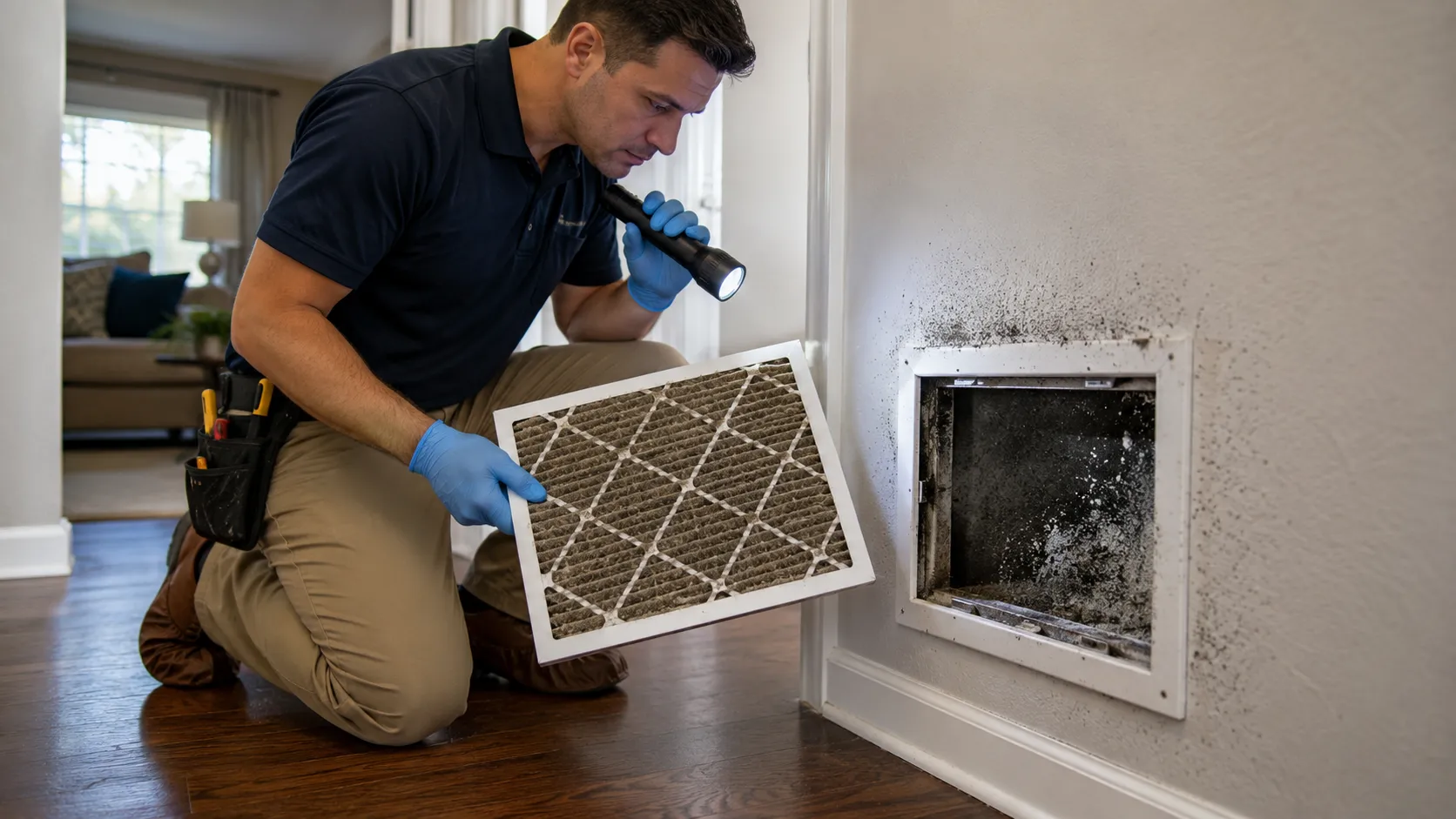
Mold in Air Ducts: Signs, Risks, and When to Get Help
Mold in air ducts can feel especially worrying because your HVAC system doesn’t just affect one room. It moves air through the whole home.
Maybe you notice a musty smell when the system turns on. Maybe there are dark spots around a vent. Maybe your HVAC filter looks suspicious, or symptoms seem worse when air is circulating. It’s natural to wonder whether mold is being pushed through the house.
Caleb Jones, Lead Inspector at Spotless, checks HVAC systems often during mold inspections because they can play a major role in indoor air quality.
“HVAC systems are very common places for mold to start.”
Caleb Jones
But here’s the important part: the issue may not be “the ducts” alone. The source could be HVAC moisture, dirty coils, contaminated filters, crawl space air, leaky ductwork, or mold nearby that’s being pulled into the system.
This guide explains the signs of mold in air ducts, why Kentucky crawl spaces matter, when duct cleaning may help, and when you need a deeper mold inspection.
- Can Mold Grow in Air Ducts?
- Signs of Mold in Air Ducts or HVAC Systems
- Why Kentucky Crawl Spaces Can Affect HVAC Mold Problems
- How Mold or Contaminated Air Can Move Through a Home
- Is Mold in Air Ducts a Health Concern?
- Duct Cleaning vs Mold Remediation: What’s the Difference?
- How Spotless Inspects Suspected Mold in Air Ducts
- What to Do If You Suspect Mold in Your Air Ducts
- Final Thoughts
Can Mold Grow in Air Ducts?
Yes, mold can grow in or around HVAC systems when moisture and organic material are present.
That may include hard-surface ducts, vents, coils, drip pans, filters, insulation, or nearby building materials. Sometimes homeowners blame “air ducts” first, but the real issue is moisture inside the HVAC system or contaminated air being pulled from another space.
Caleb checks the HVAC system during inspections because it can reveal problems homeowners wouldn’t normally see.
“I usually ask the client if I can access the HVAC system. I will take the panels or the filter off and out of the HVAC system and I’ll use something called a boroscope.”
Caleb Jones
A borescope is a small camera that helps inspect tight or hard-to-see areas. It doesn’t magically see through every part of the system, but it can help identify visible concerns inside accessible HVAC components.
The EPA says homeowners should consider duct cleaning if there is substantial visible mold growth inside hard-surface ducts or on other heating and cooling system components. EPA also notes that duct cleaning is not recommended routinely for every home.
If you suspect mold in your air ducts, start with an inspection before paying for duct cleaning or assuming the whole system is contaminated.
For a wider look at hidden sources, read hidden mold in your home.
Signs of Mold in Air Ducts or HVAC Systems
No single sign proves you have mold in air ducts. But certain clues are worth investigating, especially when they show up together.
Caleb shared one inspection where the HVAC filter immediately raised concern.
“I went out to an inspection and pulled out a filter and the filter was covered in mold, and that was the first thing I did in the client’s house.”
Caleb Jones
That kind of clue matters because air passes through the filter and system before moving into the home.
Watch for:
- Musty smell when the HVAC turns on
- Moldy or dirty-looking HVAC filter
- Visible spotting around vents or registers
- Dark growth on supply or return grilles
- Condensation near vents
- Damp smell near duct runs, basement, crawl space, or mechanical room
- Symptoms or irritation that seem worse when air circulates
- Prior crawl space, attic, roof leak, or water damage issues
- Dusty or stale smell that returns after filter changes
A musty vent smell doesn’t always mean mold is growing inside the duct itself. It may be coming from coils, filters, condensate issues, nearby crawl space air, or other HVAC components.
If your vents smell musty or your filter looks suspicious, don’t ignore it — your HVAC system may be giving you the first visible clue.
For odor clues, read what black mold smells like.
Why Kentucky Crawl Spaces Can Affect HVAC Mold Problems
In Lexington and Central Kentucky homes, crawl spaces are a big part of the conversation.
Caleb specifically points out that HVAC systems often run through crawl spaces in this region. If the crawl space is damp, humid, missing a vapor barrier, contaminated, or poorly maintained, the HVAC system may be exposed to those conditions.
“Particularly in Kentucky, we tend to put our HVAC systems in crawl spaces, which can lead to a lot of issues of a client starting to feel sick in their home but not being able to see anything.”
Caleb Jones
A crawl space can affect the home when:
- Ductwork has gaps or leaks
- HVAC equipment is exposed to damp crawl space air
- Filters or panels are opened in a contaminated space
- Moisture supports mold growth on nearby materials
- Humidity affects coils, ducts, insulation, or framing
- Air is pulled upward through small gaps in the structure
This is why mold in air ducts is sometimes more than a duct issue. Cleaning ducts without addressing crawl space humidity, duct leakage, or HVAC moisture may leave the source untouched.
If your HVAC system runs through a crawl space, Spotless can inspect both the air system and the hidden space feeding conditions around it.
If symptoms seem worse in bedrooms or overnight, read bedroom mold growth and nighttime symptoms.
How Mold or Contaminated Air Can Move Through a Home
Air moves through homes in ways most homeowners never see.
Your HVAC system pushes and pulls air through supply vents, returns, filters, ducts, coils, and mechanical equipment. If part of that system is dirty, damp, leaky, or exposed to contaminated air, the effects may show up in multiple rooms.
Caleb also explains the stack effect, which is a pressure-related air movement pattern. In simple terms, when air leaves your home through exhaust fans, leaks, open doors, or pressure differences, replacement air gets pulled from somewhere else.
Sometimes that “somewhere else” is a crawl space or attic.
“Meaning that your home does typically share airspace with the crawl through the stack effect.”
Caleb Jones
That helps explain why a home can smell musty even when there’s no visible mold in the living room. The issue may be connected to air pathways, not just one vent.
Air may be carrying odors or particles from a crawl space, attic, damp HVAC component, basement, or hidden mold source.
If the smell or symptoms seem to move from room to room, the problem may be connected to air pathways — not just one dirty vent.
For testing-related questions, read how to air test for mold.
Is Mold in Air Ducts a Health Concern?
Mold affects people differently. Some people may notice very little. Others may be more sensitive, especially people with asthma, mold allergies, respiratory conditions, immune compromise, or chronic lung disease.
The CDC says mold can cause symptoms such as stuffy nose, sore throat, coughing or wheezing, burning eyes, or skin rash in some people. People with asthma or mold allergies may have more severe reactions.
The EPA also notes that mold can trigger asthma attacks in people with asthma who are allergic to mold and can irritate the eyes, skin, nose, throat, and lungs.
Spotless does not diagnose medical conditions. We inspect and remediate the home environment. If you’re dealing with ongoing symptoms, speak with a qualified medical professional.
Caleb is careful not to turn mold concerns into fear-based sales pressure.
“This is a very easy industry to use fear tactics and stuff in. I try to avoid doing that.”
Caleb Jones
Still, HVAC mold concerns deserve attention because your air system can move air throughout the home.
If someone in your home is sensitive, asthmatic, immunocompromised, or reacting when the HVAC runs, it’s worth investigating the system and surrounding moisture sources.
For local support, learn more about indoor air quality testing.
Duct Cleaning vs Mold Remediation: What’s the Difference?
Duct cleaning and mold remediation are not the same thing.
Duct cleaning may remove dust, debris, or visible contamination from hard-surface duct interiors. It can be useful in specific situations, especially where there is substantial visible mold growth inside hard-surface ducts or on HVAC components.
But duct cleaning does not necessarily fix the moisture source, crawl space conditions, HVAC condensation, contaminated insulation, affected drywall, or hidden mold nearby.
Mold remediation focuses on the source and affected materials.
| Duct cleaning | Mold remediation |
| Cleans duct surfaces or debris | Finds and addresses the moisture source |
| May help when visible duct contamination exists | Controls contamination and affected areas |
| Does not always fix crawl space or HVAC moisture | May involve HVAC, crawl space, materials, and IAQ |
| Can be useful in specific cases | Needed when mold source/contamination is confirmed |
EPA guidance says duct cleaning has not been shown to prevent health problems and recommends duct cleaning on an as-needed basis rather than as a routine service for every home.
Caleb’s approach is to make sure the right problem is being solved.
“I try to approach the project from a standpoint of do it correctly the first time and make sure you’re covering all your bases.”
Caleb Jones
Before you pay for duct cleaning, make sure someone has identified whether the issue is dust, HVAC moisture, duct contamination, crawl space air, or a larger mold problem.
For other odor sources, read what can be mistaken for mold smell.
How Spotless Inspects Suspected Mold in Air Ducts
A proper HVAC mold inspection should go beyond glancing at the vents.
At Spotless, Caleb looks at the pattern of concern. When does the odor appear? Does it happen at system startup? Is it worse in certain rooms? Did it begin after water damage? Is the HVAC in a crawl space, attic, basement, or mechanical closet?
The inspection may include:
- Checking vents, registers, returns, and filters.
- Opening accessible HVAC panels when appropriate.
- Using a borescope to look inside accessible areas.
- Inspecting crawl spaces, attics, basements, or mechanical rooms.
- Checking moisture and humidity conditions.
- Looking for condensation, leaks, or water history.
- Using swabs, air testing, or on-site air quality tools where useful.
- Recommending cleaning, remediation, or referral depending on the findings.
Caleb also wants homeowners involved in the inspection process.
“I want my clients to be as much of a part of the inspection as possible because I think there’s a lack of transparency in my industry.”
Caleb Jones
We get it. If you’re worried your HVAC system is spreading mold, you don’t need scare tactics or vague answers. You need a careful inspection and a clear next step.
If the concern points to hidden contamination beyond the HVAC system, advanced hidden mold detection through Mold Dog Network may help identify hidden areas that need further evaluation.
A proper HVAC mold inspection should tell you where the concern is coming from — not just whether the vent looks dirty.
To schedule local help, visit mold inspection in Lexington KY.
What to Do If You Suspect Mold in Your Air Ducts
If you suspect mold in your air ducts or HVAC system, don’t start aggressively brushing vents, removing suspicious material, or shaking out moldy filters inside the home.
Start with a safer plan:
- Take photos of visible spotting, filters, vents, or condensation.
- Note when the odor appears: HVAC startup, heat/AC changeover, after rain, at night, or in certain rooms.
- Replace filters as normal, but don’t assume that fixes the source.
- Check safe clues around the crawl space access, attic, basement, or mechanical room.
- Don’t disturb suspected mold without containment.
- Schedule a professional inspection.
- If mold is confirmed, address the moisture/source and move into controlled remediation.
Caleb’s message to homeowners is calm and practical.
“Yes, we can fix this. This is the cost associated with it. There’s a light at the end of the tunnel.”
Caleb Jones
Spotless provides health-focused mold remediation in Lexington KY for homeowners who need source-focused remediation, containment, indoor air quality attention, and cross-contamination control.
If your HVAC system smells musty or your vents show possible mold, call Spotless before the issue spreads through more of the home.
Final Thoughts
Mold in air ducts or HVAC systems can be concerning because the system moves air throughout the home.
The signs may include musty vent odors, moldy filters, visible spotting around vents, condensation, crawl space moisture, or symptoms that seem worse when the HVAC runs. But the source is not always the duct interior itself. It may be the filter, coils, return side, crawl space, attic, or nearby hidden mold.
Duct cleaning may help in specific cases, but it should not replace source identification or controlled remediation when the issue is broader.
Spotless is a locally owned, IICRC-certified mold remediation and water damage restoration company serving Lexington and Central Kentucky. With more than 30 years of experience, our team helps homeowners inspect HVAC mold concerns, hidden moisture, crawl space conditions, and indoor air quality issues.
If your vents smell musty, you don’t have to keep guessing. Call Spotless to schedule a mold inspection and get a clear plan for what to do next.
Spotless is the most trusted name in restoration in central Kentucky including Lexington, Nicholasville and surrounding communities.
Specializing in health-focused mold remediation and water damage restoration, we leave mold-affected clients with a healthier home.
Call 859-459-0424 and speak to a technician today!